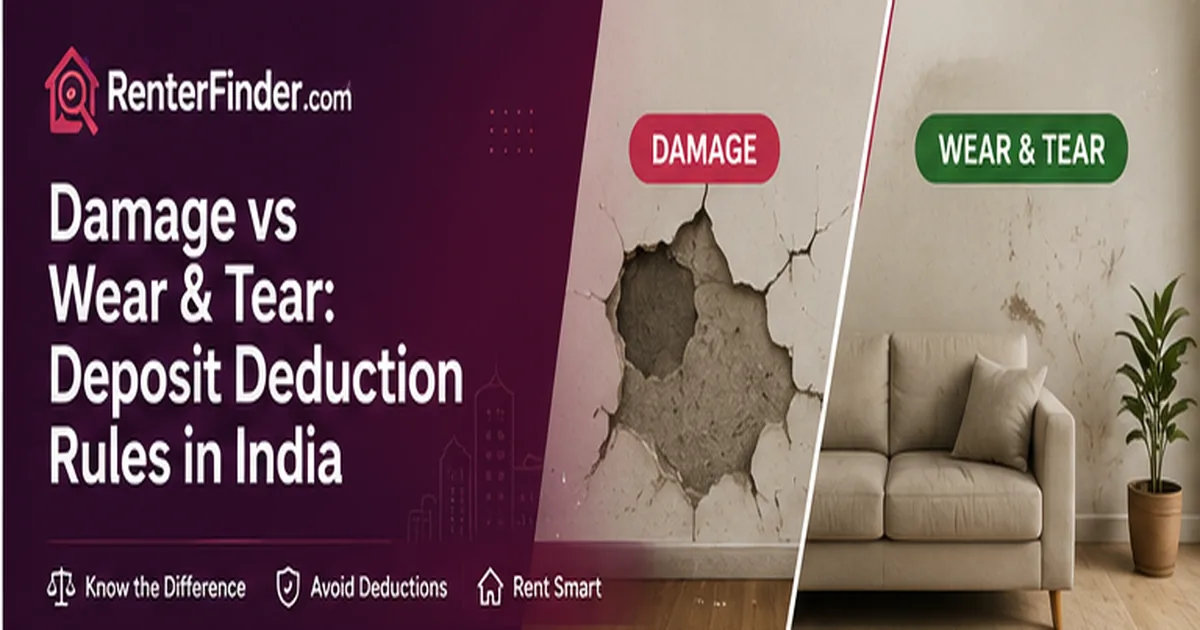
Of all the disputes that happen at the end of a tenancy in India, the most common - and the most contested - is the deposit deduction fight. The tenant insists the flat is in perfectly acceptable condition. The landlord points at the walls, the floor, or the fittings and disagrees. Both parties are often partially right, and both are frequently wrong about the same thing: what the law actually says about normal wear and tear versus damage.
The distinction matters because normal wear and tear cannot be charged to a tenant's security deposit under Indian tenancy law, particularly under the Model Tenancy Act 2021. Damage caused by negligence, misuse, or carelessness can be. Understanding where the line falls - and how to document your side of it - is the most practical thing either a tenant or landlord can do before vacating or handing back a flat.
What is normal wear and tear in an Indian rental?
Normal wear and tear refers to the gradual, inevitable deterioration that occurs from ordinary everyday use of a property. It is not caused by any particular act of negligence - it simply happens over time as someone lives in a flat. The principle behind it is straightforward: a landlord is expected to maintain their property as part of owning it, and the cost of ordinary ageing cannot be passed on to the person who was living there.
Common examples of normal wear and tear include:
- Paint that has faded or yellowed over a multi-year tenancy
- Minor scuff marks on walls from everyday movement of furniture
- Slight discolouration or fading of curtains and blinds from sunlight
- Small nail holes from hanging pictures in standard locations
- Worn-out tap washers or rubber seals in taps and showerheads
- Light switches or sockets that show normal discolouration from use
- Minor scratches on wooden floors from normal furniture placement
- Gradual loosening of door hinges or handles with age
The Model Tenancy Act 2021 specifically distinguishes between fair wear and tear (the tenant's responsibility not to charge) and damage (which may be recoverable from the deposit). Several state-level Rent Control Acts have similar provisions, though the exact wording differs. For the current text, refer to the Model Tenancy Act 2021.
What counts as damage - and what landlords can legitimately deduct
Damage, by contrast, is caused by specific acts of negligence, misuse, or carelessness that go beyond what ordinary living would produce. It is the kind of deterioration that would not have happened if the flat had been used reasonably. Landlords are generally entitled to deduct the cost of making good legitimate damage from a tenant's security deposit, provided they can show receipts or invoices for the repair work.
Examples that typically qualify as deductible damage include:
- Large holes in walls from drilling without permission or incorrectly
- Broken window panes caused by negligence (not storm damage)
- Cracked or chipped floor tiles from dropping heavy objects
- Burn marks on kitchen countertops, floors, or walls
- Staining from spills that were not cleaned up and have set permanently
- Pet-related damage to flooring, doors, or fixtures
- Broken door handles, hinges, or locks from misuse (not normal ageing)
- Missing or broken items listed in a furnished flat's move-in inventory
- Removal of fittings installed by the landlord (bathroom fixtures, cupboard handles)
- Mould resulting from the tenant blocking ventilation or failing to manage moisture
The key distinction in any dispute is: would a reasonable person, using the flat normally, have caused this? If yes, it is probably wear and tear. If it required a specific act of negligence or misuse, it is probably damage.
The grey zone: situations that landlords and tenants most often fight over
Most disputes do not happen at the extremes - a broken window or a faded curtain are usually easy to classify. The fights happen in the middle, where reasonable people disagree. Here are the most common grey-zone scenarios and how they are typically assessed:
| Situation | Likely classification | Key factor |
|---|---|---|
| Walls need repainting after 2+ years | Wear and tear | Normal fading; landlord's routine maintenance cost |
| Walls heavily marked, drawn on, or stained | Damage | Beyond ordinary use; deductible if documented |
| Geyser stops working after 3 years | Wear and tear | Appliance lifespan; landlord should replace or repair |
| Geyser physically broken from misuse | Damage | Misuse rather than natural ageing |
| Carpet worn in heavily used areas | Wear and tear | Normal foot traffic over time |
| Large stain or burn on carpet | Damage | Specific incident causing permanent damage |
| Cleaning required after normal occupancy | Wear and tear | Basic cleaning between tenants is landlord's cost |
| Flat left in extremely dirty, unhygienic state | Damage (potentially) | Depends on agreement clause and extent; needs documentation |
Repainting is one of the most frequently contested items in India. Many landlords try to charge tenants for repainting every room at move-out, but repainting is considered routine maintenance unless the agreement explicitly imposes that obligation on the tenant. Even where the agreement does include such a clause, courts and Rent Authorities often apply proportional depreciation rather than the full current cost of repainting.
What the Model Tenancy Act 2021 says about deposit deductions
The Model Tenancy Act 2021, introduced by the central government as a framework for states to adopt, provides explicit guidance on deposit usage. Under the MTA, a landlord may deduct from the security deposit amounts for: unpaid rent, outstanding utility bills, or damage caused by the tenant beyond fair wear and tear. The Act also sets a two-month cap on security deposits for residential properties in states that adopt it.
The MTA also requires that deductions be documented. A landlord cannot simply claim the flat was damaged and withhold the deposit - the amount deducted must correspond to an actual expense, supported by receipts or invoices. A blanket "the flat needs repairs" deduction without evidence is not legally defensible under the MTA framework.
Karnataka, where Bangalore is located, applies the Karnataka Rent Act 1999 (and in some cases the older Karnataka Rent Control Act) alongside the MTA framework. The state has not yet formally adopted the MTA in its entirety, but the principles around fair wear and tear and documented deductions align broadly. For current Karnataka-specific rules, refer to the official Karnataka government portal.
How to protect yourself - the move-in inspection checklist
The single most effective protection against a deposit dispute - for both tenants and landlords - is a signed move-in inspection report. This is a room-by-room written record of the flat's condition on the day the tenant takes possession, with photographs, attached as an annexure to the rent agreement. Both parties should sign it.
When you move out, you photograph the same rooms in similar lighting and compare. If the flat looks the same or shows only the expected gradual ageing, the deposit should be returned in full. If there is clear new damage, the documentation shows what changed and when, making the landlord's deduction claim far more defensible - and equally, making a baseless deduction claim far harder to sustain.
For a furnished flat, the inspection should also include a complete item-by-item inventory of every appliance, piece of furniture, and fitting, with the condition noted against each. This inventory is the reference point if anything is missing or damaged at move-out.
A workable move-in inspection covers:
- Each room: walls (marks, holes, stains), floor (cracks, stains, scratches), ceiling (leaks, cracks), windows (glass, latches), doors (hinges, handles, locks)
- Kitchen: countertops (burns, stains, chips), appliances (working condition), drainage
- Bathrooms: tiles (cracks, stains), fittings (taps, flush, geyser working status), exhaust
- All electrical: switches, sockets, fans, lights - tested and working status noted
- Furnished items: item name, condition (good/fair/worn/damaged), and quantity
- Date, both party signatures, and a photo reference note
Photographs should be high-resolution, date-stamped if your phone allows it, and stored in a cloud folder rather than only on the device. WhatsApp-sharing the photos with the landlord the same day creates a timestamped paper trail that is admissible as evidence under the Bharatiya Sakshya Adhiniyam 2023 (India's evidence law).
If the landlord makes an unfair deduction: your escalation path
If you have moved out, documented the flat's condition, and the landlord is still withholding the deposit citing items you believe are normal wear and tear, here is the step-by-step path forward:
- Written demand: Send an email or WhatsApp message clearly listing the disputed deductions, providing your documentation (photos, inspection report), and asking for the balance to be returned within 15 days. A written record is essential for any later legal step.
- Legal notice: If there is no response within 15 days, a formal legal notice via an advocate (usually ₹1,000-3,000 for drafting and sending) creates a legal record and often prompts payment from landlords who do not want further trouble.
- Rent Authority: In states that have adopted the Model Tenancy Act, file a complaint with the designated Rent Authority. The process is faster than civil court and specifically designed for tenancy disputes.
- Rent Control Court: In states where the older Rent Control Act applies (many states), file before the Rent Control Court. This takes longer but is the appropriate forum where the MTA has not been adopted.
- Consumer Forum: For smaller amounts, the consumer forum via eDaakhil (the government's online consumer complaint portal) is an accessible option. Security deposit disputes can qualify if framed as a deficiency in service.
The deposit return timeline, where specified in the agreement, should be honoured. If the agreement says the deposit will be returned within 30 days of vacating, any delay beyond that strengthens the tenant's legal position. Under the MTA, a landlord who wrongfully withholds deposit can be ordered to pay interest on the amount withheld.
Practical tips for landlords: when you legitimately have a damage claim
Landlords with genuine damage claims also benefit from the same documentation principles. If you want to be able to make a defensible deduction, the preparation starts on move-in day, not move-out day.
- Get the move-in inspection signed by the tenant on day one and keep a copy.
- Photograph the flat immediately after every tenant vacates, before any cleaning or repair work begins.
- Get itemised quotes and invoices from repairers - not a lump-sum "miscellaneous repairs" bill.
- Deduct only the amounts actually supported by receipts. Courts and Rent Authorities dismiss inflated claims.
- Return the balance promptly. Unreasonable delay weakens your legal position even if the deduction itself is valid.
- Send a written account of deductions to the tenant with the return of the balance - a simple letter or email listing each item and its cost maintains transparency and reduces the chance of dispute.
The deposit is not a catch-all for routine refurbishment costs between tenancies. A landlord who treats it that way is making deductions that will not survive scrutiny at the Rent Authority. Being accurate from the start protects landlords just as much as tenants.
Finding a tenant or landlord who understands these basics
Deposit disputes are less likely to happen when both sides understand the ground rules before signing the agreement. Part of what makes RenterFinder's model useful is that AI and human moderated chat between landlord and renter allows both parties to discuss expectations - including what the deposit covers and what happens at move-out - before any money changes hands. That kind of early conversation prevents the assumptions that usually cause disputes later.
RenterFinder launched on April 24, 2026, and the renter and landlord pool is still growing - please be patient with us as more users join. The platform connects landlords directly to renters actively searching in your city, without a broker in the middle and without inflated commissions. The fee structure is transparent and fixed.
Whether you are a renter trying to protect your security deposit or a landlord who wants to recover legitimate damage costs without a legal battle, the starting point is the same: document carefully, understand what wear and tear actually means under Indian law, and raise any disagreement in writing as soon as it emerges. The law is clearer than most people realise - the problem is almost always the evidence, not the principle.
Related Articles
- Security Deposit Rules in India: A Renter's 2026 Guide - Deposit limits, refunds, and what's legal
- Landlord Not Returning Your Deposit? A Step-by-Step Action Guide - What to do if the deposit is withheld
- Who Pays for Repairs in a Rented Flat in India? - MTA 2021 on landlord vs tenant repair duties
Browse properties or post your renter profile on RenterFinder - transparent fees, AI and human moderated chat, no hidden commissions.