- The standard document set every Indian landlord asks for
- What changes if you are self-employed, a student, or new to a city
- Aadhaar masking and the documents you should never hand over
- Police verification basics, in plain English
Renting a flat in India in 2026 is, in one sense, simpler than it has ever been. Aadhaar exists. UPI works. Most landlords accept digital copies. The agreement, when you finally get there, can be drafted on a phone. In another sense, the document conversation has quietly become more demanding. Landlords now ask for more proof, more identity verification, and more reference checks than they did a decade ago. That is partly because of police verification rules in major cities and partly because the cost of a bad tenant has risen.
This guide walks through the documents you will be asked for, why landlords want each one, and how to give them what they need without overexposing yourself. Treat it as a checklist for the next time you are house-hunting.
What landlords typically ask for in 2026
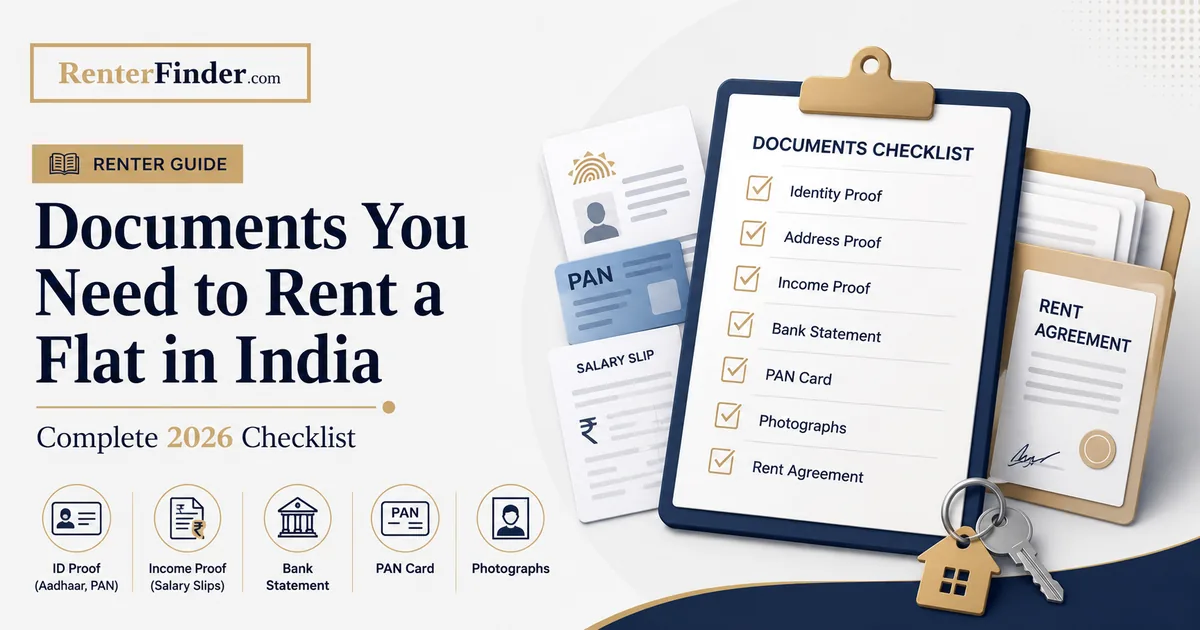
Across most Indian cities, the standard ask falls into five buckets: identity, current address, employment or income, photographs, and references. The exact list varies by city and by how cautious the landlord is, but if you walk into any rental conversation prepared with the items below, you will rarely be caught short.
- Government photo ID: Aadhaar (masked, see below), passport, driving licence, or voter ID. PAN is sometimes asked for too.
- Address proof of your previous residence: usually the previous rent agreement, a recent utility bill, or a bank statement showing the address.
- Employment proof: a recent salary slip, an offer letter, or an HR letter on company letterhead. For senior professionals, a designation card or LinkedIn profile sometimes substitutes.
- Two passport-sized photographs. Three is more common in cities with strict police verification.
- References: the previous landlord's name and phone number, sometimes an HR contact at your current employer.
Why each document is requested
Understanding what the landlord is actually worried about makes it easier to provide the right level of detail. Identity proof addresses one concern: that you are the person you claim to be, and not using someone else's name. Address proof addresses another: that you have an actual prior residence and are not freshly arrived from nowhere. Employment proof goes to the question of whether you can pay rent every month for the next several months. References address a third question, which is whether previous people who have done business with you would vouch for the experience.
If you can mentally separate these four concerns, you will notice that not every document needs to do every job. A salary slip and an HR letter cover the same concern. So do an Aadhaar and a driving licence. You usually do not need to provide three documents that prove the same thing. Push back, politely, on duplicate asks.
If you are a working professional
For salaried tenants, the common bundle looks like this:
- One government photo ID (masked Aadhaar is usually fine)
- PAN card copy
- Last one or two months' salary slips, or an HR letter confirming employment, designation, and salary range
- Last three months' bank statement showing salary credit (you can redact unrelated transactions)
- Two passport-sized photographs
- Previous landlord reference and current employer HR contact
For tenants who have just changed jobs, an offer letter on company letterhead is acceptable in most cases, especially if you can show the joining date and salary band.
If you are self-employed or a freelancer
This is where the document conversation gets longer, and it is worth being prepared. Without a salary slip to flash, you will need to substitute proof of income from other sources. The standard set looks like this:
- Income Tax Return (ITR) acknowledgement for the last one or two financial years
- Last six months' bank statement, redacted as needed
- GST registration certificate, if applicable
- A short letter from your CA confirming average monthly income, if available
- Proof of business: registration certificate, MSME registration, or an invoice sample showing recurring clients
- References from two prior landlords, if possible, instead of one
Some landlords are simply more comfortable with salaried tenants. If you sense hesitation, offering a slightly higher deposit or a longer initial commitment often closes the gap.
If you are a student or first-time renter
Without your own employment record, the practical answer is a parent or guardian guarantor. The guarantor signs the rent agreement alongside you and provides their own document set: ID, address proof, and employment or income proof. The agreement specifies that the guarantor is jointly responsible for rent.
Beyond that, a letter from your college or university confirming your enrolment, an admission letter, and a copy of your student ID help. Many landlords near university clusters are familiar with this structure and accept it without much friction. PG accommodations and student housing usually have lighter document requirements, but also less protection against unfair eviction.
What you should never share
- Aadhaar OTPs, ever, for any reason
- Your unmasked full Aadhaar number
- Original passport or original Aadhaar card (give scanned copies only)
- Complete unredacted bank statements showing every transaction
- Signed blank cheques (always fill amount and date yourself)
- Biometric data of any kind
A landlord asking for any of the above either does not understand the risks involved or is comfortable with them in a way you should not be. Politely refuse and offer the masked or redacted alternative.
Aadhaar masking and the mAadhaar option
A masked Aadhaar is a version of your Aadhaar where the first eight digits of the twelve-digit number are hidden. The last four digits and your photograph remain visible. It is officially recognised by the UIDAI and is accepted as valid identity proof for almost every offline use case, including rental verification.
You can download a masked Aadhaar from the UIDAI website by logging in with your Aadhaar number and an OTP sent to your registered mobile, then choosing the masked download option. The mAadhaar mobile app, also from UIDAI, lets you generate a masked version on demand. Get into the habit of giving the masked version by default. Hand over the unmasked one only when there is a clear, documented requirement (some bank or government KYC processes still need the full version). For rental purposes, the masked version is almost always sufficient.
Police verification basics
Tenant police verification is a requirement under local police regulations in many Indian states. The exact procedure varies by state and city, but most state police departments now provide an online tenant verification portal where the landlord uploads the tenant's ID and address proof and the system processes the request. Some cities still use a paper form submitted at the local police station.
From the tenant's side, the simplest thing is to cooperate. Provide the documents requested, sign where required, and follow up if the verification certificate has not come through within a couple of weeks. A landlord who skips police verification is, depending on the state, either making a small administrative oversight or actively breaking a local rule. Either way, it is not in your interest to have your tenancy operating outside the official record.
If you are using an online matching platform like RenterFinder.com, the document exchange happens later in the process, only after both parties have used the moderated chat to establish basic intent. That is a small but useful difference from the broker-led model, where you are sometimes asked for the full document set before you have even seen the flat.
Your printable document checklist
A final thought
The point of all this is not to make renting feel adversarial. Most landlords are reasonable people protecting a meaningful asset, and the document conversation is just their way of doing due diligence. But the asymmetry is real. The landlord usually knows what they are looking for and what they can ask. The renter often does not, and ends up handing over more than they should because they are nervous about losing the flat.
Showing up with the right documents, in the right form, signals competence. It also keeps you in control of which versions of which documents leave your hands. That balance, more than any specific item on a checklist, is what makes the rental conversation go smoothly.
Related Articles
- Security Deposit Rules in India: A 2026 Guide - Get your money back at move-out
- Red Flags to Watch For When Renting a Flat - Spot trouble before you sign
- Police Verification for Tenants in India - State-by-state walkthrough
Written by the RenterFinder Editorial Team. RenterFinder.com is India's rental-only matching platform. We just launched on April 24, 2026, and the renter and landlord pool is still growing - please be patient with us as more users join.
Browse listings or publish your renter profile and let landlords reach out directly.