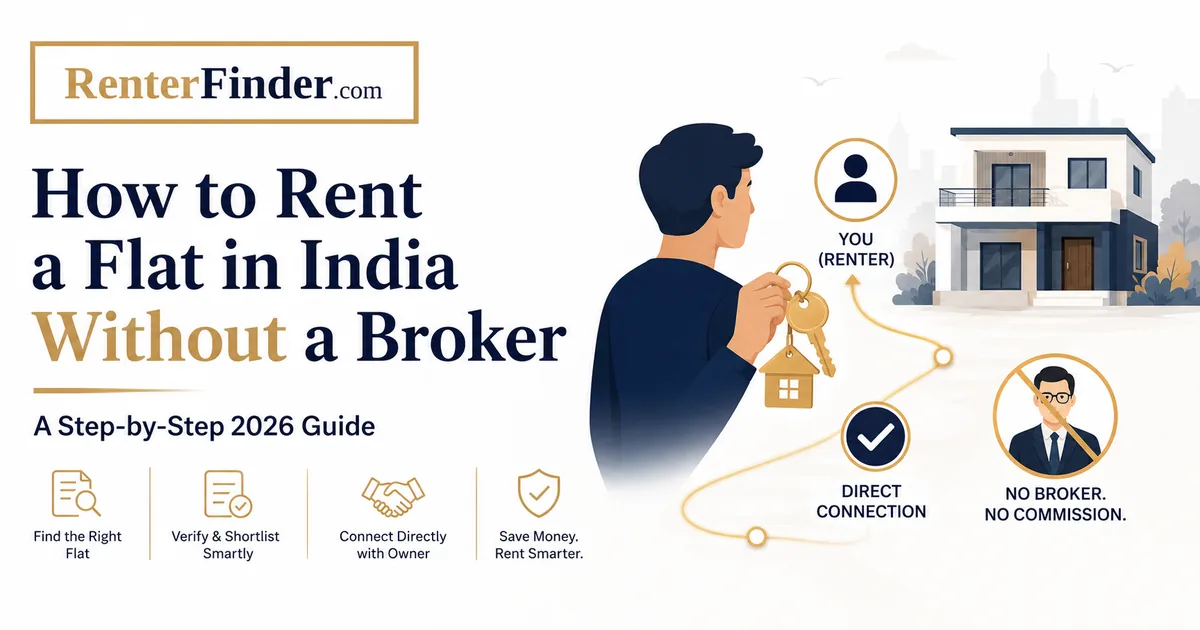
- Why brokers still exist in 2026, and what they actually do (vs. what they charge for)
- How to build a "renter pitch" that gets a serious landlord's attention in one message
- A 10-point pre-viewing checklist so you never waste a Sunday on the wrong flat
- How to vet a landlord before sharing your phone number, and the red flags to walk away from
Why brokers still exist in India in 2026
For decades the answer to "how to rent a flat without broker India" was, basically, "you can't". Brokers existed because they held information no one else did. They knew which uncle in Lajpat Nagar had a vacant 2BHK, which family in Indiranagar was relocating, which building in Kothrud allowed bachelors. That was their actual product, not their charm or their negotiation skills - it was the list of who was looking and who was leaving.
In 2026 that information advantage is mostly gone. Renters now publish their requirements on the internet. Landlords can read those requirements directly. Yet brokers persist, and the reason is mostly inertia. Many renters still believe they need one. Many landlords still default to one. The transaction is high-stakes and emotional, and a familiar middleman feels safer than figuring out a new process.
The cost of that inertia is real. A broker fee is usually somewhere between half a month's rent and a full month's rent (sometimes more), and that money buys you a service that, in most cases, ends the moment you sign the agreement. If something goes wrong six weeks later, you are on your own.
What brokers actually do, and what they don't
Be honest about what a broker provides, because that is the only way to replace it. A typical urban Indian broker will: post your search on a couple of property listing platforms, forward you 4-8 listings (some of which are stale), accompany you on 2-3 site visits, and act as the awkward translator if rent negotiation gets uncomfortable.
What a broker usually does not do: confirm ownership documents, verify the landlord's identity, check whether the building society allows your tenant profile, or stand behind the deal if it falls apart. Most brokers also have no real loyalty to either side, because their commission only triggers when a deal closes - which means anything that closes the deal faster (a slightly inflated rent, a glossed-over restriction, a "minor" maintenance issue) is gently in their interest, not yours.
Direct platforms vs the typical rental sites
When people search "rent without broker", the first results are usually broker-heavy listing platforms - sites that say "no brokerage" on the homepage but, in practice, push you toward "premium" listings that quietly involve an agent, or paid plans where a "relationship manager" calls you every two hours. Many "owner direct" listings on these sites are actually sub-listed by multiple brokers, so the landlord may not even know who is being shown their property.
A genuinely direct platform looks different. There is no relationship manager. No upgrade tier where the platform itself plays broker. The landlord and the renter contact each other directly inside the platform, and the platform's only role is to keep that contact safe and structured. The fee, if any, is small, transparent, and printed on the homepage.
When evaluating any platform, look for three things: how it makes money (if it isn't obvious, that is a red flag), whether your phone number is exposed before you want it to be, and whether the listings you see are genuinely from owners or quietly aggregated from a network of agents.
Build your "renter pitch" before you reach out to anyone
This is the single biggest mistake first-time direct renters make. They send a message that says, "Hi, is this flat available?" That message gets ignored because it tells the landlord nothing. A serious landlord with a serious flat is screening you in the first 30 seconds. Your job is to make those 30 seconds count.
A good renter pitch contains, in this order:
- BHK and locality - "I'm looking for a 2BHK in Indiranagar or HSR Layout."
- Who is moving in - "Family of three, working couple plus one school-age child" or "two working professionals, both with stable jobs in tech."
- Budget range - a specific number, not "depends". Honest budget builds trust faster than a vague one.
- Move-in date - "Looking to move in by the first week of June." Definite dates filter you up the priority list.
- Employment proof - one line is enough. "Salaried, can share offer letter and last 3 payslips." Self-employed? "GST-registered consultant, can share IT returns."
- One thing about you that isn't on the form - vegetarian, non-smoker, work-from-home most days, dog-friendly. Whatever is true. Helps the landlord picture an actual neighbour, not a generic application.
Send that, and a serious landlord will reply. Send "is this flat available", and they will not. The pitch above is also exactly the structure that direct platforms collect upfront in a renter profile, so once you have built it once, you reuse it everywhere.
How to vet a landlord before you visit
Vetting goes both ways. The landlord is checking you, but you should be checking them. A bad landlord can cost you months of stress, deposit recovery problems, or worse. Before you set a date for a site visit, get clarity on a few things.
Confirm the basics in writing (a chat message is fine):
- Is the person you are talking to the actual owner, or a representative? Ask directly.
- What is the security deposit and the lock-in period?
- Is the rent inclusive of maintenance, or charged separately by the society?
- Are there any restrictions you should know about - bachelors, food preferences, pets, working hours, guests?
- Will a registered rent agreement be made? At whose cost?
Now the red flags. Walk away if you see any of these:
- The "owner" refuses a video call or in-person visit and asks you to transfer a token amount via UPI to "block" the flat.
- The rent is unusually low compared to other 2BHKs in the same locality. Scams almost always undercut market rent.
- The landlord cannot produce ownership proof (a sale deed, society allotment, or property tax receipt) at the time of agreement.
- The agreement they propose is purely a notarised one with no e-stamp paper, or no agreement at all.
- The landlord is in another country and asks you to wire a deposit before keys are handed over by a "caretaker".
The 10-item pre-viewing checklist
A site visit is not just a vibe check, it's an audit. Take a friend or family member if you can. Spend 20-30 minutes minimum. Use this checklist on every viewing:
- Water supply. Open every tap. Ask whether supply is 24x7 or timed, and whether the building uses corporation water, borewell, or tankers.
- Electrical load. Switch on the AC and a couple of other appliances together. Check for tripping. Ask the sanctioned load.
- Cellular reception. Stand in every room and check signal on your own phone.
- Natural light. Visit during the day at least once. A "well-ventilated" flat at 7 PM looks the same as a windowless one.
- Parking. Confirm exact spot number and whether two-wheeler and car parking are separate.
- Society rules. Pet policy, late-night entry, guest policy, food rules, working-hours noise rules.
- Maintenance dues. Ask explicitly whether there are any pending dues on the flat.
- Furniture inventory. If furnished, photograph every item. This becomes your handover record.
- Common areas. Lift, stairwell, lobby. State of these things tells you a lot about the society's competence.
- Neighbours. If you can, knock on one door above and one below. A two-minute conversation tells you more than the landlord ever will.
How RenterFinder works for renters
RenterFinder is brand new, having launched on April 24, 2026 - the renter and landlord pool is still growing as more users join. We mention this upfront because it changes how you should use the platform: think of it as joining early rather than walking into a fully-stocked supermarket of listings.
Here is how it actually works on the renter side. You build a profile that includes your preferred locality, BHK, family size, occupation, budget range, and move-in date. That profile sits on the Prospective Renters' List, which landlords browse to find tenants who match their property. This flips the usual dynamic. Instead of you chasing twenty broken listings, suitable landlords come to you.
The fee structure is the part that matters most:
- Profile listing fee: ₹125, paid once when you publish your profile, valid for 3 months.
- Unlimited chat: free. Once a landlord and renter are connected on the platform, every message is free, AI and human moderated, and your phone number stays private.
- Platform service fee: split into two halves - an advance is charged after both parties have chatted and agreed to meet, and a closing payment at deal closure when the agreement is signed. Calculated on the rent posted on the portal.
No registration fee, no monthly subscription, no per-listing surcharge. The full price for using the platform is on the fees page.
There is also the 6 Match Guarantee. If your first match doesn't close after the property meeting, the same advance fee covers up to 5 more match attempts within the next 6 months. So one advance fee covers up to 6 deal attempts, all within 6 months. You don't pay again to try the next match. Compared to paying a broker afresh after every failed match, that math works out very differently.
For the full breakdown of how the chat moderation, the meeting stage, and the closure stage work end to end, see the services page.
Signing the agreement and moving in
Once you and the landlord agree on terms, the rent agreement gets drafted. In most Indian states the standard is an 11-month leave-and-licence agreement on e-stamp paper, registered or notarised depending on the state. Rules on stamp duty, registration, and deposit caps vary state to state and change from time to time. For the current national framework, refer to the Model Tenancy Act 2021 on the Ministry of Housing and Urban Affairs website, and check your state's Inspector General of Registration portal for state-specific rules.
Before you hand over the deposit, do three things: read the entire agreement (not just the rent and deposit numbers), photograph the flat in its current condition, and confirm in writing what gets returned of your deposit and on what timeline. The tenancy is going to last at least 11 months. The 30 minutes you spend on this paperwork is the cheapest insurance you will ever buy.
The short version
Renting a flat in India without a broker in 2026 is no longer the stretch it used to be. The information advantage that brokers held has shifted to platforms where renters and landlords can find each other directly. What you need to bring to the table is a clear renter pitch, a willingness to vet the landlord as carefully as they vet you, and a checklist for the site visit. The cost savings are real, the process is faster, and you walk away with a relationship you have built directly, not one a middleman patched together for one commission.
RenterFinder.com is live as of April 2026. We just launched, so the renter and landlord pool is still growing - sign up to be one of the first matches in your city.
Related Articles
- Why I Stopped Using Brokers - A Founder's Story - The other side of the same problem
- Security Deposit Rules in India - A Tenant's Guide - Get your deposit back without a fight
Written by the RenterFinder Editorial Team. RenterFinder.com is India's rental-only matching platform. We just launched on April 24, 2026, and the renter and landlord pool is still growing - please be patient with us as more users join.
Build your renter profile and let landlords find you. ₹125 listing fee, free chat, no broker.