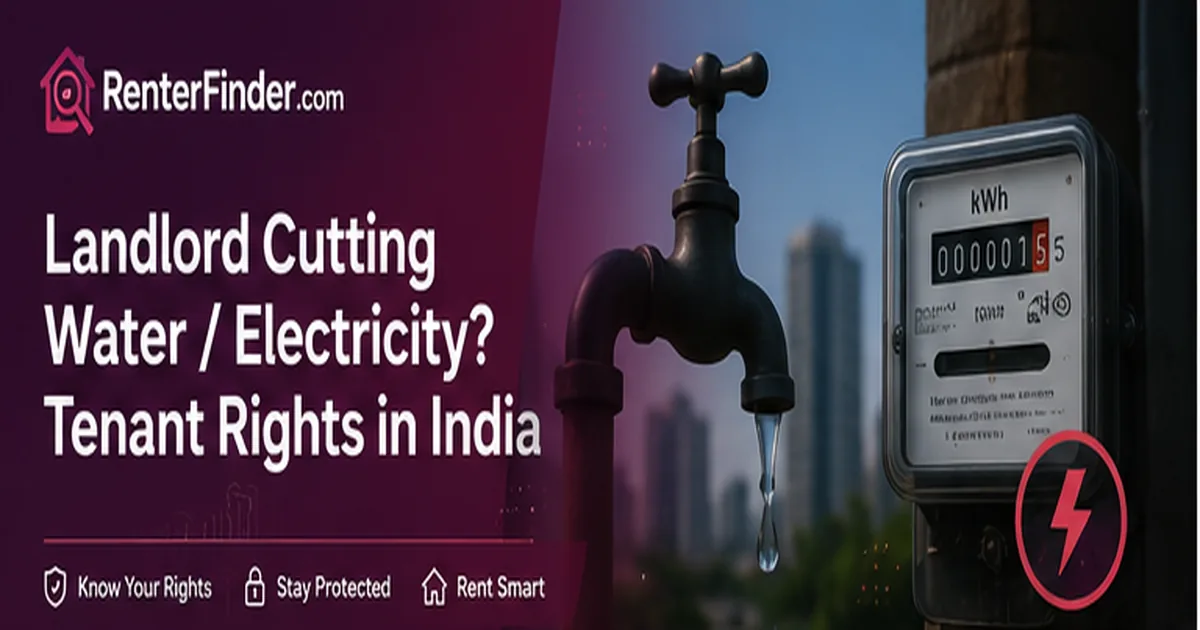
Imagine coming home after work to find the water tap dry or the lights not working - not because of a billing issue, but because your landlord has deliberately disconnected the supply in the middle of a rent dispute. It happens more often than most people realise, and the reason landlords do it is simple: they believe it is faster and cheaper than going through the courts to evict a tenant. They are also, in most cases, wrong about it being legal.
Cutting off water or electricity to force a tenant to vacate is one of the most common forms of what courts call "constructive eviction" - making living conditions so unbearable that the tenant has no practical choice but to leave. Indian law, both at the central level and in most states, treats this as unlawful. Knowing exactly what the law says, what to do the moment it happens, and how to escalate is the difference between being pressured out of a flat you are entitled to stay in, and having a landlord face real consequences for their actions.
Is It Legal for a Landlord to Cut Off Water or Electricity in India?
The short answer is no. A landlord cannot legally cut off water, electricity, or any other essential service during an active tenancy - not even if rent is unpaid, not even if the parties are in a dispute, and not even if the landlord wants the tenant to vacate.
In Indian law, the right to essential services is considered part of what the tenant bargained for when they entered the rental agreement. The moment a landlord disconnects these services, they are not just breaching the rental contract - they may also be committing a criminal act. Courts in multiple states have held that deliberate denial of utilities is not a legitimate mechanism for a landlord to exercise. The proper way to remove a non-paying tenant is through the Rent Authority or civil court - a process that takes time but is the only legally permitted path.
The reason landlords still attempt this tactic is simple: many tenants do not know their rights, and many who do know are reluctant to escalate. A landlord who cuts water at 10 PM is gambling that the tenant will find it easier to leave than to fight. This guide is designed to remove that asymmetry.
What the Model Tenancy Act 2021 Says
The Model Tenancy Act 2021 (MTA), published by the Ministry of Housing and Urban Affairs, is India's most comprehensive modern tenancy framework. Section 24 directly addresses this issue: a landlord cannot reduce or withhold any essential supply or service that the tenant is entitled to under the tenancy agreement or that has been provided to the tenant from the start of the tenancy.
The MTA lists "essential services" to include water supply, electricity, sanitation, and the use of common areas. Any wilful interruption of these services by the landlord is treated as an offence under the Act. The penalty is significant: the Rent Authority can order the landlord to pay the tenant a sum up to five times the monthly rent as compensation, in addition to restoring the services immediately.
The MTA also empowers the Rent Authority to pass an interim order for restoration of services, which means the tenant does not have to wait for a full hearing. In theory, services can be restored within 24 hours of a complaint being filed, while the full case is heard separately.
The important caveat is adoption: the MTA is a central model law, not automatically binding in every state. States must pass their own legislation or formally adopt the MTA. As of 2026, the following states have adopted versions of it (check official sources for the latest status):
- Andhra Pradesh, Telangana, Tamil Nadu, Uttar Pradesh - among the early adopters
- Karnataka - has its own Karnataka Rent Control Act 2001, which also restricts utility disconnection
- Maharashtra - continues under the Maharashtra Rent Control Act 1999
- Delhi - under the Delhi Rent Control Act, with separate provisions
Where a state has not adopted the MTA, the principle still applies through older rent control legislation and general contract law - but the specific penalty provisions of the MTA may not be available. For the most current state-by-state position, refer to your state's official housing ministry website or consult a local advocate.
Other Laws That Protect Tenants From Utility Disconnection
Beyond the MTA, several other legal provisions come into play when a landlord cuts utilities:
The Electricity Act 2003: This Act governs power supply across India. In most cases, the electricity connection to a rented flat is either in the landlord's name or the tenant's name. If it is in the landlord's name, they control the main supply - and deliberately cutting it may constitute tampering with a supply connection, which is a punishable offence under the Act. If the connection is in the tenant's name, the landlord has no legal authority to interfere with it at all.
Bharatiya Nyaya Sanhita (BNS) 2023, Section 351 - Criminal intimidation: If a landlord cuts off utilities with the explicit intention of compelling the tenant to vacate, and communicates this as a threat, it may constitute criminal intimidation under Section 351 of the BNS (the statute that replaced the Indian Penal Code). This is a cognisable offence - meaning the police can act without needing a magistrate's order first.
State Rent Control Acts: Most state Rent Control Acts contain provisions that prohibit harassment of tenants by landlords, and courts have read utility disconnection as a form of such harassment. A complaint to the Rent Control Court or its equivalent in your state is a recognised remedy.
Step-by-Step: What to Do the Moment Your Landlord Cuts Utilities
The first hour matters most. Here is what to do, in order:
- Document everything immediately. Take dated photos and video of the disconnected tap, dark meter board, or locked power room. Note the exact time. If there are witnesses in the building, ask if they can confirm what happened.
- Send a written demand to the landlord. A WhatsApp message is fine - it creates a time-stamped, platform-backed record. State clearly that the water or electricity has been disconnected, that you consider this unlawful, and that you require restoration within 24 hours. Send to their registered number. Screenshot the delivery and read receipts.
- Contact the society or RWA. The Resident Welfare Association manages building utilities in most apartment complexes. Notify them in writing (email or WhatsApp) that the landlord has disconnected your supply. Many RWAs will intervene quickly because this creates liability for the building.
- Contact the local electricity distribution company (DISCOM) if electricity is affected. File a complaint with the DISCOM office noting that your connection has been disrupted without your consent. This creates an official record outside the landlord-tenant loop.
- File a complaint with the Rent Authority. In states where the MTA or a state rent control act is in force, the Rent Authority is your fastest formal remedy. Request an emergency interim order for restoration of services. Many Rent Authorities are required to hear such emergency applications within 24-48 hours.
How to Escalate If the Supply Is Not Restored
If the landlord ignores your written demand and the Rent Authority cannot restore services quickly enough, you have several escalation paths available - and there is no reason to choose only one. Multiple parallel complaints tend to move things faster.
Police complaint (FIR): If the landlord accompanied the utility cut with threats - verbal or written - file an FIR under BNS Section 351 (criminal intimidation). Take your screenshots of threatening messages to the police station. If the officer on duty refuses to register an FIR, you can approach the Superintendent of Police or file a complaint directly with the Magistrate under Section 156(3) of the BNSS (Code of Criminal Procedure replacement).
Rent Control Court / Rent Authority: File a formal application for restoration of essential services and for compensation. The penalty under the MTA - up to five times monthly rent - is meant to be a genuine deterrent. Attach all your evidence: photos, WhatsApp messages, the rent agreement, and the electricity or water bill showing the supply arrangement.
Consumer Forum via eDaakhil: If the disruption involves a service you are paying for - such as water through a metered connection or electricity billed to your flat - and the landlord has interfered with that billed service, the Consumer Protection Act 2019 may apply. You can file a complaint through the eDaakhil portal without needing a lawyer.
Civil suit for injunction and damages: In a serious case where the above routes are too slow, a civil court can grant an emergency injunction ordering restoration of services. This requires an advocate but can be executed within a day or two in urgent circumstances.
A Note for Bangalore and Karnataka Tenants
Karnataka operates under the Karnataka Rent Control Act 2001, which governs residential tenancies in Bangalore and other cities in the state. While Karnataka has not fully adopted the central MTA, the Karnataka Act includes provisions against harassment of tenants by landlords, and courts in the state have treated utility disconnection as a form of such harassment warranting relief.
In practice, Bangalore tenants facing utility disconnection should file a complaint with the Rent Controller (the civil court designated under the Karnataka Rent Control Act) in the jurisdiction where the property is located. Emergency applications for interim relief - ordering the landlord to restore utilities while the case proceeds - are recognised under the Act.
Bangalore tenants should also be aware of one specific and common local scenario: in many apartment societies, the landlord controls the overhead tank supply or the sub-meter for the flat. If access to the overhead tank is cut or the sub-meter is disconnected by the landlord's instruction to the society, the complaint should be addressed to both the Rent Controller and the society management - the latter being particularly responsive to formal written complaints, since they carry their own legal liability as service providers.
If you are looking for flats for rent in Bangalore and want to understand how utility arrangements typically work before you sign an agreement, it is worth asking specifically whether the electricity and water meters are in your name or the landlord's name - and getting the answer in writing as part of the agreement.
What to Include in Your Rent Agreement to Prevent This
Prevention is always easier than a legal fight. If you are signing a new rent agreement - or renewing one - include explicit language around utilities. The agreement should state:
- That the landlord is obligated to maintain continuous supply of water and electricity for the duration of the tenancy.
- That the landlord cannot, for any reason, interrupt these services without a court order or the tenant's written consent.
- The mechanism for handling utility bills - who pays which bills, in whose name accounts are held, and how disputes about bills are resolved.
- A clause stating that any interruption of services by the landlord will be treated as a material breach of the agreement, entitling the tenant to terminate the tenancy and recover the full security deposit without notice.
Most landlords who use standard rent agreement templates in India include none of these clauses. Negotiating them in at the time of signing is far easier than enforcing them through court proceedings later. See our guide on who pays for repairs in a rented flat for related context on what should be explicitly stated in agreements.
One practical advantage of going through a platform like RenterFinder is that the AI and human moderated chat creates a documented record of the tenancy arrangement from the very start - before the agreement is signed. This includes discussions about utilities, deposit terms, and other conditions. If a dispute arises later, that documented conversation trail becomes part of the evidence record. It is not a substitute for a well-drafted agreement, but it does add a layer of accountability that benefits both parties.
The Bigger Picture: Your Right to a Habitable Home
The right to essential services in a rented flat is not a favour that a landlord grants - it is part of what you are paying rent for. No rent dispute, no expired agreement, no disagreement about maintenance or deposit gives a landlord the legal right to leave you without water in the middle of summer or without power at night.
Indian law has moved significantly in the direction of protecting tenants in these situations. The MTA 2021 and the new criminal procedure codes give tenants faster, more credible remedies than were available even five years ago. The gap, still, is awareness. Landlords who try this tactic are betting that tenants will not know what to do. This guide exists to close that information gap.
If you are going through a deposit dispute alongside a utility disconnection, see our detailed guide on what to do when your landlord refuses to return your deposit - the documentation steps overlap significantly, and filing both complaints together strengthens your overall position.
Related Articles
- Landlord Not Returning Your Security Deposit? Step-by-Step Action Guide - Escalation steps for deposit disputes
- Who Pays for Repairs in a Rented Flat? A 2026 Guide - Landlord vs tenant responsibilities under MTA 2021
- Every Rent Agreement Clause Explained in Plain English - What to include before you sign
On RenterFinder, every match goes through AI and human moderated chat - so you have a documented record of what was agreed before you sign anything.