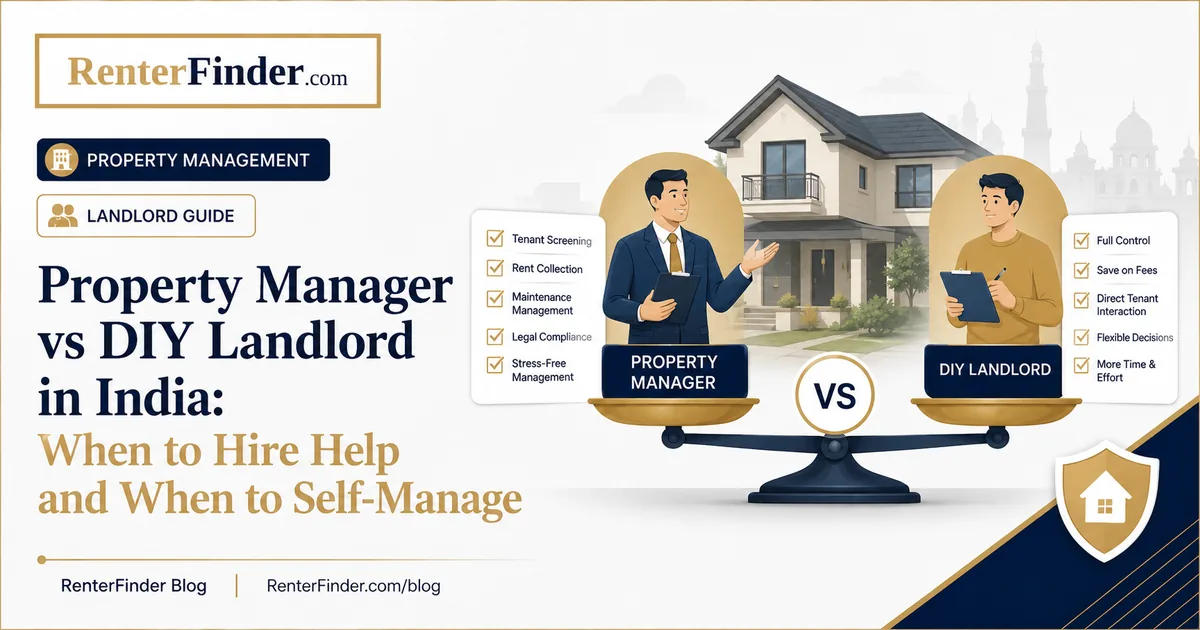
Every Indian landlord eventually reaches a point where self-managing feels like a second job. A tenant calling at 10 pm about a leaking tap, three weeks of back-and-forth over a maintenance invoice, two months of vacancy because there was no time to show the flat. The question is not whether professional property management exists - it does - but whether it makes financial and practical sense for your specific situation.
This guide compares what hiring a property manager in India actually costs versus what DIY landlord management actually requires. It covers the real workload of self-management, how the fee arithmetic works, and the circumstances that make each option the more rational choice. A six-question decision framework at the end helps you land on the right answer for your situation.
What Does a Property Manager in India Actually Do?
Property management companies in India offer a range of services, typically bundled into packages. A full-service engagement usually covers:
- Tenant sourcing and screening - The manager lists the property, fields enquiries, and shortlists candidates based on documents and references.
- Rent collection and follow-up - Monthly rent is collected and transferred to the landlord within a fixed number of days, with the manager handling late payments.
- Maintenance coordination - The manager receives tenant complaints, arranges and supervises repair work, and typically charges a mark-up on maintenance invoices.
- Police verification assistance - Managers in most cities handle or guide the tenant police verification process required under state rules.
- Agreement drafting and renewal - The manager drafts the lease, handles renewal notices, and tracks the tenancy calendar.
- Property inspections - Periodic visits to check the flat's condition.
- Monthly statements - Income and expense records provided to the landlord.
Management fees typically range from 8% to 12% of the monthly rent. Some companies charge a one-time tenant placement fee on top - often one to two months' rent - when they source a new tenant. Quality varies widely across providers. Before signing a management agreement, ask specifically what is included and what is excluded, how maintenance decisions are authorised, and what the notice period is to exit the agreement.
What Does DIY Landlord Management Actually Involve?
Self-managing a rental property in India is more time-intensive than most landlords expect when they first sign a lease. A realistic picture of the workload:
- Finding a tenant - Writing and publishing a listing, photographing the property, fielding enquiries (often 20-40 calls for a new vacancy), screening candidates, and showing the flat. This phase alone typically takes 3-8 weeks.
- Documentation - Drafting the rent agreement, collecting tenant documents (ID, address proof, employment proof, references), and completing police verification for the new occupant.
- Monthly collection - Tracking and following up on rent payments, issuing receipts, and maintaining records for income tax purposes.
- Maintenance - Being the first point of contact for every repair request, finding and supervising contractors, and adjudicating disputes over who pays for what.
- Society and RWA coordination - Intimating the housing society when a new tenant moves in, handling NOC requirements if applicable, and responding to society communications.
- Lease renewal and exits - Managing the renewal cycle, negotiating rent revisions, and handling the move-out process including property inspection and deposit settlement.
The total time commitment for a well-managed single flat in a stable tenancy is typically 4-8 hours per month. During a vacancy or tenant-change period, it can peak to 15-25 hours. Many landlords underestimate this until they are in the middle of it.
The Real Cost Comparison
The management fee is visible on paper. The cost of DIY management is mostly invisible - which is why many landlords underestimate it.
Property manager cost: At 10% management fee = 2,500 rupees/month = 30,000 rupees/year. If a one-time placement fee of one month's rent is added each time a tenant changes (roughly every two years), the total over a two-year cycle is approximately 85,000 rupees.
DIY time cost: A landlord whose professional time is worth 1,000 rupees per hour, spending 6 hours per month, is implicitly spending 6,000 rupees per month - or 72,000 rupees per year - in opportunity cost. This excludes the cost of vacancy.
Vacancy cost example: A 6-week vacancy (common during a tenant change when sourcing is slow) costs 37,500 rupees in lost rent alone - more than a full year's placement fee for a good property manager who fills the flat faster.
Other factors that shift the calculation: the management fee is deductible as a property expense under the Income Tax Act when computing taxable rental income, partially offsetting the cost. A professional manager who prevents one serious tenant dispute or avoids one costly maintenance mistake may save more than their annual fee. For the income tax treatment of rental income, refer to the Income Tax India website.
When Hiring a Property Manager Makes Sense
Certain circumstances make professional management a rational choice rather than an optional luxury:
- You live far from the property. Managing a flat in another city - or from abroad as an NRI - without someone on the ground is genuinely difficult. Tenant emergencies cannot be resolved by WhatsApp alone, and periodic inspections require physical presence.
- You own multiple properties. Once you have two or more rental units, the administrative workload multiplies and coordination becomes harder. Most landlords find that two or more properties managed simultaneously justify the cost of professional help.
- Your time is genuinely scarce. A senior professional or business owner whose time is worth significantly more than the management fee per hour may find outsourcing to be the more rational use of resources.
- You have had repeated problems with tenant disputes or vacancies. A professional manager who handles these situations routinely may reduce both the financial and emotional cost of difficult tenancies.
- You want professional documentation. A good management company produces clear rental agreements, signed inventory annexures, rent receipts, and expense records - reducing your exposure in any future dispute.
If you go this route, ask for references from other landlords the manager serves in the same city, confirm that the management agreement is in writing with a clear exit clause, and verify that all fees - including maintenance mark-ups - are explicitly stated before signing.
When Self-Managing Works Well
Self-managing is a reasonable and cost-effective choice in these circumstances:
- You live within reasonable distance of the property. Being able to visit in 30-45 minutes makes handling maintenance visits, tenant inspections, and move-in or move-out checks much simpler.
- You have one property and adequate time. For a single, stable tenancy in a well-maintained flat, the monthly workload is manageable for a landlord who has organised the documentation properly.
- You have prior experience. A landlord on their third or fourth tenancy who has dealt with a deposit dispute, a maintenance contractor, and a rent renewal has practical knowledge that makes self-management far less stressful than a first-timer faces.
- You want direct control over tenant selection. Many landlords find that a property manager's shortlist does not match their own preference for a particular type of household. Self-managing gives you full visibility of who is moving into your property.
- You are comfortable with legal paperwork. A well-written rent agreement, a signed inventory annexure, and a basic understanding of what the Model Tenancy Act 2021 says about repairs and deposits puts you in a strong position.
For self-managing landlords, two things make a meaningful practical difference: a rigorous pre-move-in documentation routine and a clearly worded rent agreement. Both are covered in the tenant onboarding checklist for Indian landlords.
The Middle Path: Direct Matching Without Ongoing Management
Many landlords do not need a full-service property manager. What they actually need is help with the hardest and most time-consuming part of the cycle: finding the right tenant in the first place.
The usual listing platforms require the landlord to wait for inbound enquiries from whoever happens to search for a flat that week - with no filter on whether those enquirers are a serious match. RenterFinder's Prospective Renters' List works the other way: landlords browse pre-submitted renter profiles with full details on BHK requirement, preferred locality, budget range, family size, occupation, and move-in timeline, then shortlist the right matches and connect through AI and human moderated chat before committing to a meeting.
Once the right renter is identified, the landlord self-manages the tenancy without paying an ongoing percentage of rent every month. The platform's service fee - split across both parties and paid in two stages - covers the matching and pre-meeting phase only. There is no recurring management charge.
This model suits the landlord who is comfortable managing a stable tenancy directly but finds the tenant-search phase to be the bottleneck - and does not want to pay a broker commission or a full management fee for that one task. See the complete fee structure here.
A Six-Question Decision Framework
Before deciding, work through these questions honestly:
- How many hours per month can I realistically commit? Less than 4 hours is workable for a stable tenancy. Consistently over 10 hours suggests you are over-extended.
- Am I within 30-45 minutes of the property? If no, professional management or a trusted local representative is worth considering seriously.
- Do I own more than one rental unit? If yes, professional management almost always pays for itself in time saved.
- Have I dealt with a difficult tenancy before? If yes, you have context for what to expect. If no, factor in the learning curve - first-time landlords often underestimate the complexity of exits and deposit disputes.
- Is my professional time genuinely scarce? If an hour of your work is worth significantly more than what a property manager charges per hour of their involvement, the arithmetic may favour outsourcing.
- Am I comfortable with legal documents and disputes? If you are uncertain about how to send a repair notice under the Model Tenancy Act 2021, handle a Rent Authority complaint, or deal with a holdover tenant, professional help may meaningfully reduce your risk.
Scoring guide: If you answered "no" or "uncertain" to three or more of these questions, a professional manager is worth a serious evaluation. If you answered "yes" to most, self-management with a good tenant-discovery platform is likely the more cost-effective path.
Self-managing versus hiring a property manager is not a universal answer - it is a function of your time, location, number of properties, and risk tolerance. For landlords who need help with tenant discovery but not ongoing management, the Prospective Renters' List at RenterFinder offers a structured alternative to broker dependency and full-service management contracts. For legal questions on tenancy management, refer to the Model Tenancy Act 2021 and your state housing authority - rules vary by state and the MoHUA website is the national reference point.
For more on the landlord side of managing a tenancy well, see our guide on who pays for repairs in a rented flat in India - particularly useful for the self-managing landlord drafting a maintenance clause in the rent agreement.
Disclaimer: This article is for general informational purposes only and does not constitute legal or financial advice. Rules on tenancy management, tax treatment of rental income, and state-level regulations vary and change. For current guidance, consult a qualified professional or your state's official housing authority. For the national tenancy framework, refer to the Model Tenancy Act 2021.
Related Articles
- Tenant Onboarding Checklist for Indian Landlords - What to do in the 48 hours after signing the agreement
- How to Find a Good Tenant in India Without a Broker - Complete landlord playbook for direct tenant discovery
- Who Pays for Repairs in a Rented Flat in India? - MTA 2021 repair responsibilities explained
Browse active renters with full profiles - BHK need, budget, move-in date, and more. No broker needed.