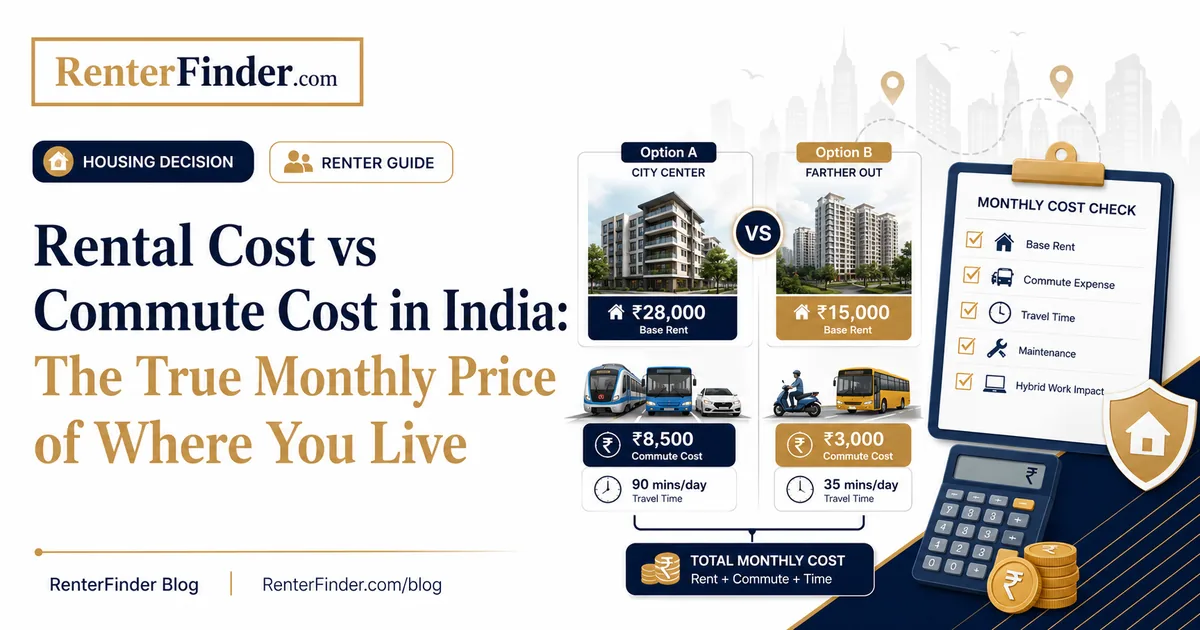
Most renters in India compare two localities by rent and pick the cheaper one. It is a natural shortcut. But rent is only one line in the true monthly housing bill. Add up what commuting actually costs - fuel, metro passes, auto fares, cab rides - and then factor in the time you spend travelling and the fatigue of doing it daily. The picture can flip entirely. The flat that looked ₹1,500 cheaper per month can easily cost ₹2,000 to ₹4,000 more once commute expenses are added back in, depending on the city and the distance.
In 2026, with hybrid work schedules making commute frequency more variable than it was before, this calculation has become both more important and more nuanced. This guide walks through how to do it properly - what to include, how the hybrid work factor changes the numbers, and how to use the result to make a better locality decision before you sign a lease.
Why Your Rent is Not Your Real Housing Cost
When you compare two flats, you are typically comparing rent figures. But the monthly amount you actually spend on housing is a larger number that includes several other items most renters do not add up in advance. Understanding this full picture is the first step to making a rational locality decision.
A more complete monthly housing cost includes:
- Monthly rent - the number you know.
- Society maintenance charges - often ₹1,000 to ₹4,000/month in urban societies; paid separately from rent in most cases.
- Utility deposits and connection costs - one-time, but a real upfront cost to factor in.
- Commute expenses - fuel, metro pass, auto or cab fares, tolls, parking. This is often the most underestimated line.
- Opportunity cost of commute time - harder to quantify but very real. Two hours a day is over 500 hours a year.
The commute line is where most locality decisions go wrong. Renters compare rent and ignore it entirely, then spend months quietly paying far more than they expected.
How to Calculate What Your Commute Actually Costs Per Month
The calculation is straightforward once you sit down to do it. The key variables are: commute distance one way, your primary transport mode, the typical cost per trip, and the number of working days per month you will actually commute. Most people assume 22 working days; if you are on a hybrid schedule, the real number is lower - more on that shortly.
By transport mode, here is how to estimate:
- Petrol two-wheeler: (distance one way x 2) / mileage x fuel price per litre x commute days per month. Add parking if applicable.
- Metro: (one-way fare x 2) x commute days per month. Factor in feeder auto or rickshaw cost at both ends if the station is not walking distance.
- City bus / BMTC / DTC: (daily bus pass or per-trip fare x 2) x commute days. Often the lowest-cost option but depends heavily on route coverage.
- Auto-rickshaw: (typical fare one way x 2) x commute days. This is often the most expensive per-km mode and is also the most variable.
- Cab / app cab: (average fare one way x 2) x commute days. Add surge premium if your schedule is peak-hour.
- Own car: Fuel + EMI allocation if financed + parking at office + parking at society. Often the most expensive mode in urban areas, though the comfort calculation is different.
Once you have the monthly commute number for each flat, add it to that flat's monthly rent. That is the figure to compare. In many situations, the number that felt "obvious" before you ran the calculation looks quite different after.
How Hybrid Work Changes the Maths in 2026
Before 2020, most salaried employees in Indian cities commuted five days a week - roughly 22 working days per month. The commute cost calculation was simple. Since then, a large share of professionals in IT, finance, and knowledge-work sectors have shifted to hybrid schedules of 2-4 office days per week, which translates to roughly 8-16 commute days per month instead of 22.
This matters for the rent-vs-commute tradeoff in two ways. First, fewer commute days mean the monthly commute cost from a distant suburb is lower than it was for a full-time office commuter. The break-even distance between "near office" and "far but cheap" shifts outward. A 20-kilometre commute that cost ₹4,000/month at 22 days now costs ₹2,000/month at 11 days. That changes the calculation significantly.
Second, hybrid work means you spend substantially more time at home. That makes the home environment itself more important - the internet connection quality, the workspace, natural light, ambient noise, access to cafes or co-working spaces nearby if you need a change of scene. A distant flat that worked fine when you were only there to sleep may feel genuinely constraining when you are working from it three or four days a week.
Three Locality Scenarios: Running the Numbers
The following three scenarios use indicative numbers - not precise city-average data, which varies too much to generalise - but the relative proportions are realistic for many mid-to-large Indian cities in 2026.
In this illustration, Scenario A (near-office) looks most expensive on rent alone. But Scenario B (far suburb) is barely cheaper than Scenario C once commute is added. And Scenario A is only ₹1,800/month more expensive than the far suburb - a gap many renters would close for the time and energy saved. This pattern repeats across many real-world decisions: the rent difference between "close" and "far" is smaller than it looks, and the commute difference is larger.
Note: if you are on a hybrid schedule of 3 days/week, redo the commute column using 12 days instead of 22. In that case, Scenario B's commute falls from ₹4,500 to around ₹2,500, and the gap between all three scenarios closes further. The near-office premium may or may not be worth it depending on the specifics.
The Hidden Costs a Spreadsheet Will Not Capture
Fuel and metro fares are quantifiable. But some of the most significant costs of a long commute are harder to put a number on - even though they are very real.
Things a spreadsheet tends to miss:
- Time: A 90-minute daily commute round trip is 33 hours per month, or roughly a full working week every 5 weeks. What you could do with that time - rest, a second skill, family, fitness - has real value even if it does not appear on a balance sheet.
- Fatigue: Long commutes on crowded metro lines or in traffic are genuinely exhausting for most people. Fatigue affects work performance, mood, and health over months. This is difficult to quantify but not negligible.
- Food spend: People with long commutes often eat out more frequently - at the office cafeteria, on the way home - because they have less energy to cook. This can add ₹2,000 to ₹4,000/month to food costs in a way that is easy to attribute to "lifestyle" rather than commute.
- Gym and recreation: A flat near the office may give easy access to gyms, parks, or markets during off-hours. A distant suburb may force a car trip for every errand, adding indirect costs and friction.
- Social life proximity: For young renters in particular, living far from friends and from the social infrastructure of the city has a slow, accumulating effect on wellbeing that is not in any spreadsheet.
None of this means "always live near the office." There are genuine trade-offs - more space, quieter living, lower rent - that are real benefits of suburban locations. The point is that the decision should be conscious, with these factors deliberately weighed, not made on the rent number alone.
I am aware this is one experience, and good outcomes happen with brokers too. I am not suggesting the platform is magical or that every match will work out. What I am saying is that the information advantage alone is worth something significant. I knew who I was meeting before I met them. That changes the dynamic of the entire transaction.
Six Questions to Ask Before You Decide on a Locality
Before signing a lease, work through these six questions. They help structure the decision beyond just comparing rent figures:
- How many days per week will I realistically go to the office? Be honest. If your company's hybrid policy says 3 days but attendance is closer to 2, use 2 for the calculation. If attendance is enforced more strictly, use the actual number.
- What is my likely commute mode? The same distance costs very differently by bike vs metro vs auto vs cab. Factor in what you will actually use, not the cheapest theoretical option.
- Does this locality add other costs? Some cheaper localities have higher maintenance charges, harder water supply situations, or require driving for every grocery run. These add to the true housing cost in ways that are not visible in the rent figure alone.
- Does my family's daily life favour one direction? If you have school-going children, is the school run shorter from one locality? If a family member has a fixed-route commute, does one option save them a meaningful amount too?
- Is the commute time predictable or traffic-variable? Metro commutes are generally time-predictable. Road commutes in Indian cities can vary by 40-80% depending on the time of day and day of week. If your schedule is inflexible, that variability is a hidden cost.
- How long am I planning to stay? If you are taking a flat for 11 months with a likely move, the upfront deposit and moving cost amortise over fewer months, making the total cost per month higher. A 2-year tenancy makes a modest rent premium much easier to absorb.
How a Renter Profile Helps You Find Flats on Your Commute Corridor
Once you have done the calculation and know which localities make sense for your commute budget, the next challenge is actually finding flats there. The traditional approach - scrolling through listings on portals - requires you to filter by locality and hope the listings are current, accurate, and actually from landlords rather than brokers re-listing properties they do not own.
A different approach is to create a renter profile on a platform like RenterFinder.com. A renter profile lets you specify the localities you want (matching your commute corridor analysis), your budget, flat type, family composition, and move-in timeline. Landlords with flats in those areas can browse the Prospective Renters' List and contact you directly through AI and human moderated chat - without your phone number being shared until both sides show genuine interest.
This flips the usual search dynamic. Instead of you hunting for flats in your target corridor and calling disconnected numbers, landlords who have the right flats in the right localities come to you. It is particularly useful when you have done the work of identifying 2-3 specific localities where the rent-vs-commute maths works for your situation - you can express that clearly in a profile, and the platform surfaces the relevant landlords.
If you are searching in a major city, it is worth creating a profile - it costs ₹125 for a three-month listing - and letting the platform work alongside your own search rather than replacing it entirely.
A Simple Summary
The decision of where to rent in India is often framed as a rent decision. It is actually a total housing cost decision. Rent, commute, maintenance, time, and quality of life at the new location all factor in. Renters who run the full calculation before signing - rather than after two months of unexpectedly high commute bills - consistently report feeling better about their choice, or at least making it with open eyes.
The calculation is not complicated. It takes about 20 minutes with a spreadsheet or even a piece of paper. Multiply your likely commute cost by your actual commute days per month. Add that to the rent and maintenance. Compare that number across your shortlisted localities. Adjust for hybrid work days. Add a gut-check on the hidden factors - space, home environment, predictability of the commute. Then decide.
That is usually enough to make a significantly better decision than comparing rent figures alone.
Related Articles
- Hidden Charges in Indian Rental Agreements - Every cost to negotiate before you sign
- How to Rent a Flat Without a Broker in India - Step-by-step guide for renters
- What 'Fully Furnished' Actually Includes in Indian Rentals - Before you pay the furnished premium
List your requirements - preferred locality, budget, move-in date - and let landlords on your commute corridor find you. ₹125 for 3 months, no broker involved.