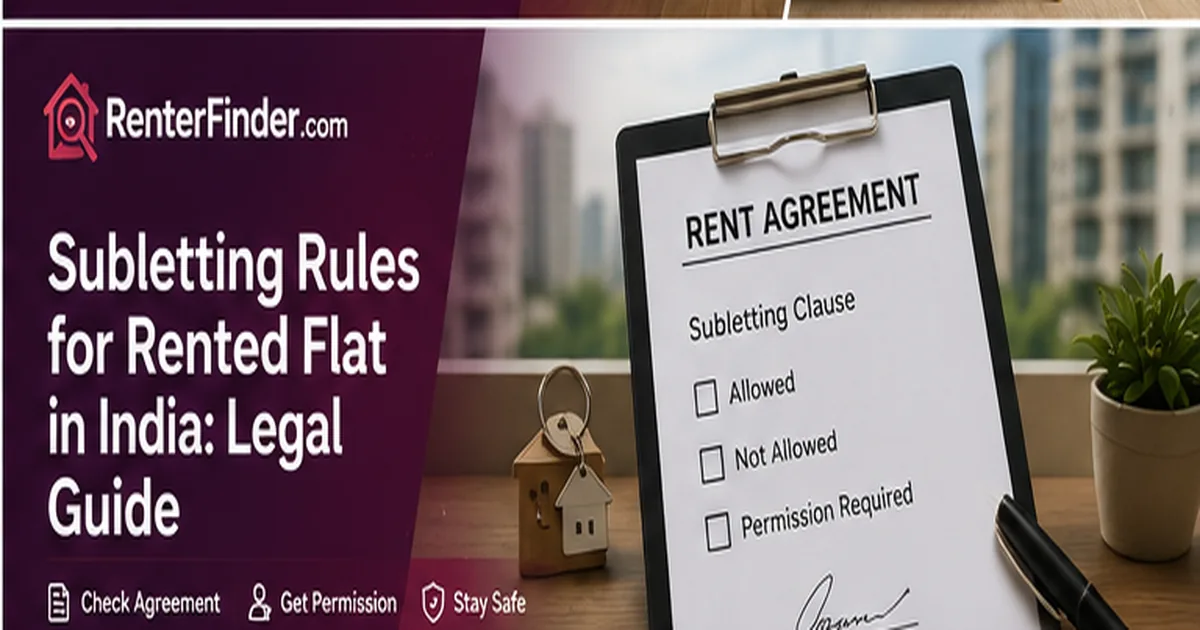
One of the most common questions renters search for - "can I sublet my rented flat in India?" - has a deceptively simple answer: technically yes, but almost always only with your landlord's written permission. Miss that step and you have handed your landlord a valid ground for eviction. The confusion is understandable. Rent agreements in India rarely explain the distinction between subletting and simply having a flatmate, and many tenants only discover the difference when there is already a problem.
This guide explains the legal rules, the flatmate grey zone, what your rent agreement is likely to say, and what actually happens if you proceed without consent. It covers the national framework under the Model Tenancy Act 2021 and the older state Rent Control Acts that still govern most tenancies in Bangalore, Mumbai, Delhi, and Chennai.
What subletting actually means (and what it does not)
Subletting means you, as the tenant, grant a third party the right to occupy all or part of the rented premises - effectively becoming their landlord while remaining your landlord's tenant. The sub-tenant pays you rent, you pay your landlord rent, and the landlord has no direct relationship with the person actually living in the flat.
What subletting is not:
- A family member moving in. A spouse, parents, or children joining you in the flat is not subletting. Most agreements and Rent Control Acts treat this as normal occupant change - still worth informing your landlord, but not a subletting trigger.
- A colleague using a spare room informally. If no money changes hands as separate rent, and the person has no independent right to occupy, the subletting question rarely arises in practice - though it depends on the agreement's wording.
- A co-tenant on the same agreement. If your landlord adds a second name to the original rent agreement as a co-tenant, that person is a joint tenant, not a sub-tenant.
The grey area - and where most disputes come from - is the flatmate arrangement: a working professional pays you a share of the rent, has their own room, and uses the common areas independently. Legally, that can look a lot like subletting, especially if the agreement says it is.
Is subletting legal in India? What the law says
Subletting is not automatically illegal. Whether it is permitted depends on three things in this order: your rent agreement, the applicable state Rent Control Act, and - in states that have adopted it - the Model Tenancy Act 2021.
Under the Model Tenancy Act 2021 (Section 13): a tenant may sublet the premises or any part of it only with the landlord's prior written consent. The tenant must apply in writing, stating the intended duration and the sub-tenant's details. The landlord is not obligated to consent. If consent is given, the landlord can set conditions. Subletting without consent gives the landlord grounds to terminate the tenancy. As of mid-2026, the MTA has been adopted in Andhra Pradesh, Telangana, Tamil Nadu, Uttar Pradesh, Uttarakhand, Assam, and the Union Territories. Karnataka, Maharashtra, West Bengal, and several other states have their own Rent Control Acts and have not adopted the MTA.
Under Karnataka Rent Act 1999: subletting requires the landlord's written consent. Subletting without consent is a valid ground for eviction under Section 27. This is the law that governs most Bangalore tenancies unless the agreement was registered under a leave-and-licence framework.
Under older Rent Control Acts in Delhi, Mumbai, West Bengal, and Tamil Nadu: subletting without landlord consent is similarly prohibited and grounds for eviction. The specific procedural rules vary - check your state's current law or consult an advocate.
| Framework | Consent required? | Consequence if violated |
|---|---|---|
| Model Tenancy Act 2021 | Yes - written | Termination + eviction |
| Karnataka Rent Act 1999 | Yes - written | Eviction grounds |
| Maharashtra Rent Control Act 1999 | Yes | Eviction grounds |
| Agreement clause (all states) | Usually expressly prohibited | Breach of contract |
Rules vary by state and change. Verify with your state's official portal or a qualified advocate.
When does taking a flatmate count as subletting?
This is the question that most flatmate seekers actually need answered. The honest answer is: it depends on the arrangement and what the agreement says. Here is a practical test.
More likely to be treated as subletting:
- The flatmate pays you a fixed monthly amount described as "rent" or "room rent"
- The flatmate has exclusive use of a specific room with the ability to lock others out
- The flatmate has an independent agreement with you (even informal)
- The flatmate is not known to or disclosed to the landlord
- The landlord would lose rent or deposit rights if the flatmate stays after you leave
Less likely to be treated as subletting:
- The person is a family member (spouse, sibling, parent)
- The landlord knows about the arrangement and has informally agreed
- The flatmate's name is added to the existing rent agreement as a co-occupant
- No separate rent is charged - the person contributes to household expenses only
In practice, most Indian courts and Rent Controllers look at substance over form. If the arrangement functionally divides the flat between two independent tenants, it is likely subletting regardless of what you call it. The safest position: if money changes hands and a separate person gets exclusive use of space, disclose it to your landlord and get their consent in writing before the arrangement begins.
For anyone looking to find a flatmate in Bangalore - which is precisely what RenterFinder's flatmate matching model supports - this conversation with the landlord is the single most important step before you list your spare room or accept a flatmate's request.
What your rent agreement likely says
Almost every standard rent agreement in India includes a clause prohibiting subletting without landlord consent. The exact language varies, but you will typically find something like: "The Tenant shall not sublet, assign, or part with possession of the premises or any part thereof without the prior written consent of the Landlord."
Some agreements go further and list specific permitted occupants by name - in which case any additional person staying beyond a short visit may technically require an amendment to the agreement. Others simply use the language above and leave interpretation to the parties.
A few things to look for in your agreement:
- Does it define "occupants"? If the agreement lists permitted occupants, adding a flatmate not on that list is a potential breach even if no separate rent is charged.
- Does it have a "no subletting" clause? If yes, you need written consent before proceeding regardless of how informal the flatmate arrangement is.
- Does it say what happens if you sublet without consent? Many agreements list this as a ground for early termination - meaning the landlord can potentially end the tenancy before the natural expiry date.
- Is the agreement registered? A registered agreement (Kaveri 2.0 in Karnataka, leave-and-licence registration in Maharashtra) carries more evidentiary weight if there is a dispute. An unregistered agreement is still enforceable but harder to prove in court.
Consequences of subletting without permission
If a landlord discovers unauthorized subletting, the consequences in practice range from an informal warning to a formal eviction petition. Here is what can happen:
- Termination notice. The landlord issues written notice to vacate, citing unauthorized subletting as the ground. Under the MTA 2021, the landlord can give notice under Section 21 and approach the Rent Authority if you do not comply.
- Eviction petition. If you do not vacate, the landlord files a petition with the Rent Controller or Rent Authority. Under the Karnataka Rent Act, unauthorized subletting is one of the specified grounds for eviction under Section 27.
- Deposit forfeiture. The agreement may specifically provide that unauthorized subletting leads to forfeiture of the security deposit. Even without an explicit clause, deposit deduction disputes become more complicated when the landlord has a legitimate complaint.
- The sub-tenant's rights. A sub-tenant has no independent rights against the landlord. If the primary tenancy is terminated for unauthorized subletting, the sub-tenant must also vacate. The sub-tenant's recourse - if any - is against the primary tenant who set up the arrangement.
One realistic note: most landlords in India do not immediately go to court over an informal flatmate arrangement if they like the primary tenant otherwise. The practical risk is highest when the landlord-tenant relationship is already strained, or when the flatmate causes issues with the society or building. But "the landlord is unlikely to act" is not the same as "you have a legal right" - and the legal right is clear.
How to legally add a flatmate or co-occupant
The good news is that most landlords - if approached honestly - are willing to agree to a flatmate arrangement, especially in cities like Bangalore where multi-person flat sharing is common and landlords expect it. The right process is simple:
- Write to your landlord first. A WhatsApp message or email documenting the request is sufficient. State the flatmate's name, identity document type, their occupation, and the proposed start date. Keep the record.
- Wait for consent before the person moves in. Do not bring someone in and then ask. That changes the landlord's negotiating position and creates bad faith immediately.
- Get the agreement amended or noted in writing. If the landlord agrees verbally, follow up with a confirmation message: "Thank you for agreeing to [name] joining as co-occupant from [date]. Please confirm." The landlord's reply creates a record.
- Consider a co-occupant endorsement. In cities where rent agreements are formally registered (Karnataka under Kaveri 2.0, Maharashtra under leave-and-licence), an addendum or co-occupant letter can be added to the registered agreement. This protects both the primary tenant and the flatmate.
- Do police verification. Karnataka Police's Suraksha app and similar state portals allow tenants to do self-verification of co-occupants. This is not legally mandatory in all states but protects everyone and is increasingly expected by society RWAs. Visit your state's police portal for the current process.
The flatmate model on RenterFinder and how it works
RenterFinder's flatmate-matching model is designed for exactly the scenario this guide addresses. A flatmate seeker - someone looking to join a pre-occupied flat or find someone to share their flat with - can create a listing on the platform. The other party, whether the existing tenant or a fellow seeker, connects through the platform's AI and human moderated chat. No phone numbers change hands until both parties show genuine intent.
The platform currently serves flats for rent in Bangalore and across India. The profile-based approach means a potential flatmate can see your occupation, preferred living setup, and budget range before any conversation begins - which makes the "is this person right for our flat" question easier to answer before committing.
A word on the platform's current stage: RenterFinder launched on April 24, 2026, and the user pool is still growing. Please be patient as more flatmate seekers and landlords join - the matching gets better as the community grows. The ₹125 listing fee covers three months of profile visibility, and the Platform Service Fee applies only when both parties agree to meet and eventually close a deal.
What the platform does not do: it does not negotiate the subletting permission for you. That conversation with the landlord is still your responsibility - but it is the one-time step that makes everything else straightforward. Get the consent in writing before your flatmate moves in, and the rest of the arrangement sits on a solid legal foundation. See the RenterFinder FAQ and fee structure for more on how the platform works.
The bottom line on subletting in India
Subletting a rented flat without landlord consent is not technically criminal in most states, but it gives your landlord a valid ground for eviction under virtually every applicable law in India - the MTA 2021, the Karnataka Rent Act, and most state Rent Control Acts. Taking in a paying flatmate who has independent use of a room is likely to be treated as subletting if the landlord ever decides to test it.
The way to make the arrangement work is also the simplest: tell your landlord, get written consent, and document everything. Most landlords are reasonable when approached honestly before the fact. It is when the flatmate is discovered rather than disclosed that problems escalate quickly.
If you are already in a situation where a flatmate has moved in without landlord knowledge, the least-bad path is still to disclose and ask for retroactive consent - a frank message explaining the situation is better than waiting for the landlord to find out another way. For guidance specific to your state's law, consult a qualified advocate or approach your state's Rent Authority.
Related Articles
- Every Rent Agreement Clause Explained - Understand what you signed before adding a flatmate
- Notice Period Rules in Bangalore (2026) - What happens when the flatmate arrangement ends
- Security Deposit Rules in India - How deposits work when there are multiple occupants
RenterFinder connects flatmate seekers through AI and human moderated chat - no phone numbers shared until both parties show genuine intent.