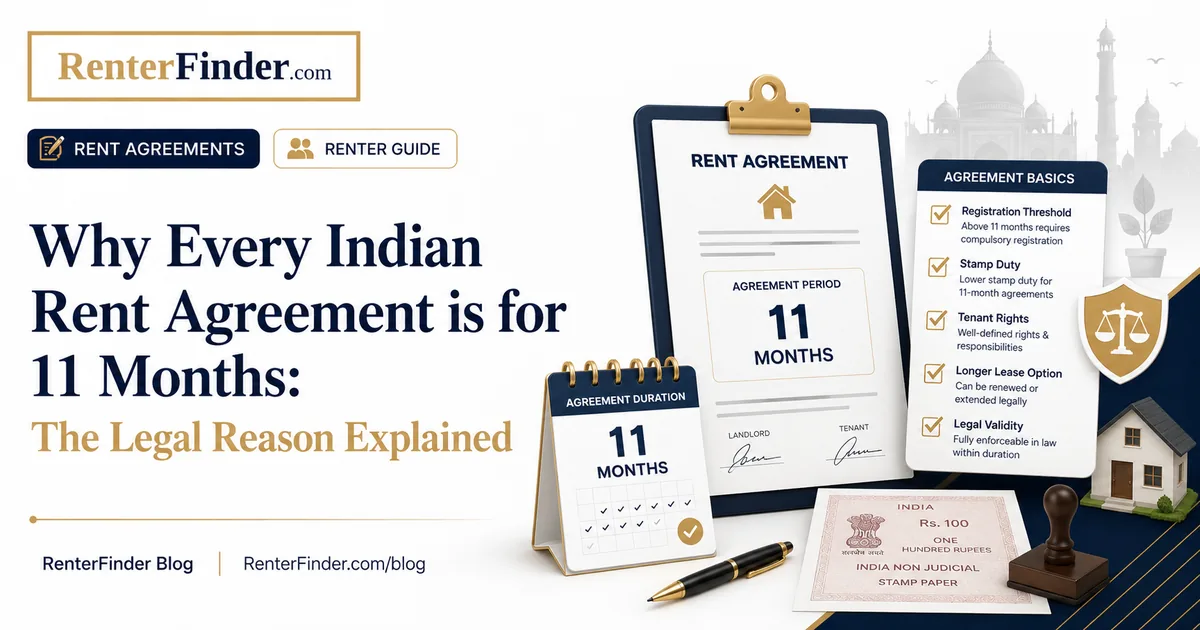
An 11-month rent agreement is as Indian as a society maintenance notice. You sign it, move in, and rarely question why the number is 11 and not 12. Ask your landlord and they will probably say "that is just how it is done" - which is correct but incomplete. The reason is grounded in a specific provision of the Registration Act 1908, and understanding it will change how you read every rental agreement you sign from now on.
This is not a loophole exploited in bad faith. It is a deliberate, widely accepted convention - and once you understand why, the entire 11-month agreement stops being mysterious and starts making practical sense for both landlords and renters.
The 11-month agreement is everywhere - here is what is actually going on
Whether you are renting a studio in Koramangala, a 3BHK in Gurgaon, or a one-room flat in Lucknow, the agreement your landlord puts in front of you will almost certainly be for 11 months. The name varies by state - "leave and licence agreement," "rent agreement," "tenancy agreement" - but the duration is near-universal.
The reason sits in Section 17 of the Registration Act 1908. Under that section, leases of immovable property "from year to year, or for any term exceeding one year, or reserving a yearly rent" must be compulsorily registered at the Sub-Registrar's office. A lease for 11 months - less than one year - falls outside this mandatory requirement. It can be a valid, enforceable agreement without going through the registration process.
That single provision has quietly shaped how hundreds of millions of rental transactions have been documented across India for generations. The 11-month number is not arbitrary - it is the highest duration that stays just below the one-year threshold that triggers mandatory registration.
What the Registration Act 1908 actually requires - and what it does not
Section 17(1)(d) of the Registration Act 1908 lists the documents that must be compulsorily registered. It includes "leases of immovable property from year to year, or for any term exceeding one year, or reserving a yearly rent." If your lease falls into any of these categories and it is not registered, it cannot be admitted as evidence of its contents in a court proceeding under Section 49 of the same Act.
Registration requires visiting the Sub-Registrar's office, submitting the document and identity proofs, paying the registration fee, and having the document entered into the official government register. Once registered, the document is public record and can be produced as primary evidence in any dispute. For the current text of the Act, see India Code (indiacode.nic.in).
An 11-month agreement falls outside this requirement. It does not need Sub-Registrar registration to be valid. It simply needs to be executed on the correct denomination of stamp paper for the state, signed by both parties, and witnessed. Once that is done, it is an enforceable contract.
One clarification worth making: notarization is not the same as registration. Getting an agreement stamped by a notary public - a service many lawyers and document writers offer - does not satisfy the Registration Act. It simply attests to the identity of the signatories. Notarization is useful but not a substitute for registration when registration is required.
Stamp duty: the real cost hiding behind the 12-month threshold
When landlords say they want to avoid "registration," what they are often really avoiding is stamp duty - the tax levied by state governments on certain legal instruments, including rent agreements. Stamp duty is different from the registration fee (which is the cost of the registration process itself), though in practice both are incurred when a lease requires registration.
For an 11-month agreement, stamp duty is typically a low, fixed amount. In many states it works out to somewhere between ₹100 and ₹500, paid by purchasing pre-printed stamp paper of the appropriate denomination. The agreement is typed or written on this paper, signed, and that is typically the end of the cost.
For a 12-month or longer lease, stamp duty is usually a percentage of the total annual rent - and sometimes of the deposit as well. Across most Indian states this works out to roughly 1% to 2% of the total rent for the lease period. Registration fees are charged separately on top. Here is a rough sense of the numbers:
Rates vary by state and change over time. Check your state's stamps and registration department portal for current rates.
These costs are not catastrophic for most renters, but they are real, and they explain why the convention of 11-month agreements has persisted even as rental markets have matured. When both parties prefer to avoid the cost and paperwork, and the shorter agreement is legally adequate for their situation, the 11-month term is the rational choice.
What an unregistered 11-month agreement means for your rights as a tenant
This is the part most renters do not fully understand - and it is important. An unregistered 11-month agreement is still legally valid and still enforceable. The restriction in Section 49 of the Registration Act applies only to documents that were required to be registered but were not. Since an 11-month agreement is not required to be registered, there is no Section 49 problem.
Under the Bharatiya Sakshya Adhiniyam 2023 (which replaced the Indian Evidence Act), electronic records and secondary evidence of an unregistered contract can be admitted in proceedings. Your WhatsApp messages about the deposit, your bank transfer receipt, your photographs of the property condition at move-in - all of these can be used as supporting evidence in a dispute.
The Model Tenancy Act 2021, in states that have adopted it, also gives tenants rights that operate independently of the agreement format. These include the two-month cap on security deposits for residential premises, the right to receive rent receipts, the right to a fair-wear-and-tear standard at exit, and the right to approach the Rent Authority for disputes. For the current text of the MTA, see the official Model Tenancy Act 2021 (MoHUA).
Practical steps to protect yourself as a renter with an 11-month agreement:
- Keep the original agreement. Both parties should receive a signed copy on stamp paper.
- Scan and store digitally. Email yourself a photo of the agreement. Electronic records are admissible under the Bharatiya Sakshya Adhiniyam 2023.
- Pay the deposit by bank transfer. Use a description that clearly states "security deposit for [property address]." Avoid cash for large amounts.
- Keep all rent receipts. A physical or digital receipt for each month's rent, with the landlord's signature or at minimum a WhatsApp acknowledgement, builds your paper trail.
- Document the property at move-in. Photographs and a short move-in checklist signed by both parties will protect you from arbitrary deductions at exit.
State-by-state variations: the rule is national, the practice is not always uniform
The Registration Act 1908 is a central law that applies across India. But tenancy law itself is a state subject, and each state has its own rent control legislation, stamp duty rates, and norms around what type of agreement landlords prefer. The 11-month convention is practiced nearly everywhere, but the legal context it sits within differs by state.
Maharashtra has historically preferred the leave-and-licence model rather than a traditional tenancy agreement. A leave-and-licence agreement gives the occupant fewer protections than a tenant under rent control provisions - which was a deliberate preference of landlords wanting to avoid the historically strict eviction rules of the Maharashtra Rent Control Act 1999. The state even has an online portal for registering leave-and-licence agreements, and many landlords in Mumbai, Pune, and Nashik do register these electronically even for 11-month terms - though it is not mandatory.
Tamil Nadu and Karnataka have their own Rent Control Acts and the 11-month norm is standard for private residential rentals. Rent control protections in these states can still apply to tenants in older buildings that predate certain thresholds, even without a registered agreement.
Delhi operates under the Delhi Rent Control Act 1958 for older buildings and the Transfer of Property Act for newer ones. Leave-and-licence agreements on 11-month terms dominate in newer residential properties. Kerala uses the Kerala Buildings (Lease and Rent Control) Act 1965, and landlords there traditionally ask for advance rent (not deposit) of several months - but the 11-month agreement convention applies to the documentation of the tenancy period.
The national Model Tenancy Act 2021 aims to standardise the framework and introduce Rent Authorities in each state as dispute resolution bodies. Adoption has been uneven. Andhra Pradesh, Telangana, Tamil Nadu, and Uttar Pradesh have moved forward with MTA-aligned changes, while several other states continue under older rent control laws. For current state adoption status, refer to the Ministry of Housing and Urban Affairs (MoHUA).
The 11-month renewal cycle in practice: what renters need to know
After 11 months, one of three things typically happens. Understanding which path you are on - ideally before the last month, not after - saves significant stress.
- Both parties sign a fresh 11-month agreement. The most common outcome. Rent may be revised upward during this renewal - there is no national cap on renewal rent increases for unregistered agreements. Read our guide on rent increase rules in India 2026 for how to negotiate this.
- The tenant moves out. Either voluntarily or because the landlord chooses not to renew. The agreement is not automatically renewable - both parties must agree to continue.
- The tenant stays on without a signed renewal. This creates a holdover tenancy. Under the Model Tenancy Act 2021, a holdover tenant can be charged up to double the monthly rent once the tenancy period expires and the landlord has given written notice to vacate. In states that have adopted the MTA, this is enforceable.
Most 11-month agreements include a notice clause - typically one to two months. If you want to leave, you give the agreed notice before the end of your term. If you want to stay, start renewal discussions with your landlord at least 45 to 60 days before expiry. Do not assume an automatic rollover. A verbal "we are fine to continue" from both parties with no written agreement creates ambiguity that can complicate deposit recovery later.
When to insist on a longer, registered lease
The 11-month convention serves most renters in most situations adequately. But there are circumstances where a longer, registered agreement - despite the higher cost - is worth pushing for. As a renter, you have every right to request a registered lease; a landlord who refuses to discuss it entirely is worth approaching with caution.
Consider requesting a registered 12-month or longer lease if any of the following apply:
- You are relocating a family with school-age children. Admission cycles are rigid. A non-renewal mid-year is extremely disruptive. A two-year registered lease gives meaningful tenure security.
- You have made significant investments in the flat. If you are planning to install an AC, a modular kitchen component, or custom storage, you want documented tenancy duration before spending that money.
- The monthly rent is high. A flat at ₹60,000 or ₹80,000 per month represents a large financial commitment. Clearer contractual protection is proportionate to the stakes.
- The landlord is abroad or frequently unavailable. A registered, clearly documented agreement reduces the risk if the landlord's circumstances change - a sale, an estate dispute, a change of power of attorney.
- You are signing with a corporate lease. Many large employers reimburse rent for employees, and their HR or finance teams may require a registered agreement for reimbursement processing.
The stamp duty and registration fee for a longer lease are typically split between landlord and tenant, or borne by one party as negotiated - just like any other cost in the rental transaction. For current fees and the registration process, check your state's stamps and registration department portal directly.
Disclaimer: This guide explains general legal principles as they are commonly practiced. It is not legal advice. Laws vary by state and change over time. For advice specific to your situation, consult a qualified advocate or your state's official legal resources.
The bottom line for renters in 2026
The 11-month rent agreement is not a workaround or a questionable trick. It is a widely accepted, legally sound practice rooted in the Registration Act 1908. For the overwhelming majority of residential rentals in India, it provides adequate documentation and legal validity - provided it is executed on proper stamp paper, signed by both parties, and both parties keep their copies safely.
What it does not do is protect you from a poorly drafted agreement. A well-drafted 11-month document with clear clauses on deposit, notice, maintenance responsibility, escalation, and exit condition will serve you far better than a registered 12-month agreement with vague terms. Before you sign anything, read it. All of it. Our guide to every rent agreement clause explained walks through what to look for, and our companion piece on hidden charges in Indian rental agreements covers what to negotiate before you sign.
If you are currently searching for a flat and would rather have landlords approach you based on your specific requirements - BHK, locality preference, budget, family size, move-in date - consider listing a renter profile on RenterFinder's Prospective Renters' List. See our transparent fee structure and the FAQ if you have questions before registering.
Related Articles
- Every Rent Agreement Clause Explained - Plain-English breakdown of what each clause means
- Hidden Charges in Indian Rental Agreements - What to negotiate before signing
- Security Deposit Rules in India: A Renter's 2026 Guide - What is legal and what is not
Tell landlords what you are looking for - BHK, locality, budget, family size, move-in date. Landlords on RenterFinder browse renter profiles and approach you directly. No broker, no cold calls.