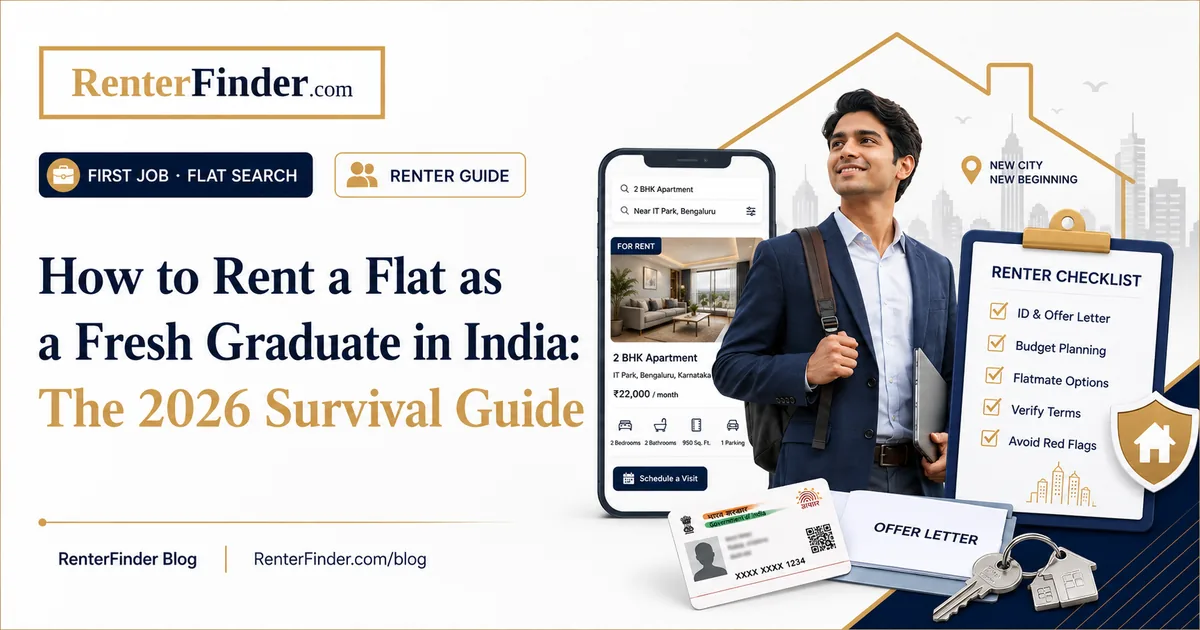
Every year, hundreds of thousands of fresh graduates move to a new city for their first job and face the same jarring discovery: renting a flat as a fresher is significantly harder than anyone warned them. The challenges stack up quickly. No salary slips yet. No rental history. A company name the landlord has never heard of. A background that reads "just moved here" in every possible way. And in many cities, the added friction of bachelor restrictions at the building or society level.
None of this is insurmountable. Landlords in metro cities - especially in IT corridors - have been renting to fresh graduates for decades. The question is how to present yourself in a way that answers a landlord's unstated concerns before they have a chance to raise them. That is what this guide covers.
Why renting as a fresh graduate in India is harder - and why it does not have to be
The difficulty is not primarily about money. Many fresh graduates earn salaries that are comfortably sufficient for rental budgets in good localities. The difficulty is about documentation and signalling. Landlords making a rental decision have no prior data on you. A salaried tenant of five years has a trail - salary slips, rental references, a credit history. A fresh graduate has none of that, and landlords know it.
Add to this a layer of cultural conservatism in many residential societies. Building rules in older housing societies in Chennai, Pune, Hyderabad, and parts of Delhi often explicitly restrict bachelor occupancy or require society committee approval for unmarried individuals. These rules are set by Resident Welfare Associations (RWAs) or housing society committees and are not illegal under any central law, though they sit in an uncomfortable legal grey zone when they discriminate on grounds beyond what the law permits.
Finally, fresh graduates often make predictable tactical mistakes - approaching landlords cold, underselling their employment, not preparing documents in advance, and assuming verbal assurances about deposit refunds will hold. Understanding where the friction points are is half the battle.
What documents a fresh graduate can actually produce
The good news is that most landlords do not have a rigid checklist. They want to feel confident you can pay rent and will not be a problem tenant. Documents help make that case. Here is what you can typically produce as a fresher, and what each document signals to a landlord.
- Appointment or offer letter (on company letterhead). This is your most powerful document before the first salary credit. It shows employer name, designation, and CTC. A landlord who cannot verify your company online can at least see a formal document. Carry a printed and digital copy.
- Employee ID card. A physical ID with your photograph and employer name is a quick, visible proof of employment that complements the offer letter.
- First salary bank credit. Once you have received even one salary credit, a bank statement showing that entry is strong proof. Email yourself a PDF from your banking app.
- Aadhaar card (masked). Share only the masked version - available via the UIDAI portal (uidai.gov.in) or the mAadhaar app. Never give your full Aadhaar to a landlord or broker unless absolutely required for police verification.
- Home address proof. This is typically your Aadhaar or a utility bill from your home city. Landlords use this to understand where you come from and to have an emergency contact address on record.
- Passport-size photographs. Two to four copies. These go on the rent agreement and in police verification forms.
- Parent or family member as guarantor (optional but helpful). A signed letter from a parent or guardian stating they will ensure rent obligations are met is a simple reassurance tool. Not all landlords ask for it, but offering it proactively removes an objection before it is raised.
For a complete breakdown of all documents by tenant type - salaried, self-employed, student - and what you should never share, see RenterFinder's guide to documents needed to rent a flat in India.
The bachelor restriction problem: how to handle it strategically
Bachelor restrictions are among the most frustrating experiences for fresh graduates moving to a new city. You find a flat you like, the rent fits, and then the landlord says "sorry, society does not allow bachelors." It feels arbitrary - and sometimes it is - but it is also a real operational reality in hundreds of residential societies across India.
Understanding where bachelor restrictions are common and where they are rare saves significant time in your search.
These are general patterns. Always confirm with each landlord before shortlisting a property.
Practical strategies that improve your chances in bachelor-friendly markets:
- Share with colleagues from the same company. Two people from the same employer signals stability and professional seriousness. Landlords in IT corridors have seen this combination work well hundreds of times.
- Offer an employer HR reference. A quick email from your company's HR department or even a manager's visiting card can resolve a landlord's uncertainty about whether you are actually employed.
- Avoid cold calling during your flat hunt. Approaching a landlord whose listing explicitly says "families only" and trying to negotiate is time-consuming and rarely successful. Use your search time on landlords who have already indicated openness to working professionals.
- Be clear about your occupancy from the start. State clearly how many people will live in the flat and what their employment is. Surprises after agreement signing create the worst kind of landlord friction.
The flat-sharing equation: does splitting rent actually make sense?
Most fresh graduates do not need to share a flat. They choose to - because sharing a 2BHK with a colleague means living in a locality and flat type they could not afford solo. This is a reasonable trade-off, but it is worth doing the maths clearly before committing.
Consider a flat in Bangalore's Koramangala or Chennai's Velachery. A 1BHK might rent for a certain amount per month, while a 2BHK in the same area might rent for significantly more. Two people splitting the 2BHK each pay less than the 1BHK price - and get more space, a larger kitchen, and often a better building. The flat-sharing model, when done right, is financially rational.
The legal part requires a little care. The rent agreement will name one person as the primary tenant and one as an additional occupant, or both as co-tenants. A few rules that protect everyone:
- List all occupants in the agreement by name. Even if only one person signs as the primary tenant, all co-occupants should be mentioned as permitted occupants. This protects both parties if a dispute arises about who was authorised to be in the flat.
- Clarify who is responsible for the deposit. Either both contribute and the agreement notes both names, or one person pays and has a side arrangement with the other. Whatever the arrangement, write it down - even a WhatsApp message stating "you paid X portion of the deposit" is useful evidence if you later disagree about refunds.
- Both occupants should complete police verification. In states that require tenant registration or police verification, all occupants should be registered - not just the primary tenant.
- Decide what happens if one person wants to leave mid-tenancy. The most common scenario: one flatmate gets transferred, gets married, or simply finds a better option. Agree in writing, before moving in, how you will handle this.
For more on how to handle leaving mid-tenancy or finding a replacement flatmate, see the first-time renter's guide to India for foundational tenancy advice.
Building a renter profile that landlords take seriously
The standard way of renting in India is reactive: a landlord lists a property, renters call or message, and the landlord chooses from the people who responded. For fresh graduates - with no track record and limited credentials - this model is unfair. You are competing against applicants who have salary slips, references, and sometimes even prior landlord recommendations.
The renter profile model flips this. Instead of reacting to listings, you create a structured profile describing what you are looking for - BHK size, preferred locality or localities, monthly budget, number of occupants, your employer and designation, and your move-in timeline. Landlords who are open to renting to someone like you can approach you directly, which means the first contact already comes with intent and openness.
For fresh graduates, the renter profile is particularly valuable because it lets you front-load the information a landlord would otherwise have to extract through a phone call. A landlord browsing a profile that says "Software Engineer at [Company Name], joining on June 1, looking for 2BHK in Whitefield to share with one colleague" already knows the most important things before picking up the phone. That saves both sides time and reduces early-stage rejection.
RenterFinder launched on April 24, 2026, with exactly this model - landlords browse the Prospective Renters' List and approach renters who match their property, rather than waiting for cold enquiries. See the fee structure for how the platform works once a match is made.
Red flags fresh graduates often miss (that experienced renters catch)
First-time renters are disproportionately affected by avoidable mistakes. Not because they are careless, but because nobody teaches this. Here are the most common traps and how to sidestep them.
- Paying a token amount or advance before seeing an agreement draft. A token payment is not a booking fee protected by any law. Once paid, recovering it if the deal does not go through is entirely dependent on the landlord's goodwill. Never pay anything before you have seen the property in person and reviewed at least the key terms of the proposed agreement.
- Accepting a rent that seems too good for the area. Unusually low rent in a prime area is the most reliable indicator of a fraudulent listing. The landlord may not own the property, may be subletting in violation of their own agreement, or the property may have structural or legal issues that are not visible at a quick viewing.
- Not verifying that the person showing the flat actually owns it. Ask for the property tax receipt or electricity bill in the owner's name. A landlord who becomes evasive when asked for basic ownership documents is a significant red flag. See our detailed guide on how to verify a landlord is the real property owner.
- Paying the deposit in cash with no receipt. Always transfer the security deposit to the landlord's bank account with a clear transaction description. A cash deposit with no written acknowledgement is almost impossible to prove in a dispute. Even a WhatsApp message from the landlord confirming the amount received is useful, but a bank transfer is better.
- Not reading the rent agreement before signing. This sounds obvious but happens constantly. Fresh graduates, eager to close the deal and move in quickly, sometimes sign agreements they have not fully read. The maintenance responsibility clause, the lock-in period, the painting and cleaning obligations at exit, and the notice period all need to be understood before you sign. Our guide on every rent agreement clause explained walks through each clause in plain language.
- Ignoring the security deposit cap. Under the Model Tenancy Act 2021, the security deposit for residential premises is capped at two months' rent in states that have adopted the MTA. In states with older rent control laws the cap may differ, but a deposit demand of more than two or three months' rent for a residential flat is worth questioning. Disclaimer: tenancy laws vary by state and change over time. For advice specific to your situation, consult a qualified advocate or your state's official legal resources.
The bottom line for fresh graduates renting in 2026
Your first flat in a new city is a practical problem, not an emotional one. Treat it that way. Prepare your documents before you need them. Research the localities suited to your commute and budget before you start calling landlords. Understand the bachelor restriction landscape in your target city so you spend time on leads that can actually close. And know your rights on deposit limits and deductions so you are not caught off-guard at move-out.
The biggest shift fresh graduates can make is from reactive to proactive. Instead of scrolling listings and cold-calling landlords, consider building a renter profile that describes you clearly - your employer, designation, budget, BHK requirement, and preferred localities. Landlords who are open to renting to someone like you will come to you, rather than you having to qualify yourself afresh with every cold call.
Your first flat is not forever. It is a base from which to learn how the rental market works, build a tenancy reference, and establish yourself. The experience you gain in this first tenancy - negotiating terms, maintaining good documentation, keeping the landlord relationship straightforward - will serve you in every subsequent rental. Start with the basics done right, and the rest follows.
If you are looking for a broker-free way to search, see our guide to renting a flat in India without a broker, and use RenterFinder's Prospective Renters' List to list your profile so landlords can approach you directly. The FAQ covers how the platform works if you have questions before registering.
Related Articles
- Documents You Need to Rent a Flat in India: Complete 2026 Checklist - Full checklist for salaried, self-employed, and student renters
- How to Rent a Flat in India Without a Broker - Step-by-step guide to bypassing brokers
- Security Deposit Rules in India: A Renter's 2026 Guide - What is legal and what is not
Tell landlords what you are looking for - BHK, locality, budget, family size, move-in date. Landlords on RenterFinder browse renter profiles and approach you directly. No broker, no cold calls.