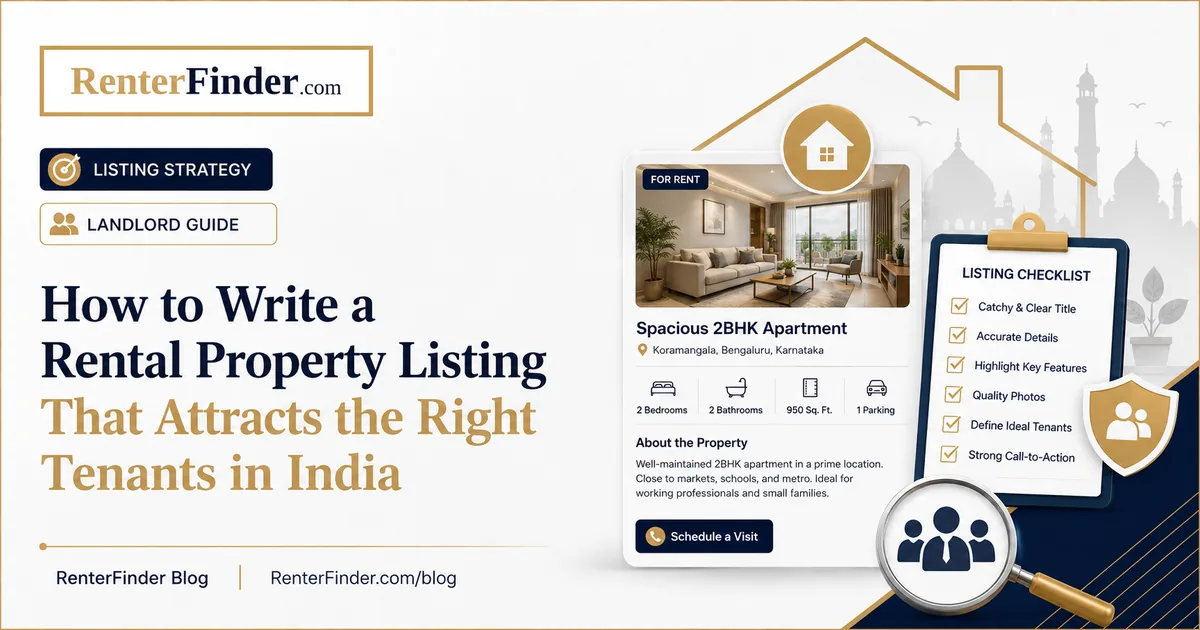
Most rental property listings in India look something like this: "2BHK, 2nd floor, 30k, call owner." The result is a flood of enquiries from people who are too far away, out of budget, want a different furnishing level, or are simply not ready to move for another two months. The landlord fields twenty calls to find two serious candidates. This is not how a well-written listing should work.
A listing is not an advertisement. Its job is not to attract everyone - it is to attract the right person and quietly turn away everyone else, before the first phone call is made. The landlords who rent quickly and well are almost always the ones who spend 30 minutes on an honest, detailed listing rather than a quick classified-style post. This guide walks through exactly what that looks like.
With rents in most Indian cities rising steadily in 2026 and tenant competition for good flats increasing, a landlord with a clear, complete listing has a significant advantage over one who simply posts a one-liner and waits. Here is how to write one that works.
Why Most Rental Listings Attract the Wrong Enquiries
The problem is two-sided. A sparse listing attracts everyone, because no one can filter themselves out. "2BHK, furnished, central location" leaves everything open: the bachelor who hates the no-smoking rule you forgot to mention, the family of five who cannot fit into an 850 sq ft flat, the remote worker who needs dedicated parking but there is none, the person whose budget is ₹22,000 but your expectation is ₹28,000 once maintenance is added.
The flip side is also true: listings written in broker-style jargon - "prime location, vastu compliant, best deal" - carry no actual information and generate bulk enquiries with no intent. The caller has not pre-screened themselves at all; they are simply responding to a signal of availability.
A good listing does two things simultaneously: it tells the right tenant "this is exactly for you" and it tells the wrong tenant "this is clearly not for you." Both outcomes save everyone time. The landlord who achieves this with a listing spends one hour writing it and then fields five serious enquiries. The landlord who writes a one-liner spends three weeks on the phone with twenty people who are not going to sign.
The Eight Details Every Rental Listing Must Include
Before writing a single sentence of description, collect these facts. Missing any one will generate the exact kind of back-and-forth a good listing is supposed to eliminate:
- BHK and carpet area - not built-up area. Tenants need to know whether their furniture fits. A 1000 sq ft built-up flat may have only 780 sq ft of usable space.
- Floor number and whether there is a lift - a 4th floor without a lift is a dealbreaker for many families, older tenants, and anyone moving furniture. State it plainly.
- Exact locality and nearest landmark - not just the city or broad area. "Near Koramangala 5th Block" or "10 minutes from Hinjewadi Phase 1 gate" is genuinely useful. "Bangalore" is not.
- Monthly rent and what it excludes - if maintenance, parking, power backup, or water charges are separate, say so and give the approximate figures. A listing showing ₹22,000 that actually costs ₹27,500 once extras are added is a waste of everyone's time.
- Security deposit amount - in absolute figure or months of rent. The Model Tenancy Act 2021 recommends capping residential deposits at two months' rent, but practice varies widely by city and agreement.
- Furnishing level with specifics - "fully furnished" means different things to different landlords. List what is actually there: AC, washing machine, refrigerator, bed, wardrobe, geyser. See our guide on what fully furnished actually includes in India for the standard that serious tenants expect.
- Tenant type preference - if you prefer a working couple or a nuclear family, say so. If you accept bachelors, say that. If pets are allowed or the society has restrictions, state them upfront. Silence on this point leads to conversations that end awkwardly after significant time has been invested.
- Lock-in period and notice period - a surprising number of wrong-fit enquiries happen because these were not mentioned and the tenant's timeline does not match.
How to Describe Your Property Honestly - and Why It Matters
Overpromising in a listing is the fastest way to waste a site visit - for both parties. If the kitchen is compact, say it is compact. If the building is older but well-maintained, say that. If the view from the balcony is of a neighbouring wall, the tenant will see it on arrival. Discovering a mismatch in person is far more expensive than filtering it out in the listing text.
Three things in particular deserve honest language:
- Age and maintenance state of the property - "1998 construction, well-maintained, new electrical wiring" is far more useful than "old building." Tenants who prefer newer buildings self-select out; tenants who value a maintained older flat at a better rent are your actual audience.
- Commute from the flat - give an approximate drive or walk time to the nearest metro station, IT park, or business district. This is one of the top reasons tenants choose a flat, and vague language like "close to everything" triggers scepticism, not interest.
- Society rules and restrictions - vegetarian-only policy, no pets, no guests after a certain hour, no vehicles of a specific type, visitor registration required. These are not negotiable, they belong in the listing, and stating them upfront saves everyone an uncomfortable conversation later.
A listing is a matching document, not a sales pitch. The more accurate it is, the fewer calls you field from people who would say no the moment they saw the flat.
Writing for the Tenant You Actually Want
Before writing the listing, ask yourself one question: who is my ideal tenant? A young professional who travels frequently and needs someone low-maintenance? A family with school-age children who is likely to stay for three or more years? A working couple who will keep the flat in good condition and pay rent without reminders? The answer shapes every word in the listing.
Once you have that picture, write the listing as if speaking directly to that person. Use details that signal relevance to them specifically. "Metro line is a 12-minute walk" speaks to the working professional who does not own a car. "The society has a park and a primary school within 300 metres" speaks to the family with young children. "The lane is quiet and away from main road traffic" speaks to the person who works from home. You do not need to write different listings for each type - you simply need to include the details that each type would search for.
On RenterFinder's Prospective Renters' List, landlords can take this one step further. Instead of writing a listing and waiting for enquiries, landlords can browse actual renter profiles - each showing BHK preference, budget range, preferred locality, family size, occupation, and move-in timeline. You can initiate contact with renters who already match your flat on paper, before either party has said a word. This flips the usual model entirely and eliminates the guesswork of writing for an unknown audience.
Photos: The Element Most Landlords Underestimate
In most Indian rental markets, a listing without photos is skipped by serious tenants - particularly those relocating from another city who cannot visit immediately. And yet a large proportion of landlord listings on the usual portals either have no photos at all, or have two dark, blurry images taken at floor level with a shoe in frame.
A useful photo set for a rental listing needs at minimum:
- Living room from two angles, including the window to show natural light
- Kitchen with visible countertop, storage, and any appliances provided
- Each bedroom, with the door open and the bed visible
- At least one bathroom, showing the geyser and basic fittings
- Building entrance and corridor or staircase
- Any amenity that is a selling point: lift, covered parking, terrace, gym, children's play area
Shoot in the morning when natural light is strongest. Remove personal items and clutter from the frame - you want the tenant imagining their own belongings in the space. A clear, well-lit phone photograph in good light consistently outperforms a dark DSLR shot.
If the flat is furnished, photograph what is provided. A visible washing machine, refrigerator, and air conditioning unit in the listing saves five repetitive questions in every enquiry conversation. Tenants viewing a furnished flat from another city rely almost entirely on photos to assess whether the furnishing level justifies the rent - give them enough to decide before they call.
Pricing Transparency: Why Hiding Costs Backfires
A listing that shows ₹28,000 but actually means ₹28,000 rent plus ₹4,000 maintenance plus ₹1,500 parking plus ₹600 power backup is not a ₹28,000 flat. The tenant who budgeted ₹30,000 all-in will be surprised, frustrated, and will walk away having wasted both your afternoons. The tenant who can afford ₹34,000 total would have come regardless - but only if the listing had stated the real number upfront.
State all monthly outflows clearly. If maintenance is charged by the society at a fixed rate, give that figure. If parking is a separate slot with a separate charge, say so. If power backup has a unit rate, mention it. Tenants who can afford the true total will respond. Tenants who cannot will self-select out. This is a feature of a transparent listing, not a problem.
The same principle applies to the security deposit. Putting the deposit upfront in the listing builds trust before the first conversation. The Model Tenancy Act 2021 recommends capping residential deposits at two months' rent, though state practice varies. Whatever your figure, state it clearly - tenants who consider it reasonable will proceed; those who consider it too high will not, and that is fine.
Transparent pricing also removes the need for the uncomfortable "sir can you do less?" negotiation that follows a misleading listing. When the numbers are clear from the start, the conversation is about the flat, not about peeling back hidden costs layer by layer.
What to Include in Your First Response to an Enquiry
A well-written listing generates good enquiries, but your first response keeps them alive or kills them. A one-word "call me" reply to a detailed, thoughtful enquiry often loses the tenant - especially a professional with multiple options who is evaluating several flats at once.
A useful first response to a rental enquiry should cover:
- Confirmation that the key details the person asked about are accurate - availability date, deposit, furnishing
- Two specific time slots for a site visit, rather than "anytime works"
- One question back: when are you looking to move in? This gently filters out people who are browsing six months in advance
On RenterFinder, the first contact happens through AI and human moderated chat inside the platform. Neither party exchanges phone numbers until both have shown genuine intent. This eliminates cold calls, spam enquiries, and tenants who ghost after a site visit. The platform's moderation layer means your first real conversation is with someone who has already read your listing details and is seriously considering the flat - not someone who called from a "To Let" board at random.
For landlords who want to understand how to evaluate a tenant once enquiries start coming in, the guide on how to find a good tenant without a broker covers the screening conversation in detail, including the ten questions worth asking before arranging a site visit.
A Listing is a Filter, Not an Advertisement
A well-written rental listing is not trying to maximise the number of calls it receives. It is trying to maximise the quality of the calls - which means actively filtering out the wrong tenant before anyone picks up the phone. The landlord who achieves this with a listing spends one hour writing it once and saves hours of wrong-fit conversations across the weeks that follow.
The eight details listed in this guide, combined with honest property description, clear photos, and transparent pricing, cover the vast majority of filtering work that a listing can do. Beyond that, the first response to an enquiry continues the process - one good question about move-in timing reveals whether the conversation is worth continuing.
If you prefer a different approach altogether, RenterFinder's Prospective Renters' List lets landlords browse renter profiles and approach the ones who already match on paper - no listing required, no waiting for inbound enquiries. For more on the fee structure, see our fees page.
For landlords looking at the furnished versus unfurnished question before listing, our guide on furnished vs unfurnished rental strategy in India walks through the trade-offs and the tenant profiles each approach attracts.
Related Articles
- How to Find a Good Tenant Without a Broker - Screening conversations and the 10 questions to ask
- Furnished vs Unfurnished: A Landlord's 2026 Guide - Choosing the right strategy for your property
- Documents Tenants Need to Rent a Flat in India - Know what to ask for before signing
Instead of writing a listing and waiting, browse active renter profiles - BHK, budget, locality, family size - and reach out to the right match directly.