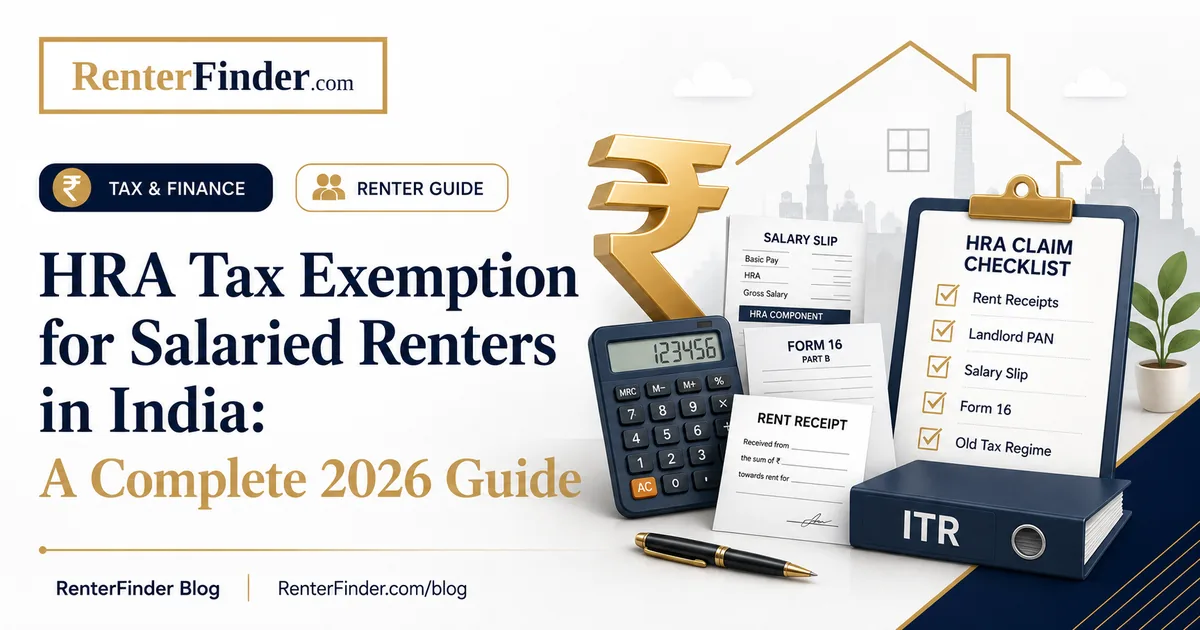
Every year, a large number of salaried employees in India pay rent, receive House Rent Allowance (HRA) as part of their salary package, and then fail to claim the full tax exemption they are legally entitled to. The reasons vary: some forget to submit rent receipts to their employer on time, some are unaware of the formula, and some assume the employer's Form 16 has already handled everything. With the Income Tax Return filing deadline for individuals in FY 2025-26 approaching on July 31, 2026, now is the right time to understand exactly what HRA exemption means, how to calculate it, and what to do if you have missed the employer window.
This guide covers the essentials for salaried renters under the old tax regime. If you have opted for the new tax regime, HRA exemption does not apply to you - the new regime does not allow most individual exemptions and deductions. Check your ITR filing software or a qualified CA to confirm which regime is beneficial for your specific income profile.
What is HRA and who is eligible for the exemption?
House Rent Allowance is a component of the salary package that many employers in India provide to help employees meet rental costs. It appears as a line item in your salary slip alongside Basic Pay, DA (Dearness Allowance), and other allowances. Not all salary structures include HRA - some employers bundle it into a consolidated package or offer flexible benefit plans that may not separately label HRA. If your salary slip does not show an HRA line, check with your HR team or refer to your appointment letter.
To claim the HRA exemption under Section 10(13A) of the Income Tax Act, you must satisfy three conditions: you must actually receive HRA from your employer, you must actually pay rent for a residential property, and you must not own the property you are living in in the same city. If you pay rent but do not receive HRA, a separate deduction route called Section 80GG exists - covered later in this guide.
Central and state government employees who receive HRA under government pay scales follow the same exemption rules. The exemption applies only under the old tax regime. If you have opted for the new regime in your ITR for FY 2025-26, you cannot claim this exemption.
How the HRA exemption formula works
The amount of HRA that is exempt from tax is the lowest of three calculated figures. The tax department does not allow you to pick the most favourable number - the minimum wins. Here are the three figures to compute:
- Actual HRA received from employer - the total HRA amount shown in your salary slip for the year.
- Actual rent paid minus 10% of (Basic Salary + DA) - calculated on an annual basis. If you pay rent of, say, ₹18,000 per month (₹2,16,000 per year) and your Basic + DA is ₹5,00,000 per year, this figure is ₹2,16,000 minus ₹50,000 = ₹1,66,000.
- 50% of (Basic Salary + DA) if you live in a metro city; 40% if you live in a non-metro city. The metro cities recognised for this purpose are Delhi, Mumbai, Kolkata, and Chennai. All other cities - including Bengaluru, Hyderabad, Pune, Ahmedabad, and every other large city - are treated as non-metro for this calculation.
The exempt amount is the smallest of these three. The remaining HRA (the portion not exempt) is added to your taxable income and taxed at your applicable slab rate.
These are illustrative figures. Your actual numbers depend on your salary structure, the city you rent in, and the rent you pay. For the authoritative calculation rules, refer to the Income Tax Department portal or your employer's payroll team.
Documents you need to claim HRA exemption
You do not attach rent receipts to your ITR when filing online. However, you must keep them available in case the Income Tax Department asks for them during scrutiny. The practical question is what your employer requires before computing your TDS. Here is what is typically needed:
- Rent receipts. A signed receipt from the landlord for each month of rent paid. The receipt should mention your name, the landlord's name, the property address, the rental period, and the amount. A revenue stamp is no longer legally mandatory, but many employers still require it for amounts above ₹5,000 per month - check your payroll policy.
- Rent agreement or lease deed. A copy of the rent agreement showing the property, parties, rent amount, and duration. This is strong corroborating evidence and is often requested by employers even when receipts alone may suffice.
- Landlord's PAN. Mandatory if your total annual rent paid to a single landlord exceeds ₹1,00,000. You must provide this to your employer. If the landlord refuses to share their PAN, you must still declare this fact to your employer - the Income Tax rules require it. For the latest guidance, refer to the Income Tax Department portal.
- Bank transfer records. While not a statutory requirement in themselves, bank statements or UPI/NEFT records showing regular rent transfers strongly support your claim and are the best protection against scrutiny. Cash payments are harder to prove.
If your landlord is unwilling to provide a PAN or refuses to sign receipts, document this in writing (a message thread is sufficient evidence under the Bharatiya Sakshya Adhiniyam 2023). Your entitlement to claim does not disappear because the landlord is uncooperative, but the burden of proof shifts to you. In practical terms, always pay rent by bank transfer and always use a written rent agreement - these two habits resolve most documentation problems before they arise.
What to do if your employer did not account for HRA in Form 16
Many renters submit rent receipts to their employer's HR or payroll team late in the financial year, or forget entirely. In some cases, an employer may not process the declaration at all. If your Form 16 does not reflect the HRA exemption, you are not out of options.
When filing your ITR, you can compute the exempt HRA using the formula above and declare it yourself. In the ITR forms (ITR-1 for most salaried employees), there is a section for salary income where you enter the gross salary and then the exemptions under Section 10. You enter the exempt HRA amount under Section 10(13A). The net taxable salary is then the gross figure minus the HRA exemption and any other applicable exemptions.
This means you may be entitled to a tax refund if your employer deducted more TDS than was actually owed. The refund is claimed in the same ITR filing and is processed by the Income Tax Department after assessment.
Paying rent to a family member: what the tax department says
One arrangement that some salaried employees use is paying rent to a parent, sibling, or other relative who owns the property they live in. The Income Tax Department does not prohibit this, but it scrutinises such arrangements carefully. To make the claim stand up, several conditions should be met simultaneously:
- The family member must be the legal owner of the property. The title deed or sale deed should be in their name.
- There must be a written rent agreement between you and the family member, signed by both parties.
- Rent must be paid by bank transfer - not in cash - on a regular monthly basis.
- The family member must declare this rental income in their own Income Tax Return. It is taxed under "Income from House Property" in their hands, after the standard 30% deduction that the law allows on rental income.
Paying rent to a spouse is generally not accepted by the Income Tax Department, as the benefit is considered to flow back to the same household. The department may disallow the exemption if the arrangement appears artificial. Consult a CA if your situation involves rent paid within the family, as the evidence requirements are stricter than for third-party landlord arrangements. Refer to incometaxindia.gov.in for the current position on family rent arrangements.
Section 80GG: if you pay rent but your salary has no HRA component
Not every salaried employee has HRA in their salary. Some employers structure packages without a named HRA component - particularly smaller companies, startups, or those offering fully consolidated gross salaries. Self-employed individuals and freelancers also do not receive HRA. For all these people, Section 80GG of the Income Tax Act provides an alternative route to claim a deduction for rent paid.
To claim Section 80GG, you must meet several conditions: you must not be receiving HRA from any employer, you must not own a residential house in the city where you live and work (or the city where your spouse or minor child owns a house), and you must file Form 10BA with your ITR declaring that you satisfy these conditions.
The deduction under 80GG is the lowest of three figures:
- ₹5,000 per month (₹60,000 per year)
- 25% of total adjusted income
- Actual rent paid minus 10% of total adjusted income
Section 80GG deductions are significantly smaller than what HRA exemptions typically yield for salaried employees in metro cities, but they are worth claiming if you qualify. Download Form 10BA from incometaxindia.gov.in and attach it to your ITR filing.
How your rent agreement protects your HRA claim
A well-drafted rent agreement is not just a housing document - it is direct evidence of the rental relationship that underlies your HRA claim. When the Income Tax Department reviews your ITR, the rent agreement establishes: the identity of the landlord (whose PAN you have provided), the property address, the rental period, and the monthly rent amount. It corroborates every line in your rent receipts and bank statement.
Many renters in India operate without a proper rent agreement - particularly those who found their flat through informal channels or brokers who skipped the paperwork. If your rent is above ₹8,333 per month (₹1 lakh per year), and you do not have a written agreement or the landlord's PAN, your HRA claim is technically at risk during scrutiny even if you have receipts.
Finding a landlord through a platform that uses AI and human moderated chat - like RenterFinder's Prospective Renters' List - typically produces cleaner documentation. When both parties communicate through an accountable channel, the probability of getting a proper written agreement and PAN is higher than with informal broker referrals. For more on what rent agreements should say, see our Rent Agreement Clauses guide.
A practical ITR season checklist for renters
The ITR filing deadline for individuals for FY 2025-26 is July 31, 2026. With roughly two and a half months remaining, now is the time to get organised. Here is a quick checklist:
- Locate rent receipts for April 2025 through March 2026 (or whichever months you rented during FY 2025-26).
- Confirm you have the landlord's PAN if total annual rent paid exceeds ₹1,00,000.
- Pull your rent agreement and confirm the monthly rent figure matches your receipts and bank transfers.
- Calculate the three-way HRA formula using your salary slip data (Basic + DA, HRA received, actual rent paid).
- Check Form 16 (issued by your employer) to see whether HRA exemption was already accounted for.
- If not, compute the exempt amount and enter it manually in your ITR under Section 10(13A).
- If you have no HRA in your salary, check whether Section 80GG applies and file Form 10BA.
- Confirm you have opted for the old tax regime in your ITR - HRA exemption applies only under the old regime.
For the most current ITR form instructions, HRA calculation guidance, and Form 10BA download, refer to the Income Tax Department's official portal. This guide is informational only and does not constitute tax advice. Consult a qualified CA for your specific situation.
Related Articles
- Rent Agreement Clauses Explained - What your agreement should include to protect your HRA claim
- Documents Needed to Rent a Flat in India - Full checklist including what to share and what to never share
- Security Deposit Rules in India - Know the legal limits and protect your deposit
On RenterFinder, you can list your renter profile and get matched with landlords directly - no broker, which means a proper rent agreement and documentation from day one. Build your HRA claim on a solid paper trail from the start.