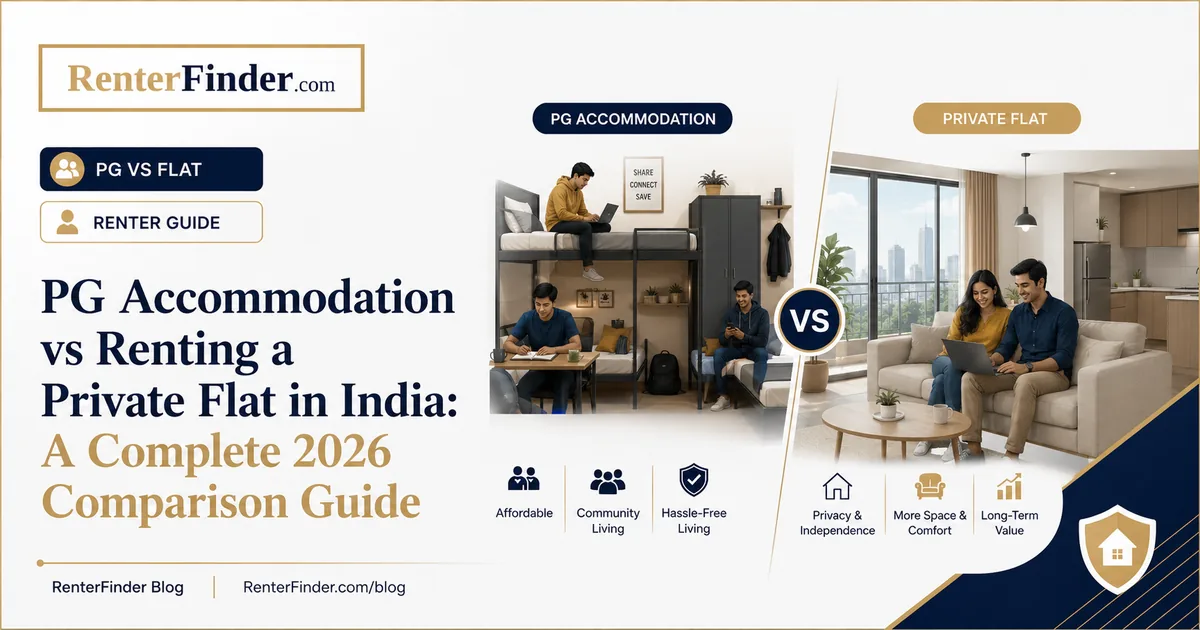
Every year, tens of thousands of young Indians relocate to a new city for a first job, a transfer, or a college programme and face the same immediate question: PG or flat? In 2026, with urban rents rising across most major cities, the cost calculation matters more than it did a few years ago. Add lifestyle preferences, legal protections, and the reality of what each option actually delivers on the ground, and the answer is rarely simple.
This guide breaks both options down honestly: what a PG actually includes (and what it quietly restricts), what a private flat genuinely costs when you add up all the bills, the lifestyle trade-offs, and a decision framework to help you choose based on your specific situation. If you are already in a PG and thinking about moving to a flat, there is a section on how to find one without going through a broker.
What PG Accommodation Actually Includes in 2026
A paying guest arrangement covers renting a room in a house or managed facility, where some services come bundled with the monthly charge. What those services are varies significantly depending on the type of PG you are looking at.
In a typical managed PG facility, you usually get:
- A furnished room, often shared with one to three others (single rooms exist but cost noticeably more)
- Two or three meals per day, typically Indian vegetarian
- Basic housekeeping and periodic linen change
- Wi-Fi included in the monthly charge
- Electricity up to a fixed unit limit (overage is often charged extra)
What is commonly restricted or not included:
- Guests: overnight guests are rarely permitted; many PGs restrict visitors past a certain hour
- Kitchen access: most managed PGs do not provide kitchen access - you eat what is served
- Diet: non-vegetarian cooking is restricted or banned in a large number of PG facilities
- Pets: not permitted in the vast majority of PGs
- Hours: late-return curfews are still common in cities like Jaipur, Lucknow, and many localities in Pune
- Air conditioning: available only in premium PGs, or charged separately as a monthly add-on
The advertised monthly figure for a PG is not always the final number. Electricity over a fixed limit, water heater use during winter, and AC during summer are frequently metered or charged extra. Always ask for the itemised cost including all add-ons before committing.
The True Monthly Cost of a Private Rental Flat in 2026
Renting a private flat gives you independent use of an entire apartment. The cost structure is different from a PG, but the gap is often smaller than it looks once you account for what a PG charges separately.
Typical monthly costs for a private flat:
- Rent - the headline figure on the listing
- Society maintenance - typically separate, ranging from a few hundred to a few thousand rupees depending on building tier
- Electricity - billed monthly by the local discom based on actual consumption
- Internet - a separate broadband plan (typically ₹500-900 per month for decent speeds)
- Cooking and groceries - significant if you were previously eating PG meals, though you control the quality and diet
- Furnishing - a one-time investment if the flat is unfurnished
The deposit is a separate upfront cost. Under the Model Tenancy Act 2021, the security deposit is capped at two months' rent for residential tenancies. In practice, many landlords still ask for more, particularly in cities that have not formally adopted the MTA 2021. Two months' rent is the legal baseline to negotiate from. See the full text at the Ministry of Housing's Model Tenancy Act 2021.
The critical comparison: add up your PG monthly charge plus whatever you spend on outside food (since most PGs only cover two meals, and dinner quality is often limited), transport from the PG to your office, and any extras like laundry. Compare that against a shared flat's per-person rent plus groceries. For many young professionals, the private flat comes within ₹2,000-4,000 per month of the PG once food costs are properly counted - and the lifestyle difference is significant.
Lifestyle Trade-offs: Privacy, Freedom, and Restrictions
Beyond the numbers, PG and private flat deliver very different day-to-day experiences. Neither is uniformly better - it depends on your priorities.
PG advantages: Ready community, no cooking burden, zero setup cost, easy monthly exit. Works especially well for someone new to a city who values social connections over independence, or anyone on a very short-term assignment under three months.
PG disadvantages: Curfew restrictions cause real friction for professionals who work evening shifts or go out socially. Non-vegetarians will find food options limited. Pet owners have almost no PG options. Work-from-home setups in a shared room with strangers are rarely ideal. And frequent roommate changes in managed PG facilities can disrupt sleep and routine in ways that affect work quality.
Private flat advantages: Complete control over your schedule, diet, guests, and environment. Genuinely quiet for remote work. Long-term rent stability (an 11-month agreement fixes your cost for that period). The lifestyle freedom compounds over time - you eat what you want, keep your own hours, and build your space the way you prefer.
Private flat disadvantages: Setting up an unfurnished flat costs time and money. If you are new to the city and do not yet know anyone, the initial period can feel isolating. Managing your own bills, maintenance requests, and landlord communication takes some effort that PG life does not require.
Flat-Sharing: The Affordable Middle Path
Most of the cost disadvantage of a private flat disappears when you share it with two or three people. Splitting a 2BHK or 3BHK between friends or colleagues can bring the per-person monthly cost close to or below PG rates while preserving the full lifestyle freedom of a private flat.
What flat-sharing gives you over a PG:
- Lower per-head rent than a solo flat, often competitive with a PG
- Shared electricity, internet, and grocery bills
- No curfew, no food restrictions, guests by mutual agreement rather than management rules
- A proper tenancy agreement that gives all co-tenants legal standing
The main requirement flat-sharing adds is compatibility. Financial reliability, cleanliness standards, and lifestyle alignment (sleep hours, noise levels, hosting frequency) matter more when you share a kitchen and bathrooms. For fresh graduates renting their first flat, a full guide covering documents and the process is available at How to Rent a Flat as a Fresh Graduate in India.
If you are flat-sharing, ensure all co-tenants are named in the rent agreement or are at least acknowledged by the landlord in writing. This protects each person's deposit rights. For what to do if a flatmate wants to leave before the lease ends, see What to Do When Your Roommate Wants to Leave Mid-Lease in India.
Who Should Choose PG and Who Should Choose a Private Flat
The decision is not one-size-fits-all. Here is a practical framework:
| Your Situation | Better Choice |
|---|---|
| First month in a new city, know nobody | PG |
| Staying less than 3 months | PG |
| Working night shifts or irregular hours | Private flat |
| Non-vegetarian diet or strong food preferences | Private flat |
| Pet owner | Private flat (with a pet-friendly landlord) |
| Work-from-home or frequent calls all day | Private flat |
| Staying 6+ months with stable income | Private flat |
| 2-4 friends or colleagues relocating together | Shared private flat |
| Family unit (couple or with children) | Private flat |
A useful rule of thumb: use a PG as a transition arrangement - a place to land while you explore the city, find your preferred locality, and build some savings for a flat deposit. Once you have settled and your income is stable, the private flat almost always delivers better long-term value and lifestyle quality.
Legal Protections: Does the Model Tenancy Act Apply to PG Residents?
This is a question many renters overlook. The Model Tenancy Act 2021 applies to premises let out under a formal tenancy or lease agreement. Whether a PG arrangement falls under MTA 2021 protection depends on how the arrangement is structured.
Most managed PG facilities structure their arrangements as licences rather than tenancies - meaning the tenant occupies the premises with the owner's permission, but without the legal protections a formal tenancy agreement would carry. In these cases, the MTA 2021's two-month deposit cap, the 24-hour landlord entry rule, and the Rent Authority dispute process may not automatically apply.
Practical implications for PG residents:
- There is no guaranteed legal cap on your PG deposit amount unless your state's specific consumer or rental protection rules apply
- Without a written agreement, you have almost no legal recourse if your deposit is not returned
- Always ask for a written agreement, even at a PG, and get a signed receipt for any deposit paid
- Pay deposits by bank transfer - this creates a traceable record under the Bharatiya Sakshya Adhiniyam 2023
For the full text of the Model Tenancy Act 2021, refer to the Ministry of Housing and Urban Affairs official publication. Rules vary by state and your specific arrangement. For legal disputes, consult a local advocate.
Disclaimer: This guide provides general awareness only and is not legal advice. State rules and individual arrangements vary. Consult a qualified advocate for your specific situation.
Moving from PG to a Private Flat: How to Find One Without a Broker
When you are ready to move from a PG to a private flat, the most common trap is paying a broker a substantial fee for an introduction you could have found directly. In many cities, broker commissions for renter-side facilitation range from 15 to 30 days' rent - a significant sum when you are also paying a two-month security deposit.
RenterFinder works differently. Instead of searching through listings and calling through brokers, you build a renter profile describing your BHK requirement, preferred locality, monthly budget, family size, and move-in timeline. Landlords browsing the Prospective Renters' List can then approach you directly. Chat is AI and human moderated, so your contact details remain private until both sides are genuinely interested in proceeding.
The fee structure is transparent: ₹125 listing fee for three months of visibility. A Platform Service Fee applies only after a deal closes, paid in two stages (an advance after you agree to meet, a closing payment at deal closure). No broker commission. No upfront cost to register and be visible to landlords.
For the documents you will need when renting your first flat, see Documents You Need to Rent a Flat in India. For a step-by-step broker-free process, see How to Rent a Flat in India Without a Broker.
The PG-to-flat transition is a milestone most young urban Indians make within the first year of working life. When you make it, going direct saves you a meaningful amount of money and gives you a cleaner relationship with your new landlord from day one.
Related Articles
- How to Rent a Flat as a Fresh Graduate in India - Documents, bachelor restrictions, and red flags
- Documents You Need to Rent a Flat in India - Complete 2026 checklist
- How to Rent a Flat in India Without a Broker - Step-by-step broker-free process
Build your renter profile and let landlords come to you - no broker, no commission, transparent fees.