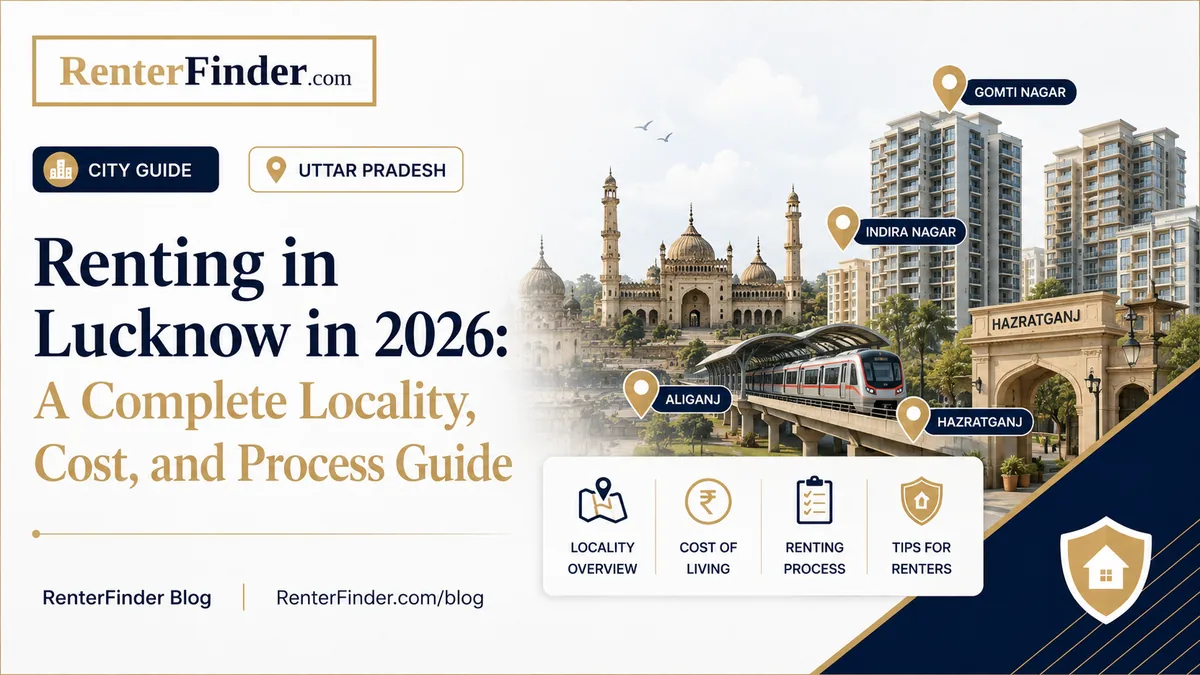
Lucknow does not get the same attention as Bangalore or Delhi NCR in rental conversations, but anyone who has spent time in the city recently will tell you something has shifted. The Lucknow Metro's growing network has made commuting from formerly overlooked localities genuinely practical. New IT parks in Chinhat, Gomti Nagar Extension, and along the Sultanpur Road have drawn a wave of working professionals who need quality rentals. Government-sector expansion - Lucknow remains one of India's largest centres for administrative and public-sector employment - keeps demand stable across multiple neighbourhoods.
If you are planning to rent in Lucknow in 2026, whether you are relocating for work, a student seeking a flat near an educational institution, or a family moving from a smaller UP city, this guide covers everything you need: the right locality for your situation, what to expect on costs, how agreements and deposits work under UP law, what restrictions you may face in some societies, and how to find a flat without paying a broker.
Why Lucknow Is on the Rental Radar in 2026
Lucknow has long been associated with government jobs - the secretariat, Vidhan Sabha, courts, defence establishments, and public sector undertakings create a consistent base of demand that most IT-driven cities do not have. What has changed in recent years is the addition of private-sector employment, particularly in IT and business process management. Areas like Gomti Nagar Extension and Vibhuti Khand host offices of several large companies, and Chinhat on the eastern side of the city has grown as an industrial and logistics hub.
The Lucknow Metro - operational on two corridors as of 2026 - has meaningfully improved connectivity between previously disconnected parts of the city. The North-South corridor (Munshipulia to CCS Airport) and the East-West corridor (Charbagh to Vasant Kunj) allow renters to live further from the city centre and still reach workplaces in reasonable time. This has made Alambagh, Mahanagar, and Aliganj more attractive for people who previously felt they had to pay premium prices to be in Gomti Nagar.
Several large educational institutions - Lucknow University, KGMU, SGPGI, IIM Lucknow (on the outskirts), BBAU - each generate their own rental demand in adjacent localities. Student renters in these areas typically look for furnished or semi-furnished 1BHK flats or shared accommodation, and this creates a separate micro-market alongside the family and professional renter segments.
Locality-by-Locality Guide for Renters
Lucknow's rental market is not as neatly zoned as a city like Bangalore, where tech corridors and residential clusters are distinct. Here is how the main neighbourhoods break down:
Premium - Gomti Nagar and Gomti Nagar Extension
Gomti Nagar is Lucknow's most well-developed residential and commercial zone, with wide roads, modern apartment complexes, malls, hospitals, and proximity to major government offices. Gomti Nagar Extension has newer, larger apartment societies with amenities like gyms, clubhouses, and 24-hour security. These are the go-to areas for senior government officials, corporate professionals, and families who prioritise infrastructure. Rent is on the higher side and availability for quality 2BHK and 3BHK flats is competitive. Hazratganj, the historic commercial heart of the city, borders Gomti Nagar and is convenient but has limited residential stock.
Mid-range - Indira Nagar, Aliganj, and Mahanagar
Indira Nagar is one of Lucknow's most popular rental localities for working professionals and families - well-connected by road, reasonably close to both the metro and the commercial areas near Vikas Nagar and Shaheed Path. The housing stock is a mix of builder floors, independent houses, and older apartment buildings. Aliganj, to the north, is an established residential area known for its spacious layouts, prominent schools, and relative greenness compared to central Lucknow. Mahanagar has a well-serviced residential feel and is particularly popular for families because of nearby schools and the proximity to Hazratganj via a short auto or cab ride.
Budget-friendly - Alambagh, Rajajipuram, and Chinhat
Alambagh is one of the most accessible and affordable rental areas in Lucknow, immediately adjacent to Charbagh railway station. It suits renters who commute frequently by train or need easy access to the bus terminus. Rajajipuram, to the west, is a large mixed neighbourhood with both government housing colonies and private builder floors - costs are lower and space is often more generous. Chinhat, on the eastern fringe, is growing fast due to the industrial and IT presence, and is a reasonable option for renters working in that corridor, though amenities are thinner than in the west.
For students and hospital workers - Vibhuti Khand and Kapoorthala
Renters connected to KGMU, SGPGI, or the medical hub on the eastern side of Gomti Nagar tend to look in Vibhuti Khand, Kapoorthala, and parts of Gomti Nagar near those institutions. Furnished and semi-furnished 1BHK flats and shared rooms are more common here than in other parts of the city. Availability tends to peak just before the academic year begins in July-August, so searching earlier gives you better choice.
Typical Rent Ranges in Lucknow in 2026
Rent in Lucknow is significantly more affordable than in India's top five metro cities, but prices vary meaningfully across localities and property types. Any figures given here are general indicators - always check current listings for your specific requirements, as rents shift with supply, season, and landlord expectations.
Furnished flats typically command 15 to 30 percent more than unfurnished equivalents, depending on the quality and completeness of furnishing. Gated-society apartments in Gomti Nagar Extension and Sushant Golf City sit at the upper end of the range - these usually include maintenance charges separately, which can add a meaningful amount to the monthly outgoing. Builder floors and independent houses in areas like Indira Nagar and Aliganj are generally more price-flexible and negotiable.
Deposits, Rent Agreements, and the UP Tenancy Context
Lucknow falls under Uttar Pradesh, which has its own tenancy legislation - the Uttar Pradesh Urban Buildings (Regulation of Letting, Rent and Eviction) Act, 1972, commonly referred to as the UP Rent Control Act. This older legislation governs buildings built before a certain year and can significantly limit a landlord's ability to revise rent or evict tenants in covered properties. Most modern construction after the late 1990s falls outside its coverage, meaning standard lease agreements apply.
For the overwhelming majority of properties renters will encounter - builder floors, apartments, and independent houses constructed in the past two to three decades - you will be signing a standard leave-and-licence or lease agreement, not subject to the older rent control protections. Always confirm whether the property is covered by UP rent control rules before signing, particularly for older buildings in areas like Hazratganj, Civil Lines, or the city's older residential colonies.
On security deposits, the national Model Tenancy Act 2021 (MTA) caps deposits at two months' rent for residential properties. Uttar Pradesh had not fully adopted the MTA framework as of early 2026, so the national cap is not enforceable as local law. In practice, most Lucknow landlords ask for two to three months' rent as deposit, with some asking more for fully furnished properties. Always negotiate the deposit amount before finalising and document it explicitly in the agreement.
Using the Lucknow Metro for Commute Planning
The Lucknow Metro is operational on two corridors as of 2026, and understanding which stations are near your target locality will significantly affect your cost-versus-commute calculation. The metro has made mid-range localities like Mahanagar, Alambagh, and Aliganj considerably more viable for renters who work in Gomti Nagar, Hazratganj, or Charbagh - commute times that once required an auto or cab journey can now often be handled on foot plus metro.
Key metro corridors to be aware of:
- North-South Corridor (Munshipulia to CCS Airport): Covers Indira Nagar (Munshipulia end), IT College, Hazratganj, Sachivalaya, KD Singh Babu Stadium, Husainganj, Charbagh, Durgapuri, Mawaiya, Alambagh, and onwards to the airport. This is the most useful corridor for daily commuting.
- East-West Corridor (Charbagh to Vasant Kunj): Connects Charbagh railway station to western localities. Useful for renters in the Rajajipuram and Vasant Kunj areas who need access to the central city.
- Areas not yet on the metro: Gomti Nagar Extension, Chinhat, Sushant Golf City, and most of the eastern and southern outskirts are not currently metro-connected. Commutes from these areas to central Lucknow depend on road transport, which can be slow during peak hours.
If you are choosing between a well-priced flat in Indira Nagar (on the metro) and a slightly cheaper flat in Chinhat (not on the metro), factor in the daily commute cost - both time and money. A 45-minute metro ride is very different from a 45-minute auto ride that you pay for twice daily. See our guide on renting in Delhi NCR for a detailed breakdown of how to run this kind of rent-versus-commute calculation.
Society Rules, Bachelor Restrictions, and What to Ask Before Signing
Lucknow has a relatively conservative rental culture in much of the city. This is not universal - you will find landlords across all neighbourhoods who are happy to rent to bachelors, working women, or unmarried couples - but it is worth doing your due diligence before viewing flats to avoid wasted trips.
A few things to clarify directly with the landlord before scheduling a site visit:
- Bachelor/single renter acceptance: Some residential colonies and societies, particularly in Aliganj and older parts of Indira Nagar, prefer families. Gated societies in Gomti Nagar Extension tend to be more open. Ask directly rather than discovering the restriction after a site visit.
- Pet policy: Many landlords in Lucknow do not allow pets. If you have a pet, filter for pet-friendly properties at the very start of your search - you will save a great deal of time.
- Dietary restrictions: Unlike cities like Ahmedabad or certain parts of Bangalore, Lucknow does not have widespread vegetarian-only restrictions in the rental market. Non-vegetarian cooking is generally accepted by most landlords. However, some societies have internal rules on cooking, particularly for certain meat types - confirm with the specific property.
- Guest and visitor policies: Some gated societies have rules on overnight guests or extended family visits. If you have family who visit frequently or for long periods, confirm the society's bye-laws upfront.
- Maintenance and society charges: In gated societies, maintenance charges are a separate monthly expense, typically ranging from a few hundred to a few thousand rupees depending on the society. Confirm whether maintenance is included in the quoted rent or separate.
Police Verification in Lucknow: What Tenants and Landlords Need to Know
Police verification of tenants is mandatory in Uttar Pradesh, and Lucknow Police actively enforces this requirement. Landlords are obliged to get their tenant's background verified through the local police station or the online portal - failure to do so can expose the landlord to legal liability if the tenant is involved in any unlawful activity during the tenancy.
The typical process for tenant police verification in Lucknow:
- The landlord (or tenant, depending on local practice) submits the tenant's documents - typically Aadhaar or government ID, photograph, and the rent agreement - to the local police station.
- The UP Police online portal (available at the UP Police official website) now allows some categories of verification to be submitted digitally. Check the current process on the UP Police website as procedures evolve.
- The police station acknowledges the application and may conduct a physical visit or enquiry.
- Keep a copy of the submitted form and acknowledgement for your records.
As a tenant, cooperate fully with the verification process. Bring original documents when asked. Masking sensitive parts of your Aadhaar (like the first eight digits) is permitted for general ID purposes, but a full copy may be required for police verification specifically - confirm the local requirement with your landlord or the police station. For a complete checklist of documents you will need as a renter in India, see our documents checklist guide.
Finding a Flat in Lucknow Without a Broker
Lucknow's rental market has a large broker presence, particularly in high-demand areas like Gomti Nagar, Indira Nagar, and Alambagh. Broker fees in Lucknow typically run between one and two months' rent, paid by the renter. On a ₹15,000 monthly rent, that is ₹15,000 to ₹30,000 paid to an intermediary for an introduction - money that could instead go toward your security deposit or first-month furniture needs.
The broker-free path requires a bit more active effort but is entirely practical. Here is how to approach it:
- Build a strong renter profile. A clear profile stating your BHK requirement, target locality, monthly budget, occupation, family size, and preferred move-in date makes it easy for landlords to evaluate you quickly. On RenterFinder's Renters' List, landlords in Lucknow can browse exactly this kind of profile and reach out directly - reversing the usual dynamic where you chase the property.
- Specify your requirements precisely. "Looking for a flat in Lucknow" is too broad. "Looking for a 2BHK in Indira Nagar or Aliganj, budget up to ₹16,000, family of two, moving in by June 15" will get you much more relevant responses.
- Use the site visit to evaluate the landlord, not just the property. How the landlord handles your questions about maintenance, previous tenants, and the deposit refund process will tell you a great deal about what the tenancy will be like.
- Get everything in writing. Deposit amount, maintenance responsibility, notice period, escalation clause (or lack thereof), and pet/guest policies should all be in the agreement before you sign.
On RenterFinder.com, creating a renter profile costs ₹125 for three months - valid for any city in India, including Lucknow. The platform uses AI and human moderated chat so that neither party shares phone numbers until both have shown genuine intent. The platform service fee is paid in two stages: an advance when both parties agree to a formal property meeting, and a closing payment at deal closure. No fee until you are actually meeting a prospective landlord. We launched on April 24, 2026, so the renter and landlord pool is still growing - please be patient with us as more users join from cities across India, including Lucknow.
Renting in Lucknow in 2026: The Bottom Line
Lucknow offers a good quality-of-life-to-cost ratio for renters compared to India's top-tier metro cities. The city has the infrastructure of a large urban centre - metro rail, expressway connectivity, a growing commercial base, established schools and hospitals - without the crushing rental prices of Mumbai or Bangalore. That combination is attracting a wider range of renters, and demand in well-connected areas is firm.
The key to renting well in Lucknow in 2026 is to plan your locality choice around commute rather than reputation alone, ask the right questions about society rules and maintenance charges before signing, get the agreement and deposit in writing, and complete police verification promptly. These steps are not complicated, but skipping any of them creates problems that are entirely avoidable.
If you are navigating the process without a broker, build a clear renter profile that lets landlords find you - it shifts the power dynamic in your favour and removes the cost and inefficiency of the typical broker introduction. On RenterFinder.com, renters across India including Lucknow can publish their requirements directly and be discovered by landlords browsing the Prospective Renters' List. See our how it works page for a step-by-step breakdown.
Written by the RenterFinder Editorial Team. RenterFinder.com is India's rental-only matching platform. We just launched on April 24, 2026, and the renter and landlord pool is still growing - please be patient with us as more users join.
Related Articles
- Renting in Delhi NCR in 2026: Delhi vs Gurgaon vs Noida - Useful comparison for Lucknow-to-NCR movers
- Documents You Need to Rent a Flat in India: Complete 2026 Checklist - Prepare before your site visit
- Hidden Charges in Indian Rental Agreements - What to watch for before you sign
Create a free renter profile on RenterFinder.com - specify Lucknow as your city and let landlords find you directly. No broker commission, no hidden fees.