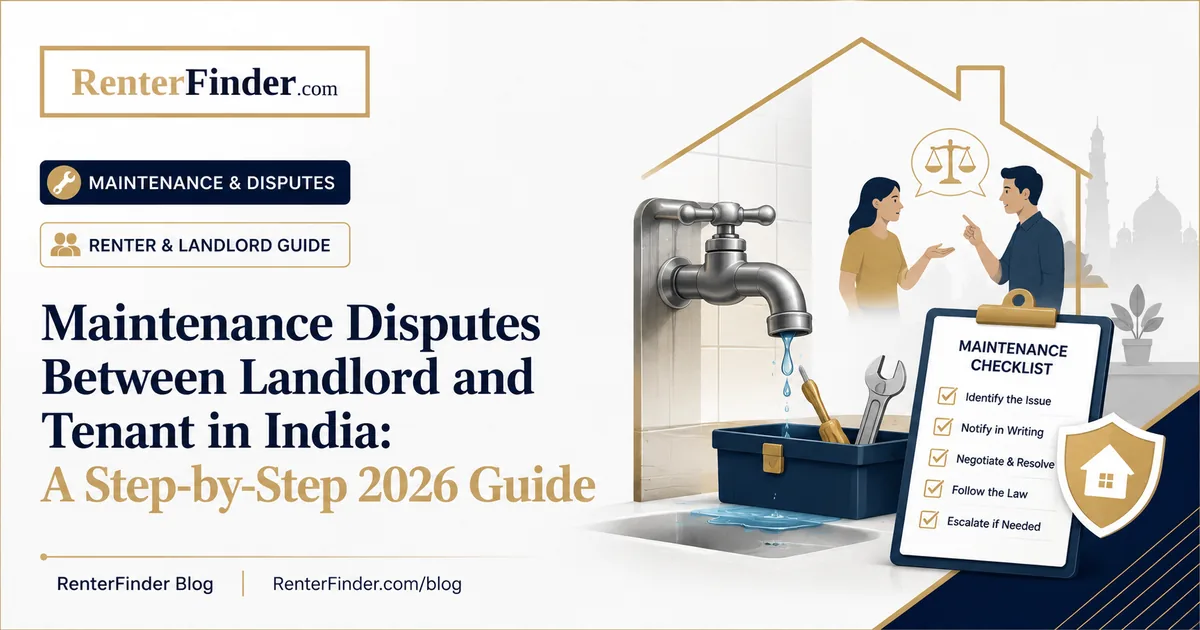
Maintenance disputes are the silent fault line in most Indian rental relationships. A landlord assumes annual AC servicing is the tenant's job. The tenant assumes the landlord owns the appliance and must therefore maintain it. A pipe starts leaking, the landlord is out of town, and by the time both sides agree on who should call the plumber, the ceiling below is damaged and the conversation has turned hostile.
In the summer of 2026, with rental supply across India rising roughly 9 percent year-on-year while demand growth has plateaued, landlords who handle maintenance disputes badly are finding that good tenants simply move on at renewal. This guide explains the legal baseline, maps out which repairs belong to which party, covers the most common disputes, and gives both sides a clear process to resolve disagreements before they become formal complaints - or worse, court cases.
What the Law Actually Says: The MTA 2021 Maintenance Split
The Model Tenancy Act 2021 (MTA 2021) is the national framework for landlord-tenant relations in India. As of 2026, it has been adopted by several states including Andhra Pradesh, Telangana, Tamil Nadu, and Uttar Pradesh. Where adopted, it gives both sides clearly defined maintenance obligations under Section 17. In states still under older Rent Control Acts, the specific rules differ - always check your state's current tenancy law.
Under Section 17, the landlord is responsible for:
- Keeping the structure, walls, and roof in sound condition
- Maintaining the electrical wiring within the walls
- Ensuring plumbing lines embedded in the structure remain functional
- Repairing or replacing major fixtures that fail through normal use
- Keeping common areas and building systems (where applicable) habitable
Under Section 17, the tenant is responsible for:
- Day-to-day upkeep and cleanliness of the flat
- Minor repairs - tap washers, toilet flush handles, light bulbs, cabinet handles
- Not carrying out structural alterations without written landlord consent
- Notifying the landlord promptly when a defect appears
The MTA 2021 also gives tenants a right to carry out essential repairs themselves (with prior written notice to the landlord) and deduct the documented cost from rent if the landlord fails to act within a reasonable period. That "reasonable period" is widely interpreted as 30 days for non-emergency repairs. For genuine emergencies - burst pipe, total electrical failure, structural collapse risk - the notice can be shorter and action more immediate.
Who Pays for What: A Quick Reference Table
The following covers common scenarios across a standard Indian residential tenancy. Where the rent agreement has a specific clause, that clause takes precedence over the default position.
| Item | Landlord | Tenant | Notes |
|---|---|---|---|
| Structural walls, roof, columns | Yes | - | MTA Sec 17 |
| Plumbing pipe in wall (burst/leak) | Yes | - | Structural plumbing = landlord |
| Dripping tap / tap washer | - | Yes | Minor repair = tenant |
| Electrical wiring in walls | Yes | - | Structural electrical = landlord |
| Light bulbs, switches, plugs | - | Yes | Day-to-day consumables |
| Geyser (major failure - element / tank) | Typically Yes | - | Major appliance failure through normal use |
| Geyser annual servicing / cleaning | - | Typically Yes | Routine upkeep = tenant |
| AC compressor / major failure | Typically Yes | - | Major appliance failure; depends on agreement |
| AC annual servicing / gas refill | - | Grey zone | Specify in agreement; tenant-heavy in practice |
| Painting - normal wear over 2-3 years | Grey zone | - | Fair wear and tear is landlord's; damage is tenant's |
| Windows / doors misaligned (structure) | Yes | - | Structural fit = landlord |
The Five Most Common Disputes - and Why They Happen
Most maintenance conflicts in India trace back to one of five root causes:
- Grey-zone appliances with no agreed clause. AC servicing is the most frequent example. If the rent agreement is silent on this, both sides can reasonably claim the other is responsible. A one-line clause at signing resolves this entirely.
- No move-in inventory was taken. When the tenant moves out and the landlord says the geyser was damaged, the tenant says it was already broken at move-in. Without a signed, photographed inventory at move-in, neither side can prove their position.
- Emergency repairs at night or on weekends. The landlord is travelling, the toilet floods, the tenant calls a plumber and pays. Then who reimburses whom - and how quickly? Emergency repair protocol is almost never defined in Indian rent agreements.
- Exit-time deductions from the deposit. "Fair wear and tear" versus "damage" is where disputes crystallise at the end of a tenancy. What counts as normal ageing of paint? Who pays for a cracked wall tile? These questions are easiest to answer when both sides documented the condition at move-in.
- Pre-existing defects the landlord did not disclose. A tenant moves in, finds the drainage is slow, the tap pressure is low, the window does not lock. If these are pre-existing, the landlord is responsible. But proving they were pre-existing, once six months have passed, is difficult without documentation.
Step 1: Document First, Dispute Second
The single most effective thing either side can do in a maintenance dispute is to have documented the flat's condition before the dispute arose. In practice, this means two things: a move-in inspection with a signed inventory, and a paper trail of every maintenance report made during the tenancy.
For the move-in inspection:
- Walk through every room together (landlord and tenant) on possession day
- Photograph or video every fixture, appliance, wall surface, and fitting
- Note anything already damaged or non-functional in writing
- Both parties sign a move-in inventory report - this becomes an annexure to the rent agreement
- Share the signed inventory via WhatsApp or email immediately so there is a timestamped copy
For ongoing maintenance reporting: the moment a defect appears, send a WhatsApp message or email to the landlord describing it clearly. Include a photograph. Under the Bharatiya Sakshya Adhiniyam 2023, digital messages with timestamps qualify as admissible evidence in Indian courts. A WhatsApp photo of a burst pipe, sent to the landlord the day it occurred, is a far stronger piece of evidence than a verbal claim six months later. The same applies to the landlord - any response, acknowledgment, or undertaking via message is on record.
Step 2: Give a Formal Written 30-Day Notice
If a defect that is clearly the landlord's responsibility is reported but not acted on, the tenant's next step is a formal written notice. This is not an escalation - it is a documented record that the landlord was informed and given adequate time. Without this notice, the tenant cannot legally deduct repair costs from rent or file a complaint with the Rent Authority.
A valid maintenance notice must include:
- The flat address and the date of notice
- A specific description of the defect (what, where, when first noticed)
- A statement that this is the landlord's responsibility under the rent agreement or MTA 2021
- A clear deadline - typically 30 days for non-emergency repairs
- A statement that if the landlord fails to act, the tenant may arrange the repair and deduct the cost from rent
Send this via WhatsApp and email. Keep screenshots. If the landlord is genuinely unresponsive, consider also sending a copy via registered post to create a physical record. A landlord who receives this kind of notice and still does not act has much weaker standing in any formal dispute. For emergencies, a shorter notice period (24-48 hours) is reasonable - get the repair done, document the cost, and notify the landlord immediately after.
Step 3: Negotiate Grey-Zone Repairs - Fairly
For disputes that fall into the grey zone - AC servicing, painting at exit, appliances that partially worked at move-in - negotiation is almost always a better use of time than formal escalation. The goal is a written settlement memo, not necessarily a court victory. A few principles that tend to resolve grey-zone disputes faster:
- Proportional use. If the tenant used the AC for three years and it needs a gas refill, sharing that cost 50/50 is reasonable. If the tenant is leaving after six months, the landlord bearing more of a full AC service cost makes sense.
- Fair wear and tear is not damage. Paint fading over two years of normal occupation is fair wear and tear - typically the landlord's cost. A child drawing on a wall or a nail hole that was not there at move-in is damage - typically the tenant's cost. The move-in inventory makes this distinction clear.
- Pre-existing defects must be established early. If a defect was reported within the first two weeks of occupancy (and you have the message to prove it), it is likely pre-existing. A landlord who disputes this without any prior record of the flat's condition is in a weak position.
- Write down any agreement. A WhatsApp confirmation that "landlord will bear cost of AC service, tenant will handle painting of one bedroom" is legally a settlement record under the Bharatiya Sakshya Adhiniyam 2023. Get it in writing before anyone spends money.
Step 4: Escalate if Negotiation Fails
If negotiation does not resolve the dispute, there are three formal routes. Choose based on the severity and the state you are in.
- Rent Authority (MTA 2021 states). States that have adopted the MTA 2021 provide a Rent Authority - an administrative body to resolve landlord-tenant disputes without the full process of a civil court. Disputes about repair obligations, deposit withholding, and maintenance can be filed here. For the full text and to identify the Rent Authority in your state, see the Model Tenancy Act 2021 and MoHUA.
- Consumer Forum via eDaakhil. For maintenance-related disputes with a monetary value, the Consumer Protection Act 2019 provides a route through consumer forums. You can file online at eDaakhil.nic.in. This works best when the landlord has clearly withheld deposit money or refused to refund a documented repair cost.
- Rent Control Court (older states). In states still under older Rent Control Acts (Maharashtra, West Bengal, Kerala, Delhi, etc.), the Rent Control Court handles tenancy disputes. Filing here is slower and more formal, but it is the appropriate route where MTA 2021 does not apply.
Before escalating to any formal body, compile: your rent agreement, the move-in inventory, a full record of your maintenance communications, photos of the defect, and any repair bills. The more contemporaneous your documentation, the stronger your case - regardless of which route you take.
Most maintenance disputes in India are not fundamentally about the cost of a repair. They are about who was heard, who was kept informed, and whether both sides acted in good faith. A written inventory at move-in, a quick WhatsApp message when something breaks, and a landlord who responds promptly are enough to prevent nine out of ten disputes from going anywhere near a formal process.
RenterFinder is designed for exactly this kind of tenancy - one where both parties communicate directly, without a broker filtering information in the middle. The AI and human moderated chat within the platform means both landlord and renter can discuss property details, maintenance history, and appliance condition clearly before the agreement is signed - which is the best time to prevent disputes, not after they have already started. See how it works at RenterFinder Services or browse the Prospective Renters' List.
Related Articles
- Who Pays for Repairs in a Rented Flat in India? - The MTA 2021 repair responsibility split explained
- Landlord Not Returning Your Security Deposit? - Step-by-step guide to recovering withheld deposits
- Hidden Charges in Indian Rental Agreements - What to watch for before you sign
Browse the Prospective Renters' List or post your property - no cost to start, no broker involved.