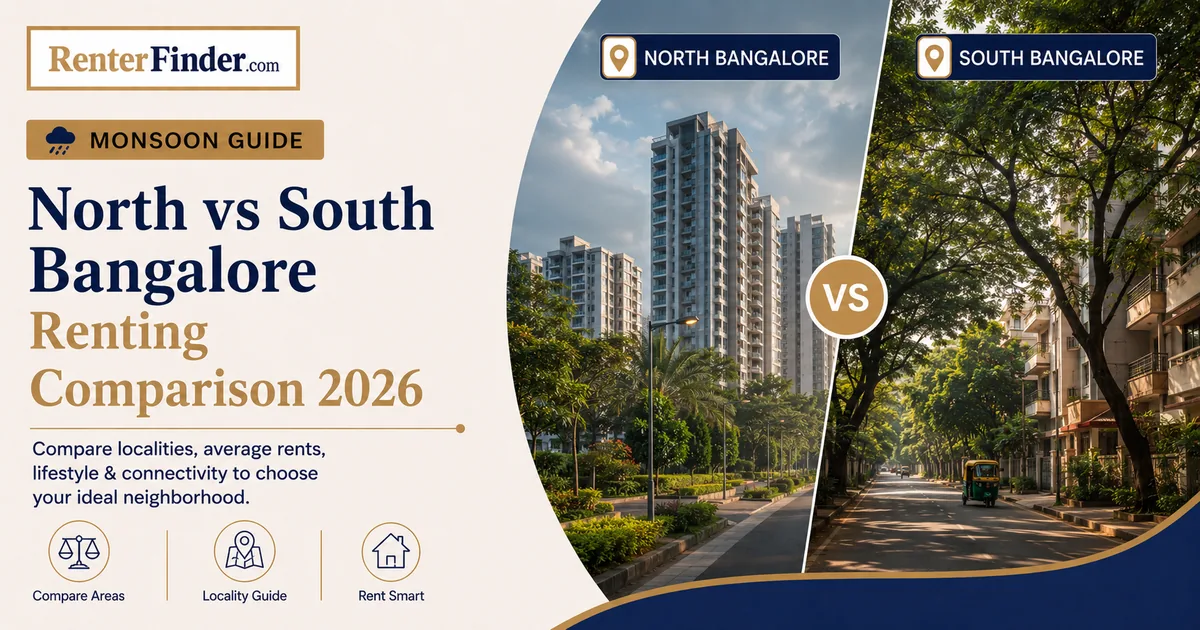
When someone moves to Bangalore for work, one of the first decisions they face is deceptively simple: north or south? Both halves of the city have passionate advocates. Tech workers near Manyata Tech Park swear by Hebbal. Families who have lived in Jayanagar for a decade cannot imagine being anywhere else. And people who moved north because the rent was lower sometimes find themselves in tanker-dependent buildings with a commute that adds an hour to their day - or the opposite, that they discovered a well-connected, green neighbourhood they never would have considered.
The truth is that Bangalore's north-south divide reflects genuinely different characters, rent levels, water realities, and social fabrics. This guide compares the two sides honestly, so you can match your priorities - commute destination, budget, lifestyle, family needs - to the right part of the city. If you are searching for flats for rent in Bangalore, understanding this divide is the starting point.
What "north" and "south" actually mean in Bangalore
Bangalore does not have a formal north-south boundary, but the Outer Ring Road and the central corridor (from Majestic and Cubbon Park toward MG Road) act as loose dividers in most renters' mental maps. North Bangalore broadly means areas above this corridor: Hebbal, Yelahanka, Thanisandra, Nagawara, Bellary Road (toward the airport), Kogilu, Jakkur, and the Devanahalli belt. South Bangalore means areas below it: Jayanagar, JP Nagar, Banashankari, Basavanagudi, Bannerghatta Road, Kanakapura Road, BTM Layout, and Electronic City.
Central and east Bangalore - Indiranagar, Koramangala, HSR Layout, Sarjapur Road, Whitefield, Marathahalli - sit in their own category and are covered in separate locality guides. This comparison focuses on the north-versus-south question that comes up most often when someone is new to the city and deciding where to start their search.
North Bangalore: the key localities and what they offer renters
North Bangalore has been transformed over the past decade by three forces: the international airport on Bellary Road, the Manyata Tech Park cluster near Hebbal, and a wave of large apartment projects that changed the housing stock entirely. The result is a part of the city that feels newer, wider, and more car-dependent - but also more affordable in the mid-tier pockets, and genuinely convenient if your commute runs north.
Key north Bangalore localities at a glance:
- Hebbal: The most prominent north Bangalore address for IT professionals. Close to Manyata Tech Park and the Outer Ring Road flyover. Rents here are not cheap - a 2BHK in a mid-tier apartment block typically runs between ₹25,000 and ₹45,000 depending on age and furnishing. Good Cauvery connection in older parts of the area. Heavy traffic toward the Hebbal flyover during peak hours.
- Nagawara and Thanisandra: A step further north than Hebbal, with somewhat more affordable rents for comparable apartments. Popular with tech-park employees who want to avoid the Hebbal bottleneck. New Metro Blue Line stations have improved connectivity.
- Yelahanka: One of north Bangalore's more established residential areas, with a mix of older independent houses and newer apartment complexes. Cauvery supply is more consistent here than on the far outskirts. Rents are generally lower than Hebbal, making it a popular choice for families who need space but are price-conscious.
- Devanahalli and Bellary Road outer belt: Airport proximity is the main draw. Renters who travel constantly find this convenient. However, these areas are far from most Bangalore workplaces, and the commute to electronic city or south Bangalore can take 90 minutes or more. Water supply in newer parts depends heavily on borewells and private tankers.
- Kogilu, Jakkur, Sahakar Nagar: Mid-tier pockets north of Hebbal that offer apartment-living at prices below the Hebbal premium. Green cover is reasonable. Connectivity to the rest of the city is improving but still depends largely on road commuting.
South Bangalore: the key localities and what they offer renters
South Bangalore is older Bangalore - the city as it was before the IT boom reshaped it. The roads are narrower in places, the trees are bigger, and the neighbourhoods have a settled, walkable character that north Bangalore is still building toward. The social infrastructure - schools with decades of reputation, well-established hospitals, markets and restaurants that have been in the same spot for a generation - is denser here than anywhere else in the city.
Key south Bangalore localities at a glance:
- Jayanagar and Basavanagudi: Among Bangalore's most coveted residential addresses for families. Wide, tree-lined streets, strong school density (both CBSE and state board), reliable BBMP services, and good Cauvery coverage. Rents are high by south Bangalore standards - 2BHK flats in well-maintained buildings run ₹30,000-₹55,000. Independent houses are available at a premium. Very little new apartment development, so stock is older but usually well-maintained.
- JP Nagar and Banashankari: More accessible price points than Jayanagar, with a similar family-friendly character. Phases 1-6 of JP Nagar cover a wide range from near-Jayanagar polish to more ordinary residential streets. Good BBMP water supply in most parts. The Banashankari metro station on the Purple Line is a significant commute asset. A 2BHK typically costs ₹20,000-₹38,000 depending on the phase and building quality.
- BTM Layout: A dense, lively locality that attracts young professionals and families alike. Close to HSR Layout and Koramangala to the east, JP Nagar to the west. Good restaurant scene, active local market. Rents are mid-range for south Bangalore. Some tanker dependence in the interior layouts, so ask specifically about water before signing.
- Bannerghatta Road: A long corridor running south from the city. Areas near Gottigere and Arekere metro stations (Yellow Line planned) are seeing growing interest. Good hospital proximity (many large hospitals along this road). Rent is lower than Jayanagar and JP Nagar, making it a budget-friendly south option.
- Electronic City: Technically south but quite far. Phase 1 and Phase 2 are major residential clusters for IT professionals working at the tech park there. Rents are comparatively affordable for the size of apartments - a 2BHK in a mid-range complex often runs ₹18,000-₹32,000. The commute out of Electronic City toward north or central Bangalore is long. Good for professionals who work in Electronic City and rarely need to cross the city. Explore flats in Electronic City if this is your tech park.
- Kanakapura Road: Gaining popularity as metro connectivity improves and land prices remain lower than adjacent south localities. A good option for families who want a south Bangalore character with slightly more space for the money.
Rent comparison: what each part of the city actually costs
Rent in Bangalore in 2026 is better understood locality-by-locality than by a north-south generality. But some broad patterns hold. The highest rents in south Bangalore cluster in Jayanagar, Basavanagudi, and parts of JP Nagar close to the central neighbourhoods - comparable in many cases to the most expensive north Bangalore addresses (Hebbal lakeside, Nagawara premium developments). The more affordable south options (Electronic City, Kanakapura Road outer stretches, Bannerghatta Road periphery) and the mid-north options (Yelahanka, Thanisandra) occupy a similar price band.
Ranges are indicative for 2026; actual figures vary by building age, furnishing, and floor. Always verify current market rents before negotiating.
Deposit norms across Bangalore - north and south - commonly run to 10 months' rent. This is a well-known city-specific practice and applies regardless of which part of the city you rent in. For context on how that compares with national norms and what the security deposit rules across India actually say, that guide covers the detail.
Water supply: the factor most renters ask about too late
Water is one of the most practical differences between north and south Bangalore, and one that renters often discover only after moving in. Established south Bangalore localities - Jayanagar, JP Nagar, Basavanagudi, Banashankari, and parts of BTM - generally have good Cauvery Corporation (BWSSB) connections. Supply is not unlimited or problem-free, but most buildings in these areas have a reliable municipal pipe connection, reducing dependence on private water tankers.
North Bangalore is more varied. Older parts of Hebbal and Yelahanka have reasonable Cauvery coverage. However, the large apartment complexes built over the past decade in Thanisandra, Nagawara extensions, and along the airport road corridor often sit outside BWSSB connection zones or have connections that were added late and are not fully reliable. Many such buildings depend significantly on borewells and private tankers - a cost that may be embedded in society maintenance charges (and may not be disclosed upfront).
Before signing any lease in Bangalore - north or south - the three water questions to ask explicitly are:
- Does this building have a BWSSB Cauvery connection, or does it rely on borewells and tankers?
- If tanker-dependent, what is the average monthly tanker cost, and is it included in maintenance or billed separately?
- Has the borewell or Cauvery supply ever run dry in summer months - and what happens if it does?
For a deeper look at how water tanker charges typically work in Bangalore and who is responsible for them, see the guide on water tanker charges and who pays.
Commute and metro coverage: which side wins for your route
The single most important factor in north-versus-south is where you work. Commuting across Bangalore from one end to the other on road - north to Electronic City, or south to Manyata - during peak hours can take 75 to 120 minutes. Choosing the wrong side of the city is one of the most common and expensive rental mistakes people make. The metro network, now considerably expanded, has changed some of these calculations.
Metro coverage by area (2026 status):
- Green Line (north-south through city centre): Runs from Nagasandra in the north to Silk Institute in the south, passing through Majestic. This is the spine that connects the two halves of the city. Yelahanka residents can access Nagasandra station; Banashankari and Jayanagar can use the southern end stations. Travel time Nagasandra to Banashankari is around 45-50 minutes without interchange.
- Purple Line (east-west): Connects Challaghatta (west) through Majestic to Baiyappanahalli and toward Whitefield. Key interchange at Majestic with Green Line. Central Bangalore is the primary beneficiary; less relevant for pure north-south decisions.
- Blue Line (airport corridor): The airport metro line now connects central Bangalore northward, making Devanahalli and the outer north belt more accessible for airport-adjacent renters. Details are covered in the Blue Line metro renting guide.
- Road commute for non-metro areas: Many north localities (Thanisandra, Kogilu, Jakkur, Devanahalli belt) and some south localities (Kanakapura outer belt, far Bannerghatta Road) are not yet on a metro line. For these, commuting remains road-dependent. A two-wheeler or cab from Yelahanka to a south Bangalore office will rarely be under 60 minutes in morning peak.
For people working on the Outer Ring Road (ORR) tech corridor - the arc from Marathahalli through Bellandur and Sarjapur - both north and south Bangalore involve a significant road commute. In those cases, HSR Layout, Sarjapur Road, or Whitefield are often more practical than either north or south.
Character and lifestyle: the feel of north vs south
Beyond the numbers, north and south Bangalore simply feel different to live in - and that matters for most families making a multi-year commitment to a neighbourhood.
South Bangalore has the texture of an old city. Jayanagar's blocks and parks, Basavanagudi's temples and the groundnut festival, JP Nagar's neighbourhood markets, the quiet lanes behind Banashankari BDA complex. These areas have walkable retail, reliable BBMP parks, and decades of social infrastructure. The downside is that new apartment supply is limited - you are more likely to rent an older flat in a building from the 2000s or before - and landlords in these areas often have higher deposit and occupancy preferences. Families with school-age children consistently rate south Bangalore higher.
North Bangalore is predominantly apartment-led, with large gated communities that include amenities like pools, gyms, and children's play areas as standard. The trade-off is that these communities can feel more insular - the social fabric of the neighbourhood beyond the gate is thinner than in south Bangalore's established areas. Restaurants, cafes, and retail are improving rapidly but are still more dispersed than in south Bangalore's walkable pockets. The street character is more highway-adjacent than urban residential in many parts.
Both halves have their trade-offs. If you value a flat with modern amenities in a gated complex, north Bangalore often delivers better value per square foot. If you value walking to a market, a park, or a school without getting into a car, south Bangalore tends to win - at a higher rent.
Who should choose north, and who should choose south
The honest answer to the north-vs-south question is: it depends on your specific priorities. Here is a direct decision guide:
- Choose north if: you work at Manyata Tech Park, Kirloskar Business Park, or anywhere on the Bellary Road corridor; you travel frequently by air; you want a newer, amenity-rich apartment complex at a mid-range rent; you commute to ORR via the Hebbal-ORR junction; or airport proximity matters for your household.
- Choose south if: you have school-age children and want proximity to established schools (Bishop Cotton, National, Vijaya, Baldwin, and dozens of others are mostly in south); you work in Electronic City or Bannerghatta Road; you prefer walkable, urban neighbourhoods; or you want better Cauvery water coverage and less tanker dependence.
- Choose east/central (neither north nor south) if: your office is on the ORR tech corridor, in Indiranagar, Koramangala, or Whitefield. For Whitefield, see the Whitefield flats guide.
- Choose south-ish (Electronic City) if: you work at the Electronic City tech park and want to minimise commute time. Just be prepared for longer cross-city travel when you need to reach north Bangalore or the airport.
If you are still deciding on a locality within whichever broad band you prefer, reading the full Bangalore renting guide will give you a more granular picture of each major locality's rent, character, and commute reality.
If you are looking for flats for rent across Bangalore, you can browse active listings and connect with landlords through AI and human moderated chat - with no broker involved.
Related Articles
- Renting in Bangalore in 2026: Complete Locality, Cost, and Process Guide - Full city overview with all major localities
- Water Tanker Charges in Bangalore: Who Pays and What Is Legitimate - Critical reading before signing in north Bangalore
- Security Deposit Rules in India: What Is Legal and What Is Not - Applies to Bangalore's 10-month deposit norm
List your renter profile or browse Bangalore properties on RenterFinder. No broker commission - transparent fees only.