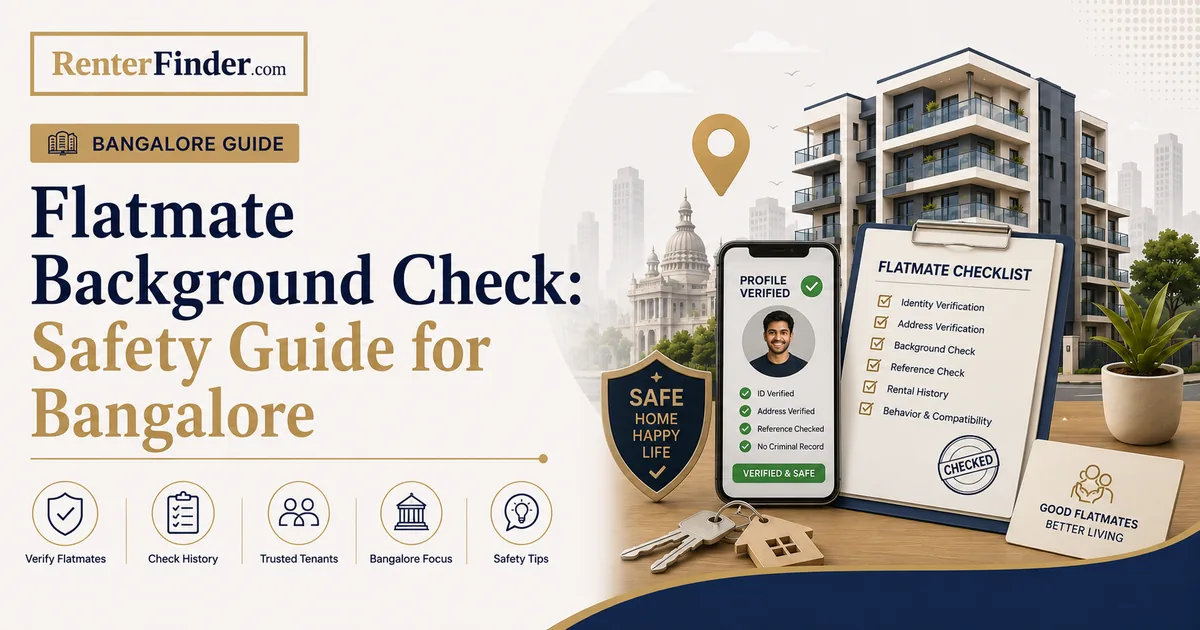
Finding a flatmate in Bangalore is one thing. Trusting that person enough to share a key, a kitchen, and a lease - or part of one - is another. The city's rental market means many people move into pre-occupied flats with strangers they have chatted with for a few days online. Most of those arrangements work out fine. But the ones that go badly often do so because basic checks were skipped in the rush to secure a room before someone else did.
This guide covers a straightforward verification process you can complete before signing anything. It works whether you are the person moving into a pre-occupied flat, or the existing tenant considering letting someone else share your space. None of the steps require a background-check agency or a lawyer - they require time, a few questions, and the willingness to walk away if the answers do not add up.
Why flatmate verification matters more in Bangalore than most cities
Bangalore draws 3-4 lakh new residents every year, mostly working professionals relocating for IT, startup, and manufacturing jobs. A large proportion of them are single, in their 20s or 30s, and looking to share a flat to manage rising rents. The typical search happens fast - someone posts in a WhatsApp group or on a classifieds site on Monday, three people express interest, and the room is committed by Friday. There is almost no time to properly evaluate the other person.
The risks are practical rather than dramatic. The most common problems are not violent crime but financial and logistical: a flatmate who stops paying their rent share without notice, one who damages the flat and disappears before move-out, one whose lifestyle (guests, noise, cleaning standards) was misrepresented in initial chats, or one who simply ghosts after collecting a deposit contribution. A half-hour of verification before committing significantly reduces the probability of each of these outcomes.
Bangalore society rules also create a specific verification context. Many gated communities and standalone buildings require the landlord to inform the Resident Welfare Association (RWA) when a new occupant moves in. If your flatmate causes a complaint, the landlord's relationship with the society is at risk - and ultimately so is your tenancy. Knowing something about who you are letting into the flat protects you as well as the landlord.
Step 1: Start with a video call before any in-person meeting
The first filter is the simplest: propose a brief video call rather than jumping straight to a flat visit. A 10-minute call does several things at once. It confirms that the person is real and matches the photos on their profile. It lets you hear how they speak about themselves - consistent and natural, or rehearsed and evasive. And it gives them an opportunity to ask questions about the flat that reveal whether they have a genuine intent to move in or are just browsing.
Someone who refuses any form of video call before an in-person meeting - in a city where this is now the norm for any decent flatmate search - is an early yellow flag. It does not prove anything, but it is worth noting. Genuine, busy people can usually find 10 minutes on a video call if they are seriously interested in a flat.
During the call, note down: their name as they give it, their employer, what they say their work schedule looks like, and why they are moving from their current place. You will use these details later to cross-check.
Step 2: Identity documents - what to ask for and how to handle them
Before a room is committed, ask to see a government-issued photo ID. The most common options in Bangalore are Aadhaar, a passport, or a driving licence. The request is not unusual - any landlord would ask for the same before letting someone into a flat, and a genuine flatmate seeker will understand this.
What you are checking for:
- Does the name on the ID match the name they gave you?
- Does the photo look like the person you spoke to on video?
- Is the date of birth consistent with what they told you about themselves?
- Is the document an original or a scanned copy? A scanned copy is fine for initial review. Do not hold originals.
If they share an Aadhaar card, you can verify it through the UIDAI portal using the 12-digit number to confirm the number is genuine - note that this only confirms the number is valid, not that the person showing you is the cardholder. For that, the video check and in-person meeting with the same person matters more. You can find the UIDAI verification portal at uidai.gov.in.
Handle document copies with care. If someone shares a photo of their Aadhaar, do not pass it on to others or post it anywhere. They are trusting you with personally sensitive information in the same way you are trusting them with access to your home.
Step 3: Employment and income verification
The second most common flatmate problem - after mismatched lifestyles - is the flatmate who cannot pay their share of rent. Employment verification reduces this risk significantly. You are not asking for a salary slip (that would be intrusive); you are confirming that the person is genuinely employed where they say they are.
Three things you can ask for:
- Company ID card. Most employees in Bangalore's IT and corporate sector carry one. It shows the employer name and (usually) the employee name. Cross-check both against what they told you.
- Offer letter or appointment letter. Useful for newer employees or those who have recently joined. The employer's letterhead and HR contact details are on it.
- LinkedIn profile. Not a substitute for a document, but a useful cross-check. Does the employer, role, and duration match what they told you? Is the profile active with real connections - colleagues, endorsements? A profile with 30 connections and a join date of two weeks ago warrants a closer look.
For self-employed or freelance flatmates - a growing category in Bangalore - the employment check looks different. You can ask for a client reference or two, a brief description of the work they do with a portfolio or website, and how they typically pay expenses (UPI, bank transfer). A freelancer who cannot articulate how their income works is worth probing further, but freelancing itself is not a red flag.
Step 4: The in-person meeting - what to observe and what to ask
The in-person meeting at the flat has two simultaneous purposes: the potential flatmate is evaluating the flat, and you are evaluating them. You can be transparent about this - most serious flatmate seekers understand that both sides are making a judgment call.
Show them the flat honestly - including the parts that might be inconvenient (noisy evenings, a small kitchen, a water supply that depends on tanker deliveries two days a week). A person who reacts to the flat's actual conditions with realism is more likely to be a stable flatmate than one who seems to be filtering everything through rose-tinted glasses. Problems that are hidden at this stage become complaints or disputes after moving in.
Questions worth asking directly during the meeting:
- Why are you leaving your current place? (Consistent, clear answer vs. vague or evasive?)
- What does a typical weekday look like for you? (Work hours, cook at home vs. eating out, how late are you usually back?)
- How do you prefer to handle shared expenses - a common kitty, or split bill by bill? (Either is fine; consistency matters.)
- How do you feel about guests staying over? (No right answer; but you need compatible expectations.)
- Do you have any lifestyle habits that I should know about before we decide? (Smoker, late-night work calls, early riser?)
- Can I speak with your previous landlord or flatmate for a reference?
The last question - asking for a reference - is the most revealing one. Someone who immediately offers contact details and says "of course" is demonstrating confidence in their track record. Someone who hesitates, redirects, or claims they had a "complicated" relationship with every previous flatmate or landlord is showing you something worth noting.
Red flags that should make you pause (and possibly walk away)
None of the following items is automatically disqualifying on its own. But a cluster of them - three or more in one interaction - is worth taking seriously:
- Refuses to video call before meeting. A genuine, safe flatmate seeker in Bangalore understands this expectation in 2026.
- Cannot produce any employment documentation whatsoever. Not just reluctance - flat refusal. Even a freelancer should be able to show something.
- Insists on paying their deposit or rent share in cash only. Bank transfer creates a record; cash does not. This matters if a dispute arises later about what was paid.
- A social media presence created very recently - within weeks of when they contacted you. Combined with other oddities, this suggests the profile may not be real.
- Every previous flatmate relationship or landlord relationship ended badly, with explanations that always put the other person at fault. Pattern rather than a single incident.
- Pressure to decide quickly - "I have two other offers and I need an answer by tonight." Real urgency is understandable in Bangalore's rental market. Artificial pressure designed to prevent you from thinking clearly is different.
- Significant inconsistencies between what they said on the call and what comes up in documents or the in-person meeting. Employer name changes, different age from ID, story about current flat that does not add up.
The co-occupant agreement: protect yourself in writing
If everything checks out and you decide to proceed, the last step before handing over a key is putting the basic terms in writing. This is called a co-occupant agreement or a flatmate agreement - it is not the same as the main lease, which is between the landlord and the primary tenant. It is an agreement between the people sharing the flat about their respective responsibilities.
A basic co-occupant agreement should include:
- Full legal names of both parties and the flat address
- Monthly rent share: who pays how much and by what date
- Deposit contribution: how much each person has put in, and what happens to it when someone leaves
- Utility cost split (electricity, water/tanker, internet, maintenance)
- Notice period for one person vacating (30 days is standard; agree on this before not after)
- House rules: guests staying over, quiet hours, cleaning responsibilities
- Who is the primary contact with the landlord
The document does not need to be notarised or registered. A signed, dated agreement on plain paper - or even a detailed email exchange where both parties have agreed to the terms - creates a record. It is not a court-proof guarantee, but it establishes a shared understanding that significantly reduces the scope for "that is not what we agreed" disputes later.
For a broader guide to what co-occupant documents should include, see our post on subletting rules in India - which covers when a flatmate arrangement may legally constitute a sublease and what that means for all parties.
How RenterFinder's platform approach helps with safer flatmate connections
The steps above work regardless of how you found your potential flatmate. But where you find them affects how much ground-level verification work you need to do upfront. Social media groups, WhatsApp communities, and classifieds sites operate without any moderation - anyone can post anything, and first contact happens through personal phone numbers or DMs, exposing both parties to unsolicited contact from unserious enquirers.
Find a flatmate in Bangalore through RenterFinder and the dynamic changes. Flatmate seekers list their pre-occupied flat or their search on the platform with real detail - occupation, lifestyle, preferred locality, budget, timeline. The initial conversation happens through AI and human moderated chat inside the platform, which means neither party's phone number or home address is shared until both sides have had a chance to assess genuine intent. This filters out casual browsers and creates a safer first-contact environment than unmoderated social media groups.
The moderation layer is live, and it applies to flatmate searches in Bangalore as well as standard tenant-landlord matches. You can learn more about how the platform works on our services page.
Note on RenterFinder's fee structure: the ₹125 profile listing fee (valid for 3 months) applies whether you are listing as a flatmate seeker or a standard renter. If a match is made through the platform, each party pays a Meeting Fee of 3 days' rent when both agree to meet and a Deal Fee of 3 days' rent when the deal is done. There is no fee for browsing or for initial AI and human moderated chat.
Flatmate relationships in Bangalore work best when both parties have been honest with each other upfront. The verification steps in this guide are not about distrust - they are about replacing assumptions with information. A flatmate who is willing to be transparent about who they are is exactly the kind of person you want sharing your space. A half-hour of structured checking before committing protects both sides and sets a healthier foundation for what is, after all, a very close living arrangement.
If you are looking for flatmates in Bangalore and want a more structured environment than WhatsApp groups and classifieds, consider listing your need or your spare room on RenterFinder. The platform's AI and human moderated chat layer keeps personal contact details private until both parties show genuine intent - which changes the dynamic of the first conversation in a meaningful way. Browse flats for rent in Bangalore or list as a flatmate seeker on our services page to get started.
This guide is for informational purposes only. For legal advice on tenancy disputes or rental agreements, consult a qualified advocate. For the current text of the Model Tenancy Act 2021, see mohua.gov.in.
Related Articles
Written by the RenterFinder Editorial Team. RenterFinder.com is India's rental-only matching platform.
List your flatmate need or spare room on RenterFinder. Initial contact happens through AI and human moderated chat - your phone number stays private until you are ready. ₹125 listing fee.