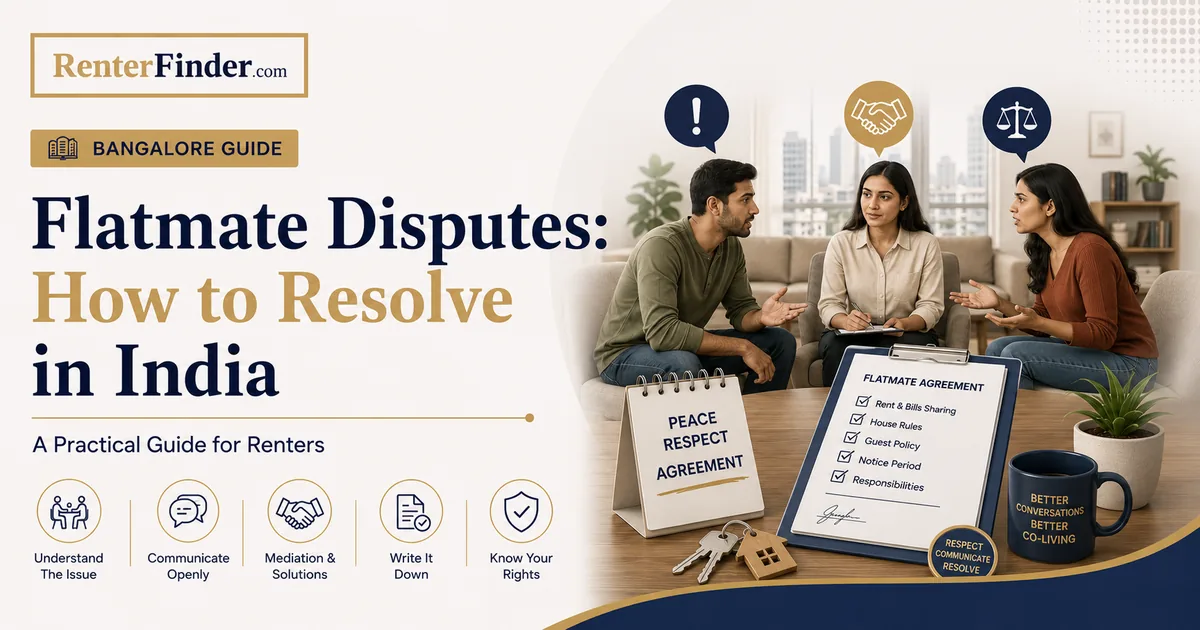
Sharing a flat in India is a practical necessity for millions of working professionals, students, and recent arrivals in Bangalore, Pune, Hyderabad, and other cities where rents have been climbing steadily. It works well - right up until it does not. A flatmate who quietly stops paying, a co-resident who leaves three months into a one-year agreement, a shared electricity bill that becomes a monthly fight: these situations are more common than most people discuss before moving in together.
This guide covers the most common flatmate disputes in India, the immediate steps to resolve each one, and - where negotiation fails - the legal route available to you. It also explains why none of this needs to end the friendship, or even the flat arrangement, if it is handled correctly from the start.
Note: this is a general guide, not legal advice. For specific situations, consult a qualified advocate. Rules vary by state and circumstances.
The legal grey zone of flatmate arrangements in India
Before getting to specific disputes, it helps to understand the underlying legal structure - because most flatmate fights get complicated by one thing: there is usually only one name on the rent agreement with the landlord.
In a typical shared-flat arrangement, one person signs the rent agreement as the primary tenant. The others move in as co-occupants - a status that is part way between a sub-tenant and a guest. The landlord recognises the primary tenant and no one else. This means:
- The primary tenant is fully responsible for the entire rent, regardless of what individual flatmates have or have not paid them.
- The security deposit belongs to the primary tenant's relationship with the landlord - co-occupants who contributed informally have a private claim, not a legal one against the landlord.
- The landlord cannot evict a co-occupant directly - that is the primary tenant's problem to manage.
- A flatmate who is not on the landlord's agreement has no direct tenancy rights under the Model Tenancy Act 2021 - those rights belong to the named tenant.
This does not mean co-occupants are legally defenceless - a written flatmate agreement between private parties is enforceable in civil court. But it does mean that disputes often have two separate layers: the primary tenant's liability to the landlord, and the co-occupants' obligations to each other. Mixing these up is where most flatmate disputes go wrong.
Dispute type 1: flatmate not paying their share of rent
This is the most common and most stressful flatmate dispute, because the clock is ticking: rent to the landlord is due whether or not your co-resident has paid you. Here is the resolution path.
Step 1: Send a written message
Do not only have a verbal conversation. Send a WhatsApp message (or email) clearly stating the amount owed, the due date it was missed, and a new deadline by which you need it. Keep it factual, not accusatory. The reason for the written record is simple: under the Bharatiya Sakshya Adhiniyam 2023, WhatsApp messages and digital records are admissible as evidence in Indian courts. This message is your evidence if the dispute escalates.
Step 2: Give a clear deadline with consequences
If the first message produces a vague promise but no payment, send a second message with a firm date and state clearly what happens if payment is not made by then - for example, that you will be issuing a formal demand letter and asking them to vacate. This is not aggression; it is the step that separates a misunderstanding from a pattern.
Step 3: Formal demand letter
If the deadline passes, send a formal demand letter by registered post or email. This does not require an advocate, though having one draft it adds weight. State the total amount owed, the period it covers, and a final deadline. Many disputes end at this stage because it makes clear you are serious about legal recovery.
Step 4: Civil court or consumer forum
If the amount is unpaid after the demand letter, you can file a civil recovery suit. For amounts below Rs 20 lakh, a small-cause court or summary suit procedure is generally faster than regular civil proceedings. Keep all payment records - UPI transfer screenshots, rent receipts, bank statements showing your payment to the landlord. These establish both what was owed and that you covered it yourself.
Dispute type 2: flatmate leaves without notice or before the lease ends
A flatmate who moves out suddenly - without the notice period agreed between you - creates two separate problems: you lose their rent contribution immediately, and you may struggle to find a replacement before the next rent cycle.
If you had a written flatmate agreement (more on this below) with a notice period clause, the departing flatmate owes you notice rent for the period they skipped. For example, if the agreement required 30 days' notice and they left in five days, they owe you 25 days of their rent contribution.
The practical resolution path:
- Document the move-out date - take photos of the vacated room and note the exact date they left. If possible, get a WhatsApp confirmation from them of when they are leaving.
- Calculate what is owed - the notice rent shortfall, plus any outstanding bills from the period they lived there.
- Send a written demand for the amount owed, with a clear deadline. Include the calculation so there is no ambiguity about how you arrived at the number.
- The deposit contribution - if they contributed to the security deposit paid to the landlord, negotiate a settlement: either a new flatmate reimburses them (offset against what they owe you in notice rent), or you refund their portion once the tenancy ends and the full deposit is returned.
If the departing flatmate is the primary tenant on the agreement and wants to end the tenancy entirely, the situation is different - the entire flat arrangement is at risk. This scenario is covered in depth in a related guide on flatmate safety and background checks, which includes what to establish before a new flatmate moves in.
Dispute type 3: shared bills, maintenance, and the deposit split
Shared bills are a persistent low-grade conflict in flat sharing: electricity runs high one month, one flatmate insists they were away for half of it, another disputes their share of the society maintenance charge. These disputes are small individually but accumulate into resentment.
Electricity and utilities
The cleanest approach is a fixed equal split, agreed in writing upfront - regardless of who uses more or less in a given month. Variable splits (based on who used the AC more, who was travelling) create endless negotiation. If equal splits feel unfair because usage genuinely differs, consider sub-metering or a notionally higher share for the room with the AC. Write down whichever method you chose and stick to it.
Society maintenance charges
Maintenance is typically paid by the primary tenant to the society and then recovered from co-residents. Agree upfront what share each flatmate pays. If the amount fluctuates (Bangalore society charges often include water tanker costs that spike in summer), decide in advance whether to split the fluctuating portion equally or fix a ceiling and review it quarterly.
Security deposit disputes between flatmates
If co-occupants contributed informally to the deposit paid to the landlord, document this with a simple written note at the time: who paid what share, and the understanding that each person gets their share back when the tenancy ends and the landlord refunds the deposit. Without this, the primary tenant technically holds the full deposit and distribution becomes a matter of trust.
When a flatmate leaves before the tenancy ends, they typically cannot recover their deposit share from the landlord - only from the primary tenant or an incoming replacement flatmate. Settle this at the time of departure, not later, when memories of the original amounts will differ.
Dispute type 4: lifestyle conflicts, cleanliness, and noise
These are the disputes that are hardest to document and hardest to resolve legally, because they involve subjective standards. One person's "reasonable quiet hours" is another's "unreasonable restriction." One person's acceptable kitchen condition is another's chronic mess.
The honest truth is that lifestyle disputes are almost never resolvable through legal means - civil courts are not equipped to adjudicate whose standard of cleanliness is correct. The resolution path is social and logistical, not legal.
What actually works:
- Write house rules before anyone moves in. Quiet hours, kitchen cleaning expectations, guest policies, overnight visitor rules. Explicitly agreed rules are much easier to refer back to than unspoken expectations.
- Name the issue directly, early. Most lifestyle conflicts escalate because neither party names the problem clearly until frustration has built up for months. A direct, non-accusatory conversation in week two ("I find it hard to sleep when music plays after 11 PM - can we set that as a rule?") is far more effective than a confrontation in month four.
- Use the written agreement as a reference, not a weapon. If you have a house-rules document, refer to it factually. "We agreed kitchens would be cleaned after cooking - can we stick to that?" is easier to hear than "you always leave the kitchen dirty."
- When rules are repeatedly violated: give one clear written notice (WhatsApp is fine) stating what was agreed and that continued violation may lead to a request to vacate. This documents your attempt to resolve the issue.
If the conflict is fundamentally irresolvable and one party wants to end the arrangement, the exit process depends on the flatmate agreement: what notice is required, how deposits are settled, and whether any incoming flatmate needs the departing person's consent. Having this written down in advance converts what could be a messy dispute into a managed transition.
Why a written flatmate agreement prevents most disputes
Every scenario in this guide becomes significantly easier to resolve if a written flatmate agreement existed before the dispute began. A flatmate agreement - also called a co-occupant agreement or house-sharing agreement - is a private contract between the flatmates themselves (separate from the rent agreement with the landlord).
It does not need to be a long document. A one-page note covering the following is enough:
- Each flatmate's name and their monthly rent contribution
- How shared bills (electricity, maintenance, internet) are split
- Who paid what share of the security deposit with the landlord
- Notice period required if someone wants to leave (typically 30 days)
- House rules on cleanliness, guests, noise, and common areas
- What happens if a flatmate cannot pay rent in a given month
- Process for bringing in a new flatmate if one person leaves
This does not need to be registered or notarised to be enforceable as a civil contract. All parties should sign it and keep a copy. The simple fact of having written it down has a significant deterrent effect on disputes - people behave better when expectations are clearly on paper than when everything is assumed.
For Bangalore flatmate arrangements specifically, our guide on questions to ask a potential flatmate before moving in includes a practical checklist of what to confirm before you even draft the agreement.
When to escalate: the legal route for flatmate disputes in India
Most flatmate disputes are resolved through conversation, written communication, or a direct settlement. Legal action is a last resort - but it is available, and knowing the path in advance reduces the sense that you have no options.
What the police can and cannot do
If a flatmate refuses to pay rent or leaves with belongings that are not theirs, the police will typically classify this as a civil dispute and decline to register an FIR. They may assist with mediation in serious cases, but they are not the primary avenue for money recovery between flatmates. The exception is if there is an element of criminal breach of trust or fraud - for example, a flatmate who collected money for rent from the others and absconded without paying the landlord. In that case, an FIR under Section 316 of the Bharatiya Nyaya Sanhita 2023 (which replaced Section 406 IPC) may be possible.
Civil court recovery
For monetary claims between flatmates - unpaid rent contributions, notice rent shortfalls, deposit not returned - the civil court is the correct forum. Small amounts (below Rs 20 lakh) can be filed in the relevant small-cause court or civil court as a summary suit for recovery of money. For smaller amounts still (below Rs 1 lakh in most states), lok adalats offer a faster mediated settlement route.
What you need to file
- A written agreement (flatmate agreement, WhatsApp messages, or any documented understanding)
- Evidence of your own payments (UPI history, bank statements)
- Records of the flatmate's non-payment or non-compliance
- Your demand letter and proof it was sent
- Any response (or lack of response) from the other party
For current rules and procedures in your state, refer to your state's court website or consult a local advocate. The Model Tenancy Act 2021 establishes dispute resolution mechanisms for landlord-tenant relationships; disputes purely between co-occupants are governed by general contract law.
Finding the right flatmate in Bangalore: start strong
The best way to avoid flatmate disputes is to choose flatmates carefully before they move in. Shared values around money, cleanliness, and working hours matter more than whether you like the same music.
RenterFinder lets flatmate seekers list their pre-occupied flat and connect with potential co-residents through AI and human moderated chat - no broker required. Detailed renter profiles show occupation, budget, and lifestyle preferences before you agree to meet. For those looking to find a flatmate in Bangalore, this means less guesswork and more informed decisions from the start.
A ₹125 profile listing fee covers three months of visibility. The platform service fee is paid only once both parties agree to proceed. There are no broker fees, no hidden charges, and the AI and human moderated chat means neither party needs to share personal contact details until they are genuinely interested. See the full fee structure here.
The renter pool for flats for rent in Bangalore grows week by week.
Disclaimer: this article is for general information only and does not constitute legal advice. Tenancy and contract law varies by state and changes over time. For your specific situation, consult a qualified advocate.
Written by the RenterFinder Editorial Team. RenterFinder.com is India's rental-only matching platform.
Related Articles
- Flatmate Background Check and Safety Guide (Bangalore) - Vet a flatmate before they move in
- Questions to Ask a Potential Flatmate Before Moving In - The pre-move-in checklist
- Security Deposit Rules in India: A Renter's 2026 Guide - What is fair and what is not
List your spare room or find a co-resident through RenterFinder's AI and human moderated platform - no broker fees.