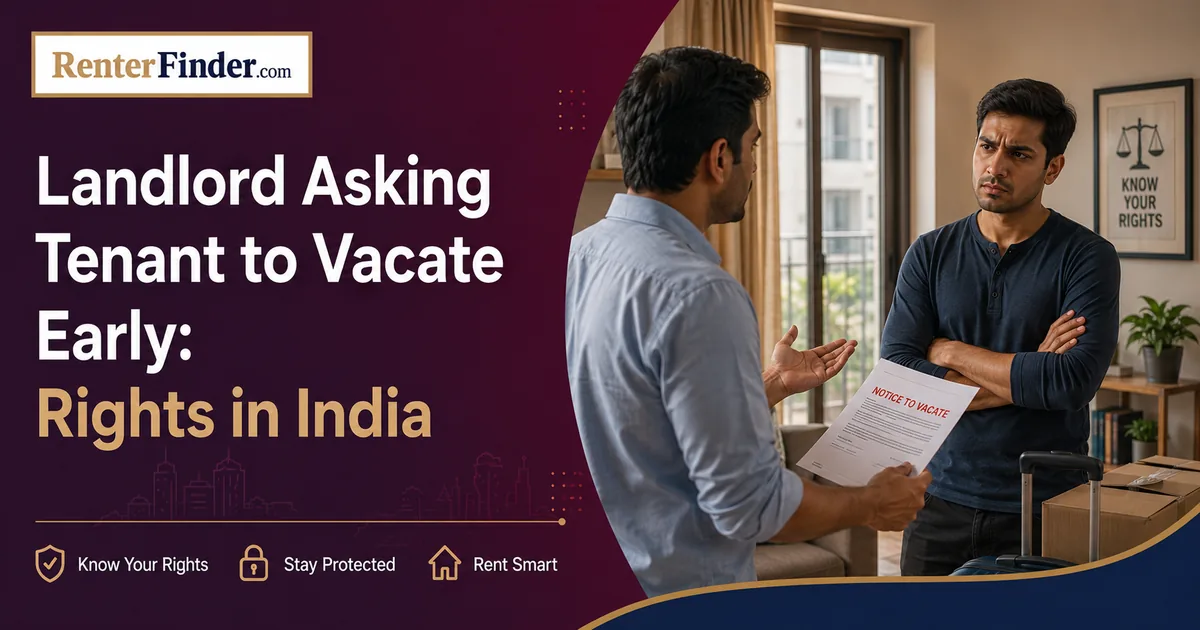
It begins, usually, as a phone call. The landlord has a reason - family member moving in, wanting to sell the property, a redevelopment plan - and they would like you to vacate by the end of the month. The rent agreement has four months left. You have paid your deposit. You have a life in that flat - school admissions, a job nearby, a lease you signed in good faith.
What are your options? This guide explains what Indian law says about landlords asking tenants to leave before the agreement period ends, what counts as a valid reason for early eviction, and what you can do if the landlord is applying pressure without legal grounds. Tenancy law varies by state, so specific procedures differ - this guide covers the national framework and notes Karnataka and Bangalore specifically where relevant.
Can a landlord legally ask you to vacate before the agreement ends?
The short answer is: they can ask, but a verbal or informal request creates no legal obligation on you to leave early.
A rent agreement is a contract. During the agreed term, both parties are bound by its terms. The landlord has agreed to give you quiet possession of the flat for that period. You have agreed to pay rent and maintain the property. Neither party can unilaterally end that agreement mid-term simply because they have changed their mind.
This principle applies across most of India - whether the governing law is the Model Tenancy Act 2021, the Karnataka Rent Control Act, or another state's equivalent statute. None of them allow a landlord to evict a tenant during a valid tenancy period simply on request. Eviction, if it must happen, must follow a defined legal process.
What this means in practical terms: if your landlord calls to say they want you out by next month and there are three months left on your agreement, you are entitled to say no. Politely, in writing, with a reference to your agreement - but no.
Valid grounds for early eviction under Indian law
While an informal request has no force, there are specific circumstances under which a landlord can initiate a formal legal process to have a tenant removed even during the tenancy period. These grounds are defined by the applicable statute - the MTA 2021 where adopted, or the relevant state Rent Control Act where not.
Under the Model Tenancy Act 2021, the grounds for a landlord to approach the Rent Authority for recovery of possession during a tenancy include:
- Non-payment of rent for two or more consecutive months after a written demand
- Misuse of the premises - using a residential flat for commercial or industrial purposes without consent
- Causing wilful damage to the structure of the property
- Subletting or assigning the tenancy without the landlord's written consent
- Using the premises for activities that are illegal, immoral, or constitute a nuisance to neighbours
- The tenant having abandoned the property
What is notably absent from this list: personal use. Under the MTA 2021, personal use by the landlord or their family is a ground for recovery of possession only after the tenancy period has expired and proper notice has been served. It is not a valid ground for mid-tenancy eviction while the agreement is still running.
The Karnataka Rent Control Act has a similar structure. A landlord in Bangalore can apply to the Rent Control Court for eviction on grounds such as default in payment, subletting without consent, or nuisance - but not simply because they want the flat back before the agreement ends. Read more about which rent law applies in Karnataka and how the two frameworks interact.
What to do when the landlord asks you to leave early: a step-by-step response
If you receive a verbal or informal request to vacate before your agreement ends, here is a practical sequence to follow.
- Do not panic or commit to anything verbally. Acknowledge you have heard the request, but do not agree to vacate on the spot. Tell the landlord you will respond in writing after reviewing your agreement.
- Re-read your rent agreement. Check the exact end date, the notice period clause, and whether there is an early termination clause. Some agreements include mutual early termination provisions - if yours does, understand what it says before deciding.
- Respond in writing. Send a letter or email to the landlord stating that you are prepared to honour the tenancy until the agreed end date, that you have received their informal request, and that you are not in breach of any agreement term that would justify early vacation. Keep a copy.
- Document everything from this point forward. Save all text messages, emails, and call logs. If the landlord says anything that could be interpreted as a threat (that they will cut water, electricity, or prevent building access), document it immediately. Courts and Rent Authorities take essential-service threats seriously - see our guide on landlord cutting water or electricity for your rights in that scenario.
- If pressure continues, consult a lawyer. A lawyer familiar with your state's rent law can issue a formal reply on your behalf, which typically stops informal pressure quickly. Many advocates handle rent disputes on a fixed-fee basis.
- If the landlord files for eviction, respond formally. They must approach the Rent Authority (under MTA states) or the Rent Control Court (in most of India). You will receive a notice and have the right to file a counter-reply. Appear in person or through a representative.
Can you file for a permanent injunction against forced eviction?
Yes. If a landlord is applying coercive pressure - threats of physical removal, cutting off utilities, changing locks, or preventing your access to the flat - you can approach a civil court for a temporary injunction (order maintaining status quo) and ultimately a permanent injunction preventing forced eviction.
This is an established remedy in Indian law. Courts have consistently held that a tenant in peaceful possession of a property under a valid agreement cannot be evicted without due process of law, regardless of the landlord's personal reasons for wanting the flat back. Physically removing a tenant or their belongings without a court order is not just a civil wrong - it can constitute trespass and criminal intimidation depending on how it is carried out.
What compensation can you claim if the landlord forces you to vacate early?
If you are compelled to vacate before the end of the agreement period - whether through direct pressure, illegal utility cutoffs, or coercion - you may be entitled to claim compensation from the landlord. The quantum and mechanism depend on your state's law and how you choose to proceed.
Potential heads of claim in such a situation include:
- Additional rent paid at the new place. If you were forced to move to a more expensive flat at short notice, the difference in rent for the remainder of the original agreement term is a recoverable loss in principle.
- Documented moving and relocation costs. Packers and movers bills, brokerage paid on the new flat, advance deposits made at a new place - these are documentable losses caused by the landlord's breach of contract.
- Loss of deposit. If the landlord is also withholding the deposit as leverage, that is a separate claim under the security deposit rules. See our detailed guide on what to do when a landlord does not return your deposit.
- General damages for breach of contract. A civil suit for breach of the tenancy contract can include general damages for the inconvenience and loss caused by the landlord's failure to honour their obligations.
In practice, litigation for compensation takes time. Many tenants find that the more immediate leverage is the credible threat of filing a formal complaint or suit - which, combined with a lawyer's letter, is often enough to result in a negotiated outcome: extension of the tenancy to a mutually agreed date, full return of the deposit, or a goodwill payment for early exit. For your specific situation, refer to the Model Tenancy Act 2021 or consult an advocate.
Common scenarios - and how the law typically applies
Here are situations tenants frequently encounter, and what the law's general position is. State-specific rules vary; always check what applies in your jurisdiction.
| Landlord's reason | Mid-tenancy eviction valid? | Tenant's position |
|---|---|---|
| Personal or family use | Generally no | Valid only after agreement ends with proper notice |
| Wants to sell the property | Generally no | Tenancy survives the sale; new owner is bound |
| Tenant not paying rent (2+ months) | Potentially yes | Landlord must send demand notice and follow Rent Authority process |
| Redevelopment / demolition | Varies by state | Usually requires municipal orders; tenant may be entitled to alternative accommodation |
| Tenant causing nuisance | Possibly, if proven | Must be established through Rent Authority; tenant can contest |
| No reason given at all | No | No obligation to vacate; respond in writing and hold your ground |
When you might genuinely need to vacate early
There are situations where vacating before the agreement ends - even without a legal obligation - may be the pragmatic choice. If the relationship with the landlord has broken down entirely and continued stay would be distressing, if the property has developed genuine structural or habitability problems the landlord refuses to fix, or if the landlord is making life genuinely difficult through small escalating actions, a negotiated exit on your terms (full deposit return plus a goodwill amount) may serve you better than months of legal resistance.
In those cases, the leverage you have from knowing your legal rights is what makes a negotiated exit possible on fair terms. A landlord who knows you are aware of your protections - and that you are prepared to use them - is more likely to negotiate reasonably than one who assumes you will quietly leave.
If you are searching for a new flat while managing a situation like this, the flats for rent in Bangalore section on RenterFinder lets you browse available properties without broker intermediaries, on your own timeline.
How to protect yourself from the start of any tenancy
The best protection against an early-vacate dispute is a well-drafted agreement at the start. Here is what experienced renters do before signing:
- Insist on a written agreement with a clear end date. Oral tenancies are enforceable but much harder to document in a dispute. Get it in writing, ideally registered at the Sub-Registrar's office for agreements of 12 months or more.
- Read the early termination clause carefully. Some agreements include a lock-in period on both sides - neither party can exit without penalty for the first N months. Others include a mutual early-exit mechanism with defined notice and compensation. Know what your agreement says before you sign.
- Keep copies of the agreement, deposit receipts, and all correspondence. Store them digitally and in a second location. They are your primary evidence if a dispute arises.
- Document the flat's condition on move-in. A signed move-in checklist or even a timestamped photo set protects you on both the deposit refund and the early-exit questions - a landlord who claims damage to justify early exit will find it much harder if you have photographic evidence of the flat's state on day one.
Platforms like RenterFinder - where both landlord and renter profiles are detailed before any contact is made - reduce the probability of a mismatch that turns into a hostile tenancy in the first place. AI and human moderated chat inside the platform means both parties establish intent and expectations before committing, which tends to produce more stable tenancies. You can see how it works on the services page.
The key takeaway
A landlord asking you to vacate before the agreement ends does not create a legal obligation to leave. The tenancy is a contract, and during its term, your right to remain in the flat is protected by law - whether that is the Model Tenancy Act 2021, the Karnataka Rent Control Act, or your state's equivalent statute. Eviction during a live tenancy period is only possible through a formal process, on defined legal grounds, before the Rent Authority or Rent Control Court.
The practical response is to stay calm, respond in writing, document everything, and consult a lawyer if the landlord escalates beyond informal requests. The law is on your side. Using it effectively is a matter of knowing what it says and keeping the right paperwork.
For the authoritative text of the national framework, see the Model Tenancy Act 2021 published by the Ministry of Housing and Urban Affairs. For state-specific rules, check your state government's official housing or urban development portal.
Written by the RenterFinder Editorial Team. RenterFinder.com is India's rental-only matching platform.
Related Articles
- Landlord Not Returning Your Security Deposit? A Step-by-Step 2026 Action Guide - What to do after vacating
- Notice Period Rules for Rented Flats in Bangalore 2026 - What the agreement can and cannot impose
- Landlord Cutting Off Water or Electricity: Your Rights in India - Essential service protection
If you are searching for a new flat in Bangalore, browse directly - no broker, no token fee to enquire.