A software professional who moved to a 2BHK in Hebbal in mid-2025 had carefully checked his rent agreement before signing. Electricity was listed. Maintenance of Rs 3,800 per month was listed. Nothing else. Three months in, his landlord forwarded a society bill with a line item he had not seen: "DG backup charge - Rs 800 per flat." When he asked why it was not mentioned at signing, the landlord said it had always been there - just absorbed into the maintenance buffer until the society started itemising it separately. He asked who was legally obligated to pay. Neither the landlord nor the society manager could give him a clear answer.
This situation plays out regularly across Bangalore apartment buildings. Diesel generator (DG) power backup is now a standard feature in almost every gated society in the city, and as building operating costs rise, RWAs are increasingly breaking it out as a separate line item or increasing the maintenance charge to cover it. For tenants, the question becomes: what were you told, what did you agree to, and what does the law actually say? This guide works through all three.
What DG backup is and why almost every Bangalore apartment has one
BESCOM (Bangalore Electricity Supply Company) supplies grid electricity to residential buildings. But Bangalore experiences load-shedding schedules - planned power cuts typically ranging from 1-4 hours per day depending on the zone and season - as well as unplanned outages. For apartments that house dozens of families, a complete power cut means lifts stop, common-area lighting fails, and water pumps cannot push water to overhead tanks.
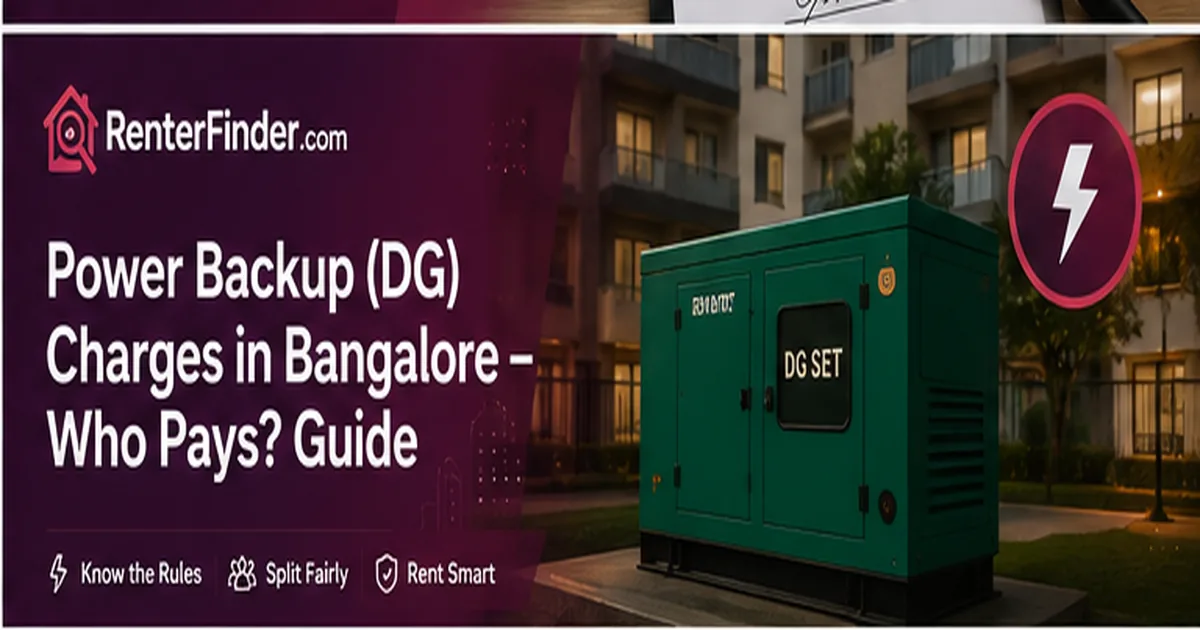
Diesel generators installed by apartment societies bridge these outages. Most gated communities in Bangalore run DG sets ranging from 62.5 kVA to 500 kVA or larger, depending on the number of flats and what the backup covers. In newer premium developments, DG backup often covers entire flats - lights, fans, and sometimes even ACs. In older or more budget-conscious societies, backup covers only common areas and essential services like lifts and water pumps, leaving individual flat circuits dark during a cut.
Running a DG set is expensive. Diesel costs, generator maintenance, operator charges, and equipment depreciation add up to a real monthly outlay. In 2026, most Bangalore apartment societies spend anywhere from Rs 15,000 to Rs 1,50,000 or more per month on DG operations, depending on outage frequency, generator size, and whether flat-level backup is provided. When RWAs divide this across flats, it produces either a flat monthly DG charge or a per-unit rate significantly higher than BESCOM tariff.
The three ways DG charges reach a tenant's bill
There is no single billing model that all societies use. The approach varies by building, and which model your society uses determines whether you have a dispute or not. The three most common arrangements in Bangalore in 2026 are:
Model 1 - Bundled in maintenance (most common). The society RWA pays DG operating costs from the maintenance fund. These costs are rolled into the monthly maintenance charge without a separate DG line item. Tenants pay maintenance, so DG costs come with it. The dispute risk here is when the maintenance charge is increased mid-tenancy to cover rising DG costs - the landlord passes the higher maintenance bill to the tenant, who did not agree to the higher amount at signing.
Model 2 - Separate DG meter per flat (increasingly common in newer societies). The building installs a separate electrical circuit for DG power with its own sub-meter for each flat. During outages, flats switch to DG power and units consumed are tracked separately. The RWA bills DG units at a higher per-unit rate than BESCOM - typically Rs 10-20 per unit, compared to BESCOM domestic rates starting around Rs 5-6 per unit. Tenants pay a DG electricity bill in addition to their BESCOM bill or combined with it. If this model exists in the building, it should have been disclosed before signing.
Model 3 - Flat monthly DG fee (common in mid-range societies). The society does not meter per-flat DG usage. Instead, it estimates monthly DG operating costs, divides them across all flats, and adds a fixed monthly DG charge to each flat's maintenance bill. This is simpler to administer and produces predictable bills. The dispute risk is when the flat fee is raised significantly - by the RWA passing higher diesel costs - without adequate notice or AGM approval.
What is a legitimate DG charge - and what is not
The short test: a legitimate DG charge reflects the actual cost of running the generator, divided fairly among flats. An illegitimate charge is one that is hidden, padded, arbitrarily applied, or never disclosed before you moved in.
Here is what legitimate DG billing looks like in practice:
- The charge was disclosed before you signed - either as a line in the maintenance breakdown, a note in the rent agreement, or a quote from the landlord in writing.
- If DG units are metered separately, the rate is stated clearly and applied consistently - not inflated beyond what diesel and maintenance actually cost.
- If DG is billed as a flat monthly fee, that fee is reflected in the maintenance charge or disclosed as a standard building charge. Changes to the amount go through the RWA's AGM process and residents are notified in advance.
- DG units are billed at the DG rate, not mixed into the BESCOM bill at BESCOM tariff. Mixing them inflates the apparent BESCOM consumption and overcharges the tenant.
What raises red flags:
- A DG charge that appears months after you moved in, with no mention of it at signing.
- A per-unit rate that is far above the market range for DG power - in 2026, rates above Rs 25 per unit in a standard apartment building would warrant scrutiny.
- A "DG surcharge" that is separate from both the maintenance bill and the electricity bill, with no documentation of how it is calculated.
- Being charged for full-flat DG backup when the society's DG only covers common areas and lifts.
- The landlord billing a DG fee directly without routing it through society accounts - a sign the charge may not correspond to any actual society expense.
What your rent agreement likely says - and what it probably misses
Most standard Bangalore rent agreements list "electricity" and "society maintenance" as tenant obligations. A minority mention "power backup charges" or "DG charges" specifically. This omission creates the disagreement: landlords interpret "electricity" to include all power consumption including DG; tenants interpret it to mean only the BESCOM grid supply bill.
Four clauses to look for when reading your agreement:
- What does "electricity charges" cover? If the agreement says "tenant pays electricity charges as per BESCOM bill," DG power billed separately is arguably not covered. If it says "all electricity charges including DG and common area," the landlord has a stronger case.
- What does "maintenance" cover? If you agreed to pay "society maintenance as applicable" or "actual maintenance as billed by the society," then DG costs bundled into maintenance are within scope - even if the amount rises. But if a fixed Rs X per month was agreed, anything above requires fresh agreement.
- Is there a DG or power backup clause? Better agreements in newer Bangalore buildings specifically list DG charges, the billing model (flat fee or metered), and the rate. If yours has this and you signed it, you agreed.
- Is there a pass-through clause for society charges? Some agreements say "any charges levied by the RWA will be borne by the tenant." This is a broad clause that can be used to pass on DG cost increases. Read it carefully before signing.
- Does the building have a DG set? What is its capacity and what does the backup cover?
- Is DG power available inside my flat, or only for common areas and lifts?
- Is DG usage metered per flat separately, or is a flat fee charged in maintenance?
- What is the per-unit DG rate, or what is the flat monthly DG charge?
- Has the DG charge increased in the last 12 months? By how much?
Ask to see a recent maintenance bill. The landlord's verbal answer and the actual bill often differ.
What the law says about electricity supply and DG charges
Karnataka has not adopted the Model Tenancy Act 2021, so Bangalore tenancies are governed by the Karnataka Rent Act 1999 and the terms of the individual rent agreement. However, the MTA 2021's framework on essential services is a useful reference for the general principle that Karnataka courts broadly recognise.
Under the MTA 2021 (Section 19): a landlord cannot cut off electricity, water, or other essential services. By extension, electricity supply - including basic power backup for habitability - is treated as a landlord obligation to maintain, not an optional extra. Whether this extends to covering the cost of DG backup for an entire flat is not definitively settled in case law. What is clearer is that a landlord cannot use the threat of withdrawing DG backup as leverage, or use it to extract payment for charges not in the agreement.
On BESCOM rules and metering: DG power is not supplied by BESCOM and is not metered through BESCOM's equipment. A building that mixes DG units into a BESCOM bill - charging you for grid units at BESCOM tariff when those units were actually consumed from the DG set - is billing incorrectly. The Electricity Act 2003 and BESCOM's own tariff orders are the reference for how electricity consumption is to be measured and billed. If you suspect your bill is mixing DG and BESCOM consumption, request a breakout of units by source from your landlord or the society manager.
The practical bottom line: DG charges that are not in your agreement and were not disclosed before you signed are contestable on contract law grounds. DG charges that are in your agreement or bundled into maintenance you agreed to pay are not - even if the amount has risen. The agreement is the operative document, not a general sense of what "should" happen.
DG charges when sharing a flat or searching as a flatmate
If you are looking to find a flatmate in Bangalore, or moving into a pre-occupied flat, DG charges deserve particular attention. Most flat-level DG billing is a fixed monthly fee per flat - meaning two occupants pay the same DG charge as one. In buildings that meter DG usage per flat, though, two residents consuming more power during outages will produce a higher DG bill than one.
Before joining a flat as a flatmate, ask the existing tenant what the actual monthly bills look like - not what the landlord quoted at listing. The primary tenant will know whether DG charges have been a line item, whether they have changed, and how the building handles them. If neither of you knows, that is worth settling with the landlord before you move in - not after the first bill arrives.
When evaluating a pre-occupied flat on RenterFinder, you can use the AI and human moderated chat to ask the existing tenant or the landlord directly about DG charges before committing to a visit. RenterFinder's model keeps communication inside the platform until both parties show genuine intent - which means you can get these practical cost questions answered without exchanging personal contact details first.
How to handle a dispute over unexpected or inflated DG charges
If your landlord bills you for DG charges that were not in your agreement and not disclosed at signing, here is a step-by-step approach:
- Put your objection in writing immediately. Send a WhatsApp message or email to your landlord saying: you received a bill for Rs X as DG charges, this was not mentioned in your rent agreement, and you are requesting the clause or document that authorises it. Keep the tone professional, not combative. This creates a timestamped record.
- Request the society's actual maintenance billing for that period. Ask your landlord to share the society maintenance demand letter or bill for the month in question. If the DG charge is a legitimate pass-through from the RWA, it will appear in the society's bill sent to the flat owner. If it does not appear there, it is not a legitimate pass-through.
- Check what owner-occupants pay. Ask a neighbour who owns their flat whether they pay the same DG charge. If owner-occupants pay the same amount through the RWA, that confirms it is a real society expense. If the landlord is charging you more than what the society bills, the difference is not legitimised by any society resolution.
- Negotiate before escalating. Most Bangalore DG charge disputes settle with a direct conversation. If the charge is real but was poorly disclosed, a reasonable landlord will agree to either absorb part of it or give written notice for future billing. Document whatever you agree to in writing - a follow-up WhatsApp message summarising the conversation is enough.
- Escalation path for Bangalore: Karnataka has not adopted the MTA 2021, so the Rent Authority under the MTA is not available here. Disputes go to the Rent Controller under the Karnataka Rent Act, or for smaller amounts, to a consumer forum via eDaakhil. An advocate's legal notice is often the most cost-effective first step for a landlord who refuses to engage.
The bottom line on DG charges in Bangalore rentals
DG power backup charges in a rented Bangalore flat are a tenant's cost when clearly agreed to at signing, and contestable when they appear later with no prior disclosure. The agreement is the document that determines who owes what - not a general principle about who "normally" pays.
The best time to resolve this is before you sign. Ask specifically about power backup, DG availability in the flat, billing model, and current monthly DG cost. If you are browsing flats for rent in Bangalore, add these questions to your property checklist alongside deposit, maintenance, and parking. One conversation before signing is worth considerably more than a dispute after you have moved in.
If you are already in a flat and a surprise DG bill has arrived - put your objection in writing, request the society's actual billing document, check what neighbours pay, and negotiate from documented facts. Most Bangalore landlords will engage with specifics. The ones who will not are telling you something about how the rest of the tenancy will go.
For guidance on how RenterFinder connects renters and landlords directly - with transparent fee terms before anyone commits to a meeting - see our fee structure and FAQ.
Related Articles
- What to Do If Your Landlord Cuts Off Water or Electricity - Essential-service protection and escalation steps under Indian law
- Hidden Charges in Indian Rental Agreements - Every unexpected cost to watch for before you sign
- Water Tanker Charges in a Rented Bangalore Flat: Who Pays? - The same question applied to water supply costs in Bangalore
RenterFinder connects renters directly with landlords through AI and human moderated chat - no broker commission, transparent fees, 6 Match Guarantee.