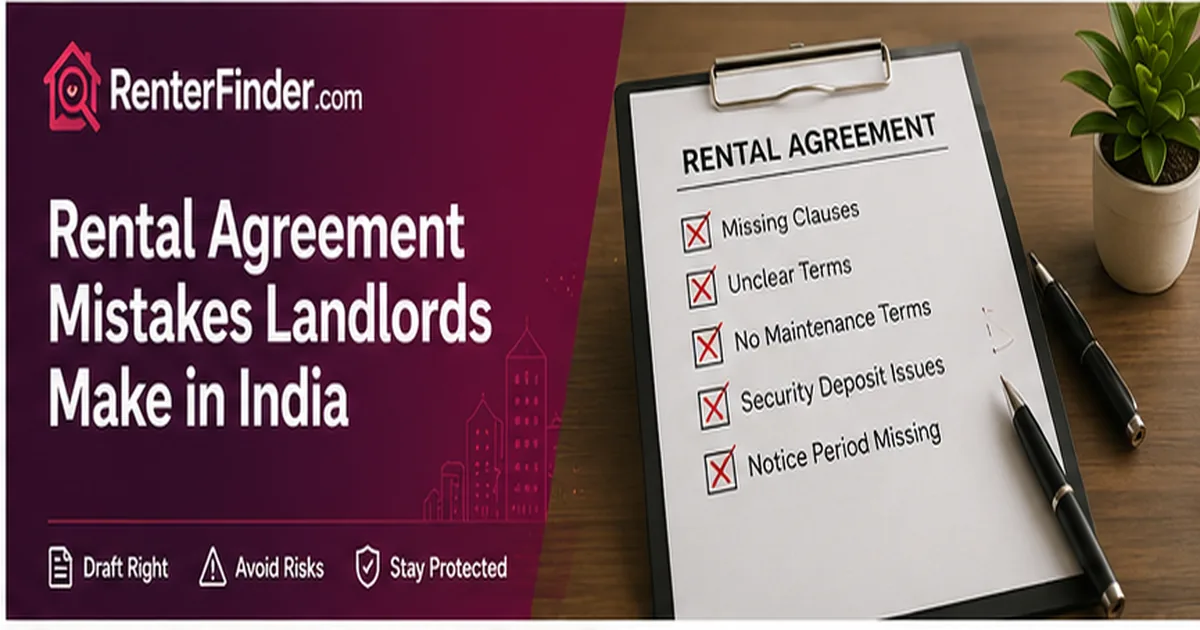
Most landlords treat the rental agreement as a formality. Print a template, fill in the rent and deposit, get it stamp-papered, move on. This is understandable - the property is ready, the tenant seems fine, and no one wants to spend three days arguing over clause wording. The problem is that when something goes wrong - a deposit dispute, a tenant who refuses to leave, a mid-tenancy fight over painting costs - the agreement is the only document that matters. And a generic, casually drafted agreement almost always fails at that moment.
These are the seven mistakes that come up again and again in Indian rental agreements, drawn from the pattern of disputes that reach Rent Authorities and consumer forums. Each one is fixable with a single clause addition or revision before you sign.
1. A deposit clause that says the amount but nothing else
This is the root cause of most deposit disputes in India. An agreement says "security deposit: 2 months' rent" and stops there. It does not say how long the landlord has to return it, what deductions are permissible and under what conditions, whether the tenant must submit a written request for refund, or what documentation is needed to justify a deduction.
When a tenancy ends and the landlord holds the deposit for three months with no explanation, the tenant has no written basis to dispute it - and neither does the landlord to justify the deduction. The result is a Consumer Forum or Rent Authority complaint where the outcome depends on which side has better paperwork.
A deposit clause that holds up should say:
- The deposit amount and the date by which it must be paid before handover.
- That the landlord will refund the deposit within 30 days of the tenant vacating and submitting a written vacancy notice (the Model Tenancy Act 2021 sets this as the baseline - see the MTA 2021 text at mohua.gov.in).
- A specific list of permissible deductions - and only those deductions. "Reasonable damages beyond normal wear and tear" is not enough; list them: unpaid rent, broken fixtures, specific cleaning charges if the flat is left in uninhabitable condition.
- That any deduction must be supported by invoices or photos taken at handover.
2. No inventory annexure attached to the agreement
A rental agreement without an attached inventory is a guarantee of a handover dispute. The agreement might say "2BHK flat, semi-furnished" - but what does semi-furnished mean? Does it include the geyser? The ceiling fans? The modular kitchen fittings? The curtain rods but not the curtains?
When a tenant moves out and something is missing or damaged, the only way to prove the original condition is a signed, dated inventory with photos. Without it, the landlord cannot claim for missing fittings and the tenant cannot prove they left it in good order. Both sides lose the ability to enforce their position.
The fix is straightforward: prepare a room-by-room inventory on a separate page, attach it to the agreement as Annexure A, and have both parties sign every page. Photograph each item on move-in day and save the photos with the date stamp visible. Do the same on move-out. This one step resolves roughly half of all handover disputes before they escalate.
3. Notice period and lock-in clauses that are vague or one-sided
Two of the most litigated clauses in Indian rental agreements are notice periods and lock-in periods - and both are frequently written in a way that helps neither party in a dispute.
The most common notice period problem: "either party shall give one month's notice." This sounds adequate until you need to enforce it. One month from when - the date of the letter, the date it was received, the first of the next month? Delivered how - verbally, WhatsApp message, registered post? If the tenant's WhatsApp message counts as valid notice, does it start the clock from send or from your read receipt? Courts have ruled differently on each of these questions in different states.
Fix this with specificity. Write: "Notice to terminate must be given in writing by registered post or email to the address stated below. Notice delivered after the 15th of a month takes effect from the 1st of the second following month. Notice delivered on or before the 15th takes effect from the 1st of the following month."
Lock-in is a different problem. Many landlords want a 6 or 11-month lock-in to ensure the flat is not vacated after two months. That is reasonable. But if the clause only says "the tenant shall not vacate during the lock-in period," it does not say what happens if they do. Are they liable for the remaining months' rent? Does the landlord forfeit the deposit in lieu? If you want an enforceable lock-in, the agreement must state the consequence explicitly - typically, that the tenant owes rent for the balance of the lock-in period, less any deposit already held.
4. No rent escalation clause - or one calculated incorrectly
Indian rental agreements are almost always 11-month documents. At the end of 11 months, either party can choose not to renew. But most landlords do not want the disruption of finding a new tenant every year, and most tenants do not want to move. So the tenancy continues, often on a verbal understanding about the new rent.
This verbal arrangement is the problem. If the agreement says nothing about rent escalation after the first term, the original rent continues to apply for as long as the tenancy runs. The MTA 2021 specifically states that rent cannot be increased mid-tenancy without mutual written consent. If the agreement lapses and there is no renewal in writing, you are renting at the original 2022 rate in 2026 because there is no written basis for anything else.
The fix: include an escalation clause in the original agreement. State the percentage increase that applies at each renewal (typically 5-10% per year, though the exact figure is negotiable - there is no legal cap under MTA 2021 for contractually agreed escalation). Also state that the escalation applies only if both parties sign a renewal addendum - so the landlord has written evidence of the new rent from day one of the second term.
5. Maintenance and utility responsibilities left undefined
Who pays for the geyser element when it fails after 14 months? Who pays for repainting a wall that developed damp patches because the monsoon leaked through a window frame? Who pays for replacing a ceiling fan motor? These are not hypothetical questions - they come up in virtually every long-term tenancy, and they cause disproportionate conflict when the agreement says nothing about them.
Indian courts and Rent Authorities apply a rough principle when agreements are silent: structural and major repairs are the landlord's responsibility; day-to-day maintenance and minor repairs are the tenant's. "Major" and "minor" are not defined anywhere in law, which is exactly the problem.
A practical maintenance clause should specify at minimum:
- Day-to-day maintenance (leaking taps, fused bulbs, minor plumbing): tenant's responsibility, cost below a stated threshold (e.g., ₹2,000 per incident).
- Major repairs (structural cracks, roof leaks, electrical rewiring, major plumbing): landlord's responsibility, to be carried out within a stated number of days of written notice from the tenant.
- Appliances provided with the flat: whether the landlord will repair or replace, or whether the tenant takes responsibility after the first year.
- Society maintenance charges: clearly state whether the tenant pays the monthly society charges directly to the RWA, or whether the rent is inclusive of maintenance.
6. Treating the 11-month agreement as automatically registration-proof
The 11-month rule is widely misunderstood. Under the Registration Act 1908, a lease of more than 11 months must be registered with the Sub-Registrar. Most landlords draft 11-month agreements specifically to stay below this threshold. That is legal. But the assumption that an 11-month unregistered agreement is always the right choice is not.
An unregistered agreement can still be used as evidence in some courts (though its admissibility is limited), but it carries significantly less weight than a registered one. In states like Karnataka and Maharashtra, stamp duty applies even to 11-month agreements, and using a ₹100 stamp paper for an agreement worth several lakhs in total rent can expose the landlord to stamp duty penalties if a dispute ever reaches a Rent Authority.
More practically: if you want to evict a non-paying tenant, a registered agreement makes the process faster and cleaner. A notarised but unregistered agreement is not the same thing as a registered one. The correct step is to have the agreement registered at the Sub-Registrar's office, paying the applicable stamp duty for your state. For Karnataka and most other states, the Sub-Registrar's portal lists current stamp duty rates.
For long-term tenancies - anything beyond 11 months - registration is not optional. Many landlords extend month-to-month on a verbal basis after the first 11-month term. This works fine until it does not. After three to five years, a verbal tenancy is very difficult to terminate cleanly because there is no written record of what was agreed.
7. Missing clauses on subletting, guests, and use of premises
A tenant taking in a paying flatmate without the landlord's knowledge is subletting, which is prohibited under most standard agreements - but many agreements say this in one line with no consequences stated. "The tenant shall not sublet the premises without prior written consent of the landlord" is technically sufficient, but does not say what happens if they do it anyway.
Add a clause specifying that unauthorised subletting constitutes a material breach of the agreement and grounds for termination, with a stated notice period for cure (e.g., "the tenant has 15 days to remedy the breach after written notice"). This turns subletting from a grey-area disagreement into a clean termination ground.
Use-of-premises clauses matter too. "Residential use only" stops a tenant converting your flat into a guest house, a tuition centre, or a storage unit. If you are renting to a working professional who occasionally works from home, that is fine - but if they are running a business from the premises, your society rules, your insurance, and potentially your tax position change. A sentence stating that the flat is for residential use by the named tenant and their immediate family is worth including explicitly.
One more step before you draft the agreement
All of the above assumes you have already found a tenant worth writing an agreement for. That step - finding someone whose rental history, income, and profile you can actually evaluate before committing - is the part most landlords get wrong first. Posting on a listing site and waiting for whoever calls is not a selection process.
A platform like RenterFinder.com works the other way: landlords browse a live list of tenants currently searching, each with their budget, BHK requirement, family size, occupation, and move-in timeline visible before any contact. You shortlist, you reach out through AI and human moderated chat, you arrange a formal meeting once both sides agree - and only then does the fee stage begin. Finding someone you actually want to write a careful agreement for makes the drafting work matter. Writing a careful agreement for someone who turned out to be a bad match is a different kind of problem.
Check the fee structure at RenterFinder.com/fees - the platform service fee is a fraction of what a broker typically charges, and the meeting advance is only triggered after both parties agree to proceed.
A well-drafted agreement, signed by a tenant you chose deliberately, is how most tenancies stay straightforward from month one to month eleven and beyond. The seven mistakes above are all fixable before you sign - they are considerably harder to fix after.
Disclaimer: This article describes general legal principles applicable in India as of September 2026. Laws vary by state and change periodically. This is not legal advice. Consult a local advocate for specific agreement drafting guidance.
Related articles
- Every rent agreement clause explained - A plain-English breakdown of what each clause actually means
- First-time landlord in Bangalore: a complete guide - Everything from listing to handover
- Normal wear and tear vs damage: deposit deductions explained - The most common deposit dispute, resolved
Browse the live Renters' List on RenterFinder.com - no broker, no upfront fee to shortlist.